The International Sustainability Standards Board (ISSB) has published new exposure drafts proposing sweeping amendments to three sector-specific SASB sustainability reporting standards, covering Agricultural Products, Meat, Poultry & Dairy, and Electric Utilities & Power Generators.
The move completes the ISSB's 12-sector enhancement agenda under its 2024–2026 work plan, with public consultation open until 24 July 2026.
For African companies in food, agribusiness, and the power sector, sectors at the core of the continent's ESG transition, these changes signal a major new disclosure reality that cannot be ignored.
The Global ESG Rulebook Just Got Rewritten
The sustainability reporting landscape shifted meaningfully on 25 March 2026, when the International Sustainability Standards Board (ISSB), the body responsible for the world's emerging global baseline for ESG disclosure, published a landmark set of exposure drafts proposing comprehensive amendments to three of its most economically significant sector-specific standards.
The sectors: Agricultural Products, Meat, Poultry & Dairy, and Electric Utilities & Power Generators, precisely the industries sitting at the intersection of climate risk, food security, and the clean energy transition.
The move is not incidental. It completes the final chapter of the ISSB's ambitious 2024 – 2026 work plan, which identified 12 sectors as priority targets for enhanced disclosure requirements under the Sustainability Accounting Standards Board (SASB) framework; the industry-specific guidance that underpins how companies apply the ISSB's two cornerstone standards, IFRS S1 (general sustainability risks and opportunities) and IFRS S2 (climate-related disclosures). Exposure drafts for the first nine sectors were released in 2025; this latest publication closes the loop.
"We know that industry-specific information is decision-useful to investors. That's why entities applying ISSB Standards are required to disclose industry-specific information to meet investor needs. The SASB Standards help companies to meet this requirement," said ISSB Vice-Chair Sue Lloyd.
Stakeholder feedback on the exposure drafts is open until 24 July 2026.
What Has Changed and Why It Matters
The proposed amendments are not cosmetic revisions. They represent a fundamental rethinking of what material sustainability information looks like in two of the world's most economically and climatically critical sectors.
For agricultural products, the ISSB wants to widen the reporting scope to include direct farming operations, bringing outgrowers, contract farmers and cooperatives into clearer view.
Proposed disclosures now cover food loss, food waste and land-use impacts, while new metrics push companies to report food safety certification levels and sustainable farming practices more transparently.
For meat, poultry and dairy, the proposed amendments sharpen disclosure by adding product innovation and separating environmental from social supply chain management.
A new nutrient management metric also gives investors a clearer way to assess the sustainability of livestock production being managed.
For electric utilities and power generators, the proposed changes broaden reporting to include ecological impacts, community rights, workforce development and supply chains
For Africa, the stronger focus on customary land and community relations is especially significant.
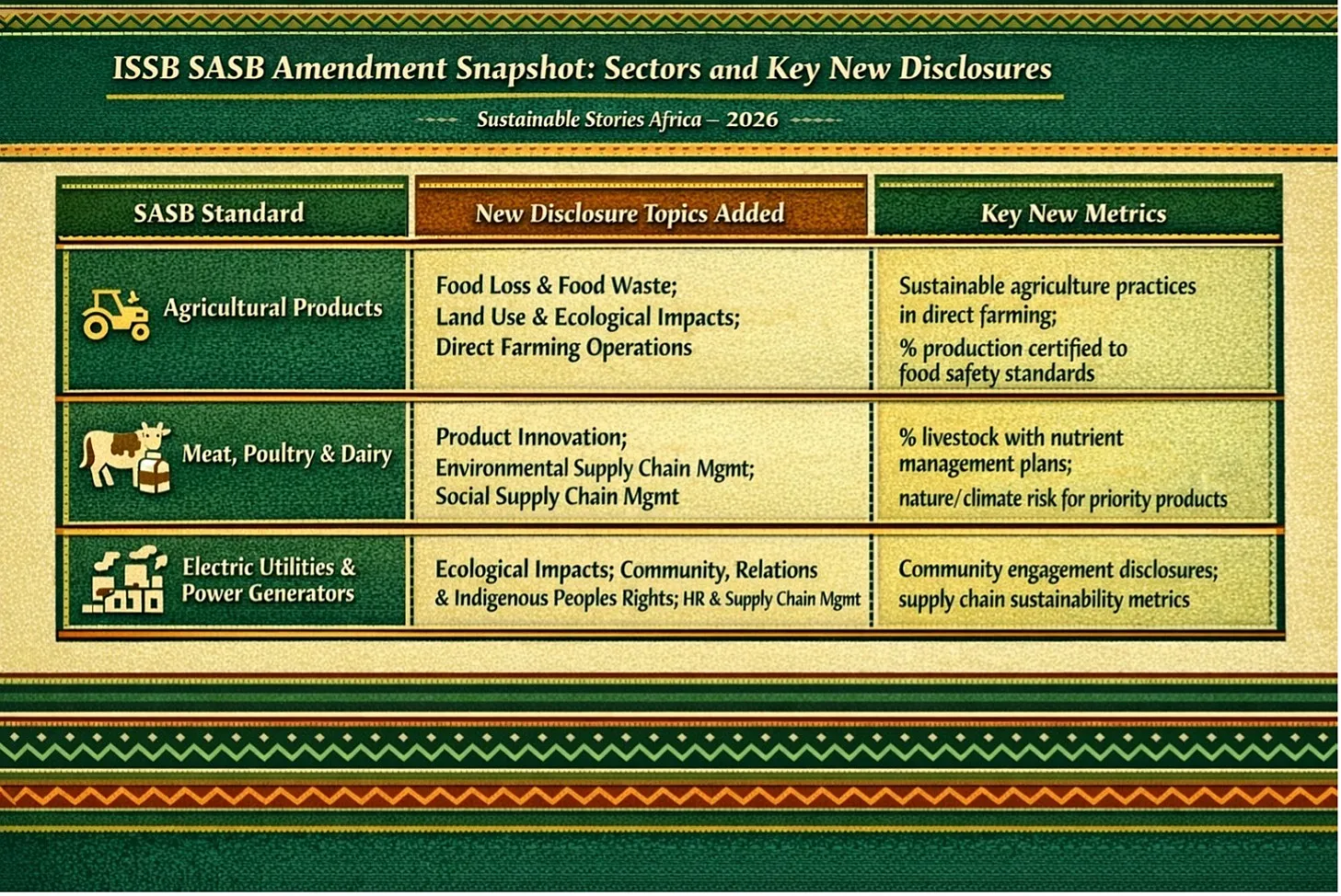
ISSB SASB Amendment Snapshot: Sectors and Key New Disclosures
| SASB Standard | New Disclosure Topics Added | Key New Metrics |
|---|---|---|
| Agricultural Products | Food Loss & Food Waste; Land Use & Ecological Impacts; Direct Farming Operations | Sustainable agriculture practices in direct farming; % production certified to food safety standards |
| Meat, Poultry & Dairy | Product Innovation; Environmental Supply Chain Mgmt; Social Supply Chain Mgmt | % livestock with nutrient management plans; nature/climate risk for priority products |
| Electric Utilities & Power Generators | Ecological Impacts; Community Relations & Indigenous Peoples Rights; HR & Supply Chain Mgmt | Community engagement disclosures; supply chain sustainability metrics |
The ISSB aims to make SASB more global, aligned and interoperable, materially reducing Africa’s reporting burden across overlapping sustainability frameworks.
A More Transparent Future for Agribusiness and Power
The proposed changes could be highly consequential if African companies, investors and regulators treat them as a strategic tool rather than a compliance burden. For agribusiness, they offer a clearer investor-grade framework for reporting nature-related risks, food safety and supply chain sustainability.
In practice, that helps exporters facing tighter scrutiny and gives utilities a stronger basis for reporting on community and ecological impacts. For investors, it improves the quality and comparability of sustainability data across key sectors.
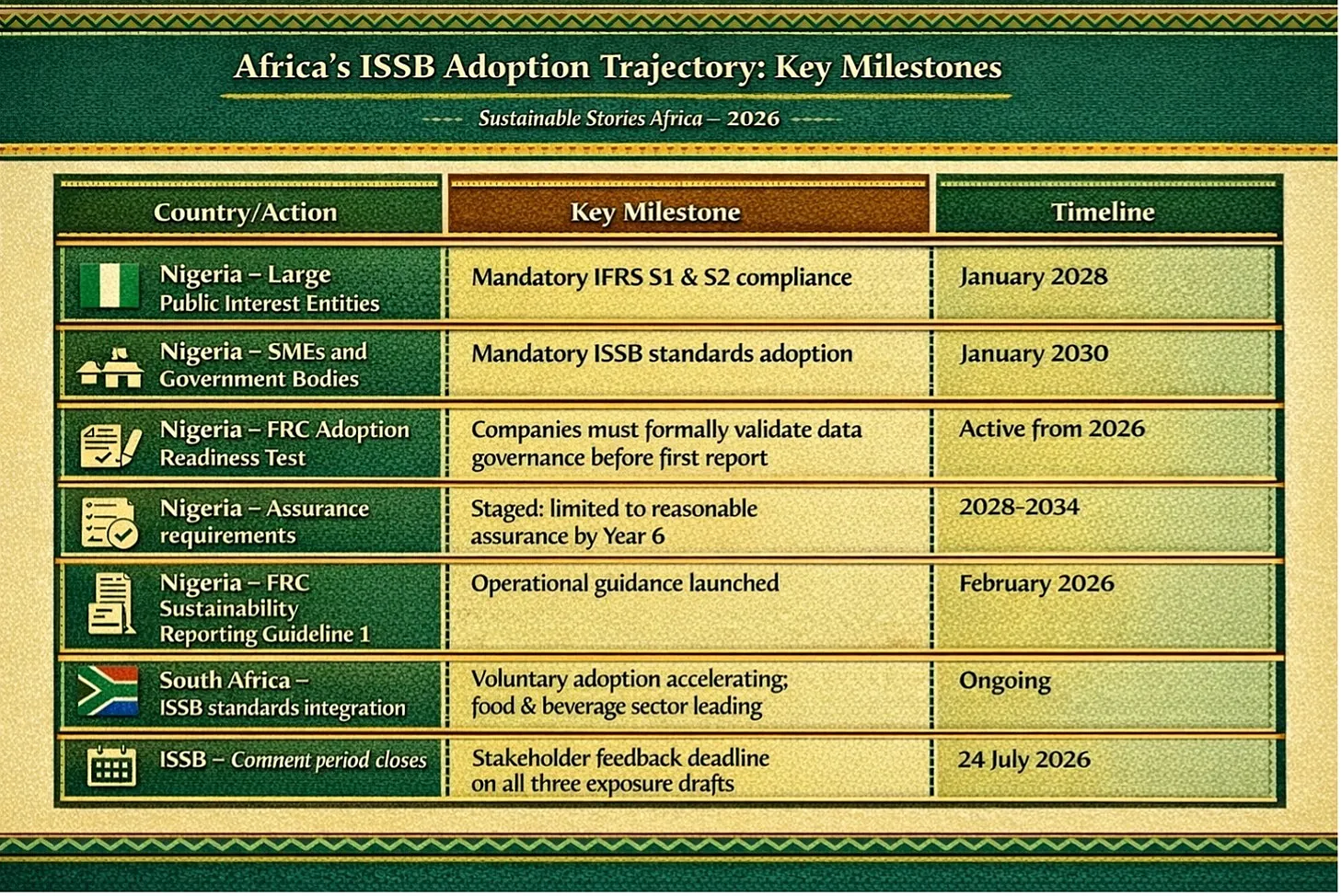
Africa's ISSB Adoption Trajectory: Key Milestones
| Country/Action | Key Milestone | Timeline |
|---|---|---|
| Nigeria – Large Public Interest Entities | Mandatory IFRS S1 & S2 compliance | January 2028 |
| Nigeria – SMEs and Government Bodies | Mandatory ISSB standards adoption | January 2030 |
| Nigeria – FRC Adoption Readiness Test | Companies must formally validate data governance before the first report | Active from 2026 |
| Nigeria – Assurance requirements | Staged: limited to reasonable assurance by Year 6 | 2028–2034 |
| Nigeria – FRC Sustainability Reporting Guideline 1 | Operational guidance launched | February 2026 |
| South Africa – ISSB standards integration | Voluntary adoption accelerating; food & beverage sector leading | Ongoing |
| ISSB – Comment period closes | Stakeholder feedback deadline on all three exposure drafts | 24 July 2026 |
Nigeria is emerging as Africa’s most advanced ISSB adopter, with 41 entities placed on a path to IFRS S1 and S2 compliance.
That makes the proposed SASB agriculture and power amendments immediately relevant for Nigerian boardrooms and sector reporting.
Stakeholders Cannot Afford to Watch From the Sidelines
The 24 July 2026 deadline is not a routine consultation; it is a strategic opening for African companies, regulators, industry groups and civil society to shape standards that will govern disclosures in food, farming and power.
With African realities still underrepresented in global standard-setting, evidence-based input now matters.
Agribusinesses and utilities should begin gap analyses immediately, strengthen data systems and treat new disclosure areas as governance priorities.
Regulators, meanwhile, should prepare sector guidance and coordinate the industry early. Africa’s food and energy sectors can still influence these rules. If they stay passive, they will inherit them.
Path Forward – Africa Must Lead, Not Just Comply
As the ISSB's consultation closes this July, African regulators, corporates, and civil society must submit coordinated, evidence-rich responses that anchor global standards in the realities of African farming and power markets, from outgrower schemes to community land rights.
Nigeria's 2028 ISSB compliance deadline means the clock is already running for agribusinesses and utilities to close data gaps, build reporting capacity, and treat the updated SASB standards as the strategic ESG infrastructure that unlocks investor capital, improves risk governance, and positions African enterprises competitively in global sustainability-linked markets.
Culled From: ISSB Moves to Update Sector Standards for Agriculture and Power Reporting