South Africa plans to double electricity imports from DR Congo’s hydropower resources.
The move comes as the country seeks to stabilise supply and reduce reliance on coal.
For Southern Africa, it signals deeper regional integration and a shift toward cleaner power systems.
A Cross-Border Energy Pivot Takes Shape
South Africa is moving to significantly increase electricity imports from the Democratic Republic of Congo, leveraging the country’s vast hydropower potential to address persistent domestic shortages and reduce pressure on its coal-heavy energy mix.
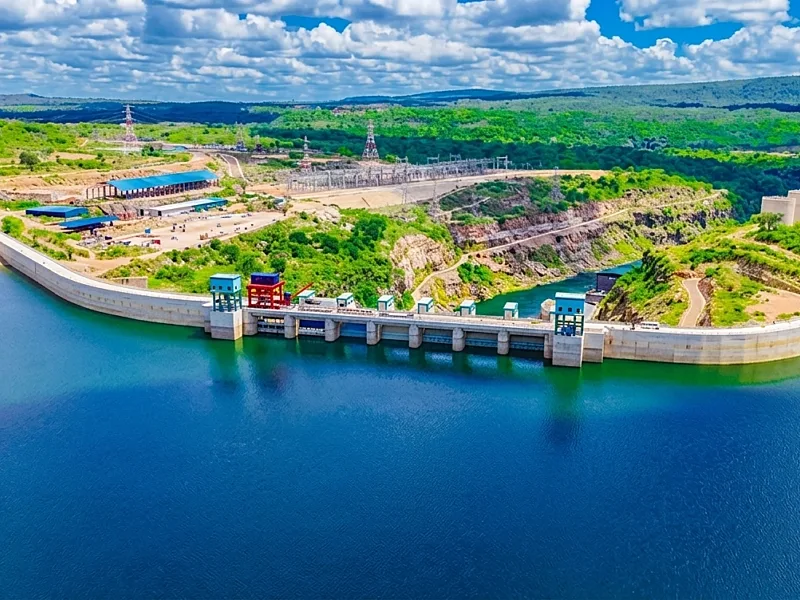
The plan, centred on scaling imports from the Inga hydropower complex, could see power flows into South Africa double over the coming years, subject to transmission upgrades and regional coordination.
At its core, the strategy reflects a pragmatic shift: rather than relying solely on domestic generation, South Africa is deepening participation in the Southern African Power Pool (SAPP), turning regional interconnection into a cornerstone of energy security.
Why Congo’s Hydropower Matters Now
The Democratic Republic of Congo holds one of the world’s largest untapped hydropower resources, with the Inga projects alone capable of generating tens of gigawatts.
However, much of this capacity remains underdeveloped due to financing, governance, and infrastructure constraints.
For South Africa, the appeal is immediate:
- Chronic load-shedding has constrained economic growth
- Ageing coal plants face maintenance and environmental pressures
- Renewable rollout, while accelerating, still requires balancing capacity
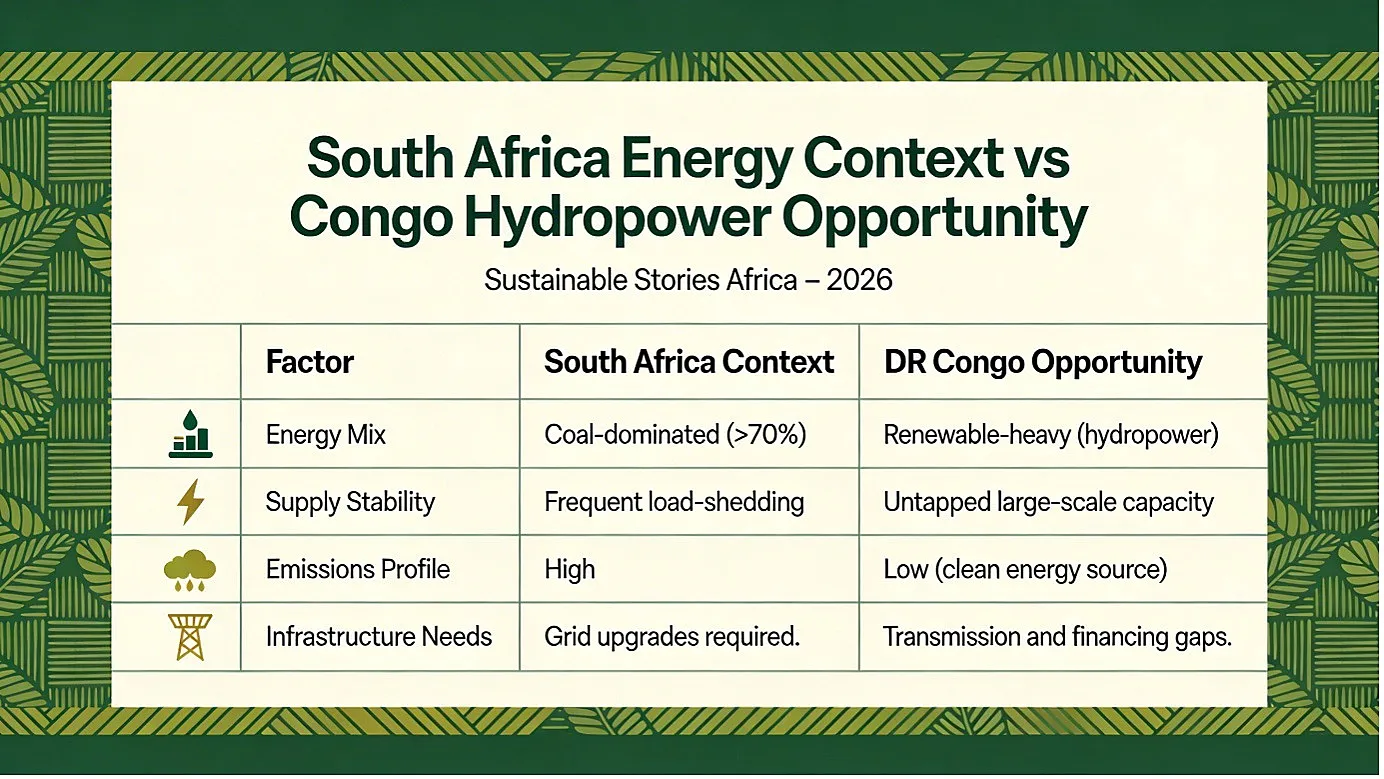
South Africa Energy Context vs Congo Hydropower Opportunity
Factor | South Africa Context | DR Congo Opportunity |
|---|---|---|
Energy Mix | Coal-dominated (>70%) | Renewable-heavy (hydropower) |
Supply Stability | Frequent load-shedding | Untapped large-scale capacity |
Emissions Profile | High | Low (clean energy source) |
Infrastructure Needs | Grid upgrades required | Transmission and financing gaps |
Regional interconnection is not new, but the scale now being proposed marks a step change. Analysts note that importing hydropower could provide a stable baseload complement to South Africa’s growing solar and wind capacity.
As one regional energy expert observed, “Hydropower from Congo can do what batteries and renewables alone cannot, provide consistent, large-scale baseload across borders.”
What a Connected Power Market Could Deliver
If successfully implemented, expanded imports from DR Congo could unlock a new phase of regional energy integration:
- Energy Security – Diversifying supply reduces reliance on ageing domestic infrastructure and mitigates outage risks.
- Decarbonisation Pathway – Hydropower imports support South Africa’s transition away from coal without compromising reliability.
- Regional Economic Integration – Cross-border energy trade strengthens cooperation within Southern Africa, enabling shared infrastructure and investment.
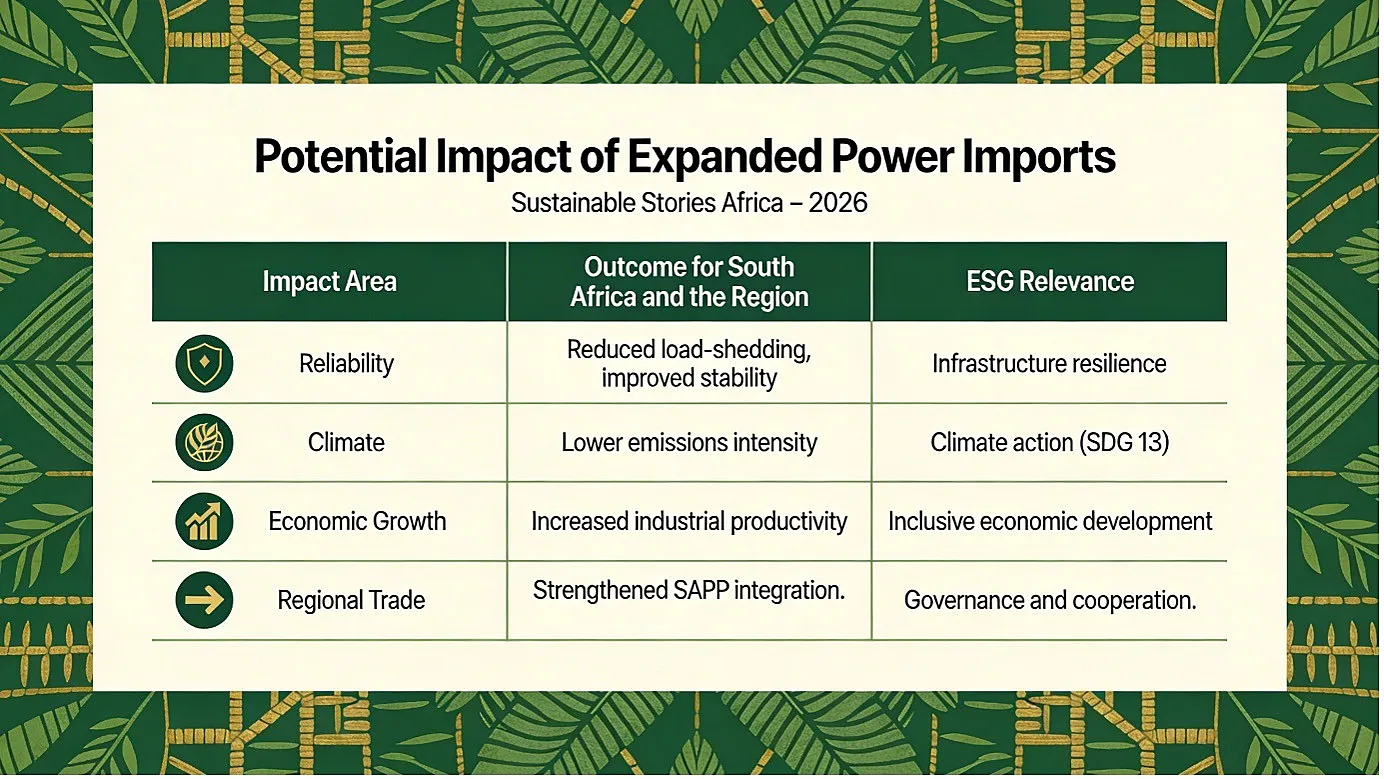
Potential Impact of Expanded Power Imports
Impact Area | Outcome for South Africa and the Region | ESG Relevance |
|---|---|---|
Reliability | Reduced load-shedding, improved stability | Infrastructure resilience |
Climate | Lower emissions intensity | Climate action (SDG 13) |
Economic Growth | Increased industrial productivity | Inclusive economic development |
Regional Trade | Strengthened SAPP integration | Governance and cooperation |
However, risks remain. Transmission bottlenecks, political coordination challenges, and financing gaps could delay or limit the scale of imports.
There are also concerns around over-reliance on external supply without parallel domestic reforms.
Turning Ambition into Infrastructure Reality
To translate intent into impact, three priorities stand out:
- Transmission Investment – Expanding cross-border grid infrastructure to handle increased power flows
- Project Financing – Mobilising capital for large-scale hydropower expansion, including Inga III and beyond
- Regulatory Coordination – Harmonising policies across SAPP member states to ensure stable, predictable trade
South Africa must also balance imports with domestic energy reform to accelerate renewable energy, improve utility performance, and modernise its grid.
For policymakers and investors, the message is clear: regional energy integration is no longer optional; it is becoming essential to meeting Africa’s growing electricity demand sustainably.
Path Forward – Regional Power Trade Gains Momentum
South Africa’s move to double imports from DR Congo signals a turning point in how African countries approach energy security, shifting from national self-reliance to regional optimisation.
Delivering on this vision will require coordinated infrastructure investment, policy alignment, and long-term financing, but the payoff could be transformative: a more stable, cleaner, and interconnected African power system.
Culled From: SA to double power imports from DR Congo