Nigeria’s transition to solar energy is being driven less by rising electricity tariffs and more by persistent grid unreliability.
Frequent outages are reshaping household and business energy decisions across urban and peri-urban areas.
The shift signals a significant structural change; in energy access, not affordability, is now the primary driver of decentralised power adoption.
Outages redefine Nigeria’s energy transition narrative
Nigeria’s solar boom is no longer a cost story; it is a reliability crisis response.
Across cities such as Lagos, Abuja, and Port Harcourt, households and businesses are rapidly installing solar systems, not primarily to reduce electricity bills, but to escape the unpredictability of grid supply. The core driver has shifted: uninterrupted power has become more valuable than cheaper power.
This marks a significant inflexion point in Africa’s largest energy market. While tariff adjustments and subsidy reforms have dominated policy debates, real-world behaviour suggests that energy consumers are prioritising resilience over price.
Grid instability reshapes energy demand and investment patterns
Nigeria’s electricity grid has long struggled with generation shortfalls, transmission bottlenecks, and distribution inefficiencies. Despite reforms, outages remain frequent, often lasting hours or days in some regions.
For small businesses, barbers, tailors, and cold-storage operators, power interruptions translate directly into lost income. For households, it disrupts daily life, from water supply to remote work and education.
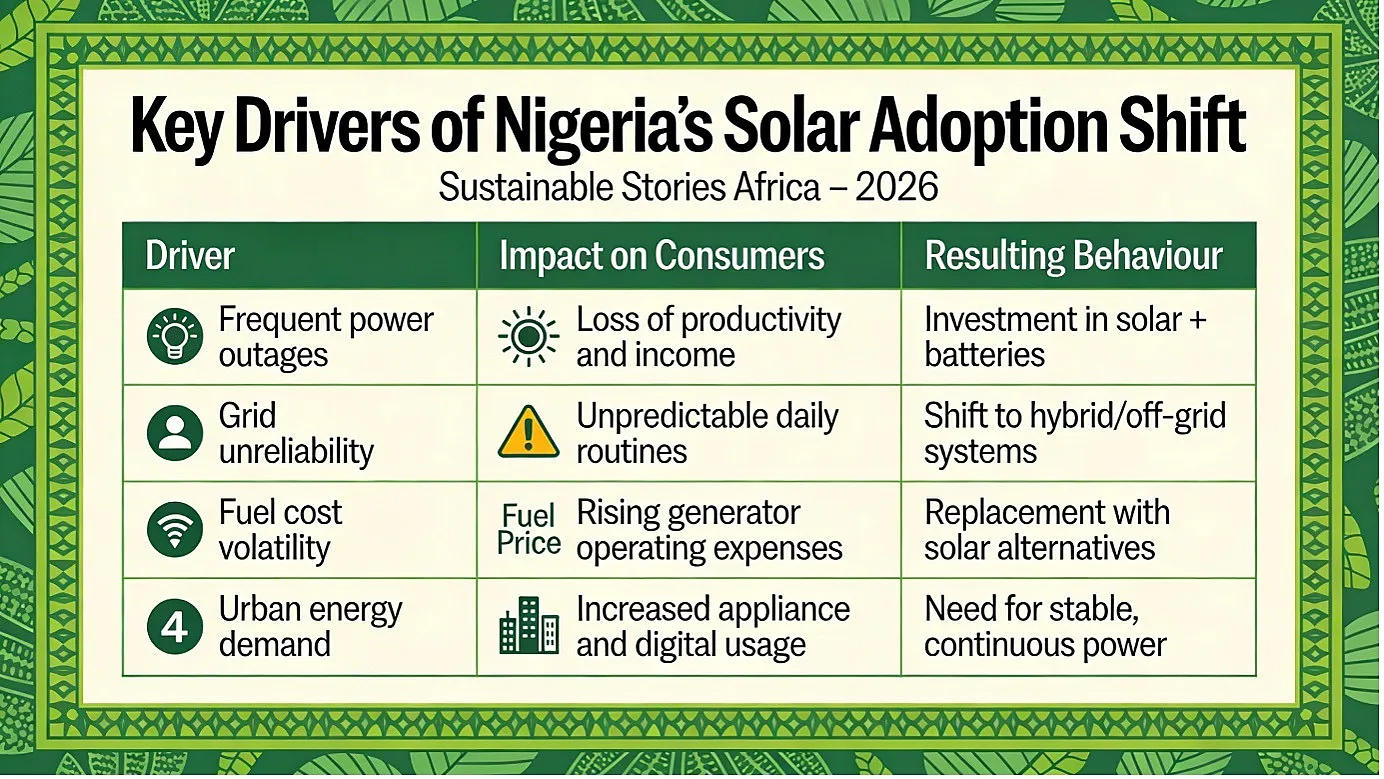
Key Drivers of Nigeria’s Solar Adoption Shift
Driver | Impact on Consumers | Resulting Behaviour |
|---|---|---|
Frequent power outages | Loss of productivity and income | Investment in solar + batteries |
Grid unreliability | Unpredictable daily routines | Shift to hybrid/off-grid systems |
Fuel cost volatility | Rising generator operating expenses | Replacement with solar alternatives |
Urban energy demand | Increased appliance and digital usage | Need for stable, continuous power |
Market data increasingly highlights that solar installations are growing fastest among middle-income households and SMEs that can finance upfront costs but are most affected by outages.
A Lagos-based SME operator captures the sentiment: “It’s not about saving money anymore. It’s about staying open.”
Energy developers and financiers are responding. Pay-as-you-go solar models, mini-grid expansions, and commercial solar leasing are scaling rapidly, particularly in underserved urban clusters.
Solar offers resilience, productivity, and long-term economic gains
If sustained, this shift could fundamentally transform Nigeria’s energy architecture.
Solar adoption is delivering immediate benefits:
- Operational continuity for SMEs
- Reduced dependence on diesel generators
- Lower long-term energy costs despite high upfront investment
- Improved quality of life through reliable electricity access
More importantly, it aligns with broader ESG and development objectives:
- Decarbonisation: Reduced emissions from diesel generators
- Energy access: Expansion of decentralised solutions beyond grid reach
- Economic resilience: Stabilised productivity in informal and formal sectors
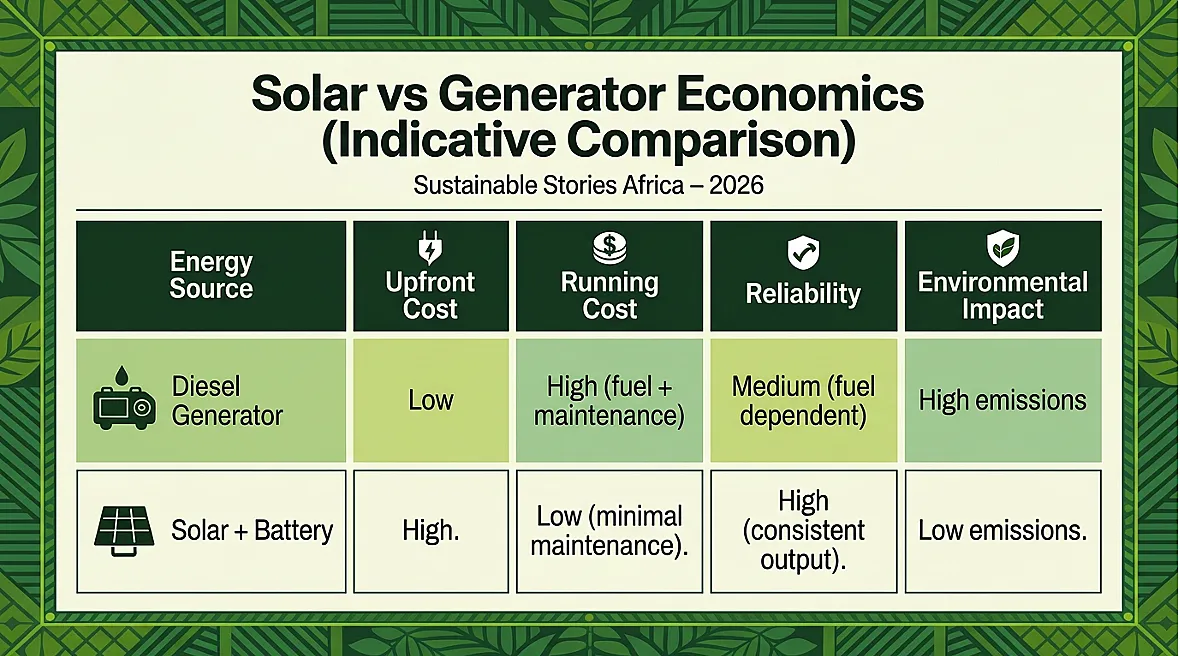
Solar vs Generator Economics (Indicative Comparison)
Energy Source | Upfront Cost | Running Cost | Reliability | Environmental Impact |
|---|---|---|---|---|
Diesel Generator | Low | High (fuel + maintenance) | Medium (fuel dependent) | High emissions |
Solar + Battery | High | Low (minimal maintenance) | High (consistent output) | Low emissions |
However, the transition is not without challenges. High upfront costs, limited access to financing, and regulatory uncertainty constrain mass adoption, especially for lower-income households.
Policy, financing, and infrastructure must catch up
Nigeria’s solar transition is happening, but largely despite the system, not because of it.
To sustain and scale this shift, stakeholders must act decisively:
- Policy reform: Clear, stable frameworks for distributed energy systems
- Financing innovation: Expansion of consumer credit, leasing, and green financing instruments
- Grid integration: Hybrid systems that complement—not compete with—the national grid
- Local manufacturing: Reducing import dependency for solar components
For investors, the signal is clear: Nigeria’s decentralised energy market is no longer speculative; it is demand-driven and accelerating.
For policymakers, the risk is equally clear: failure to align with this shift could deepen energy inequality and fragment the national power system.
Path Forward – Scaling Reliable, Distributed Energy Systems
Nigeria’s energy transition is increasingly decentralised, shaped by consumer demand for reliability rather than policy-led cost reforms.
Scaling solar adoption will require coordinated action across financing, regulation, and infrastructure to ensure that decentralised energy complements national development goals while advancing resilience, inclusion, and sustainability.
Culled From: Power outage, not electricity bills, forcing Nigerians transition to solar energy - Energy in Africa