Round-the-clock renewable power is becoming commercially viable as solar, wind, and batteries combine to deliver better electricity.
The shift matters as grids face rising demand, volatile fuel prices and growing pressure from data centres, industry and cities.
For Africa, it could turn clean power from an access solution into a productivity engine.
Clean Power Is Learning To Stay On
Renewable energy is entering a new phase: not just cheaper daytime solar or strong-wind power, but electricity designed to run when people, factories, hospitals and data centres need it most.
An International Renewable Energy Agency report says solar and wind paired with battery storage are already delivering reliable, round-the-clock electricity at costs that can compete with fossil fuel-heavy systems in several regions.
IRENA estimates 24/7 solar-plus-storage can deliver power at about $54 – $82 per megawatt-hour in the world’s best solar regions, including parts of Africa, compared with more than $100/MWh for new gas-based generation.
That changes the energy conversation. For years, the weakness of renewables was intermittency: the sun sets, wind drops, and grids strain. Now, batteries, hybrid plants, digital controls and better procurement models are narrowing that gap.
Storage Turns Intermittency Into Flexibility
The breakthrough is not one technology. It is the system.
Battery storage helps shift solar power from afternoon peaks into evening demand, stabilise grids, support wind and solar integration, and reduce the need for some network upgrades, according to the International Energy Agency.
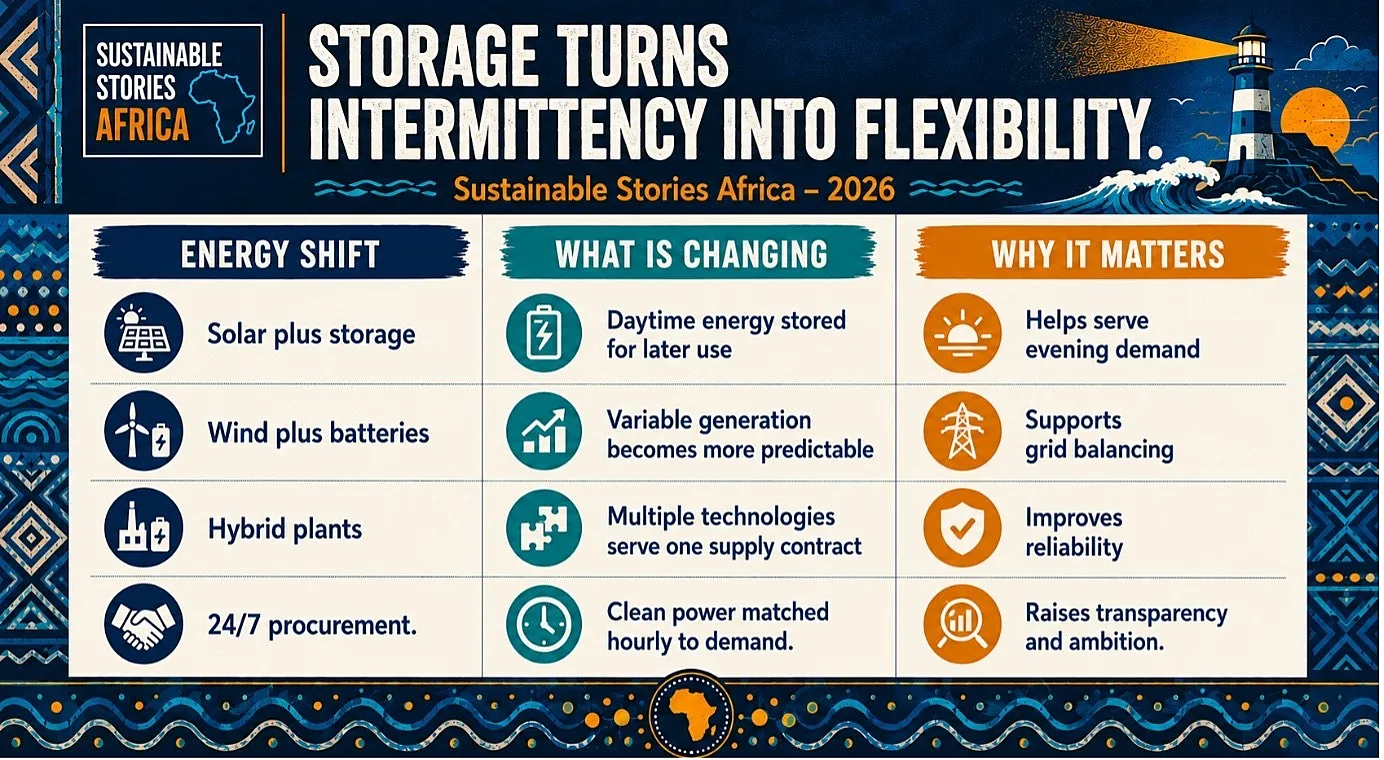
This is why 24/7 carbon-free energy matching is gaining attention. Unlike annual renewable certificates, hourly matching asks whether electricity demand is met by carbon-free generation at the same time it is used.
But the transition is still uneven. The IEA says global grid investment is lagging behind generation investment, with about $400 billion spent yearly on grids compared with around $1 trillion on generation assets.
Without stronger grids, storage and flexibility, round-the-clock renewables will remain easier to promise than deliver.
Africa’s Opportunity Is Bigger Than Access
For Africa, the opportunity is not only climate action. It is economic reliability.
In rural communities, solar-battery mini-grids can keep cold rooms running, power clinics after sunset, help rice mills process faster, and allow small manufacturers to work beyond daylight hours.
The Africa MiniGrids Program says solar-battery mini-grids are designed to improve livelihoods and economic development by transforming local energy markets.
Nigeria’s March 2025 $200 million agreement with WeLight to develop hundreds of renewable mini-grids and MetroGrids shows how this model is scaling.
The project is expected to reach 1.5 million to 2 million people in rural and peri-urban areas.
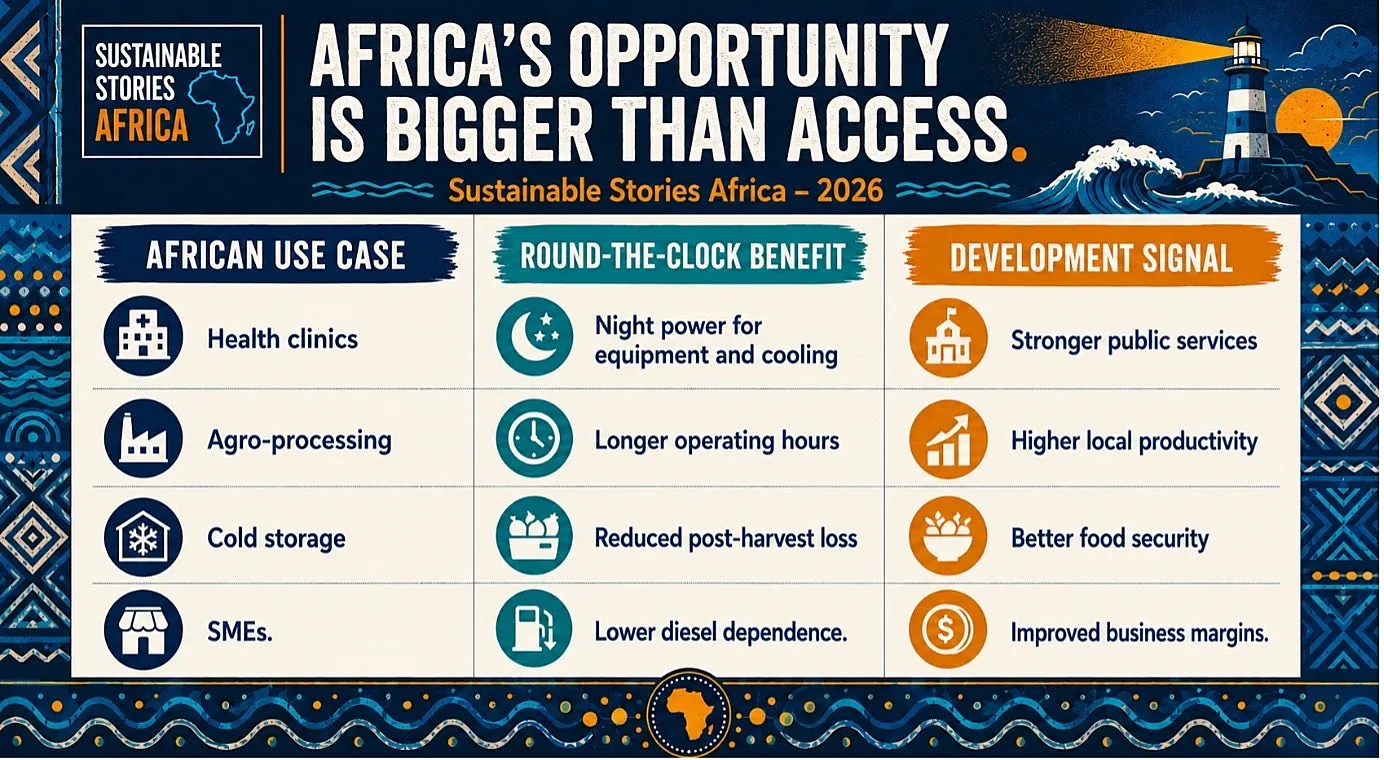
The risk is that Africa imports the old energy debate while missing the new one. The question is no longer whether renewables can generate power. It is whether policy, finance and grid planning can make them firm enough to support industrial growth.
Reliable Renewables Can Lower System Risk
The prize is large. Firm renewable systems can reduce exposure to fuel-price shocks, diesel logistics, foreign-exchange pressure and outages. For businesses, that means more predictable operating costs. For governments, it means less pressure from subsidies and imported fuel bills. For communities, it means electricity that supports livelihoods, not just lighting.
Yet no country gets there by installing panels alone. The next frontier is planning: storage regulation, bankable tariffs, grid codes, local maintenance capacity, blended finance and transparent procurement.
Corporate demand will also matter. Technology companies are already using long-term clean-power deals, storage partnerships and 24/7 targets to secure reliable electricity for data-heavy operations. Google has partnered with Energy Dome on a zero-emission power supply linked to its 24/7 carbon-free energy goal.
Africa can adapt that logic for industrial parks, hospitals, ports, universities and mines.
Build Markets For Reliable Clean Power
Governments should now treat storage, grids and flexible procurement as core energy infrastructure, not optional additions.
Developers need clearer rules for hybrid projects. Banks need risk-sharing tools for storage-heavy systems. Regulators need tariffs that reward reliability, not just generation.
Businesses should demand clean power that is measurable, dependable and locally useful.
Round-the-clock renewables are becoming real. The question is whether African markets can turn that reality into jobs, productivity and resilience.
Path Forward – Reliable Renewables Need Market Design
Africa’s priority is to move from renewable capacity targets to firm clean-power systems that serve real demand.
That means pairing solar and wind with batteries, stronger grids, bankable mini-grids and smarter procurement.
The future is not just clean electricity. It is clean electricity that arrives on time, every time.
Culled From: Round-the-clock renewables are becoming a reality