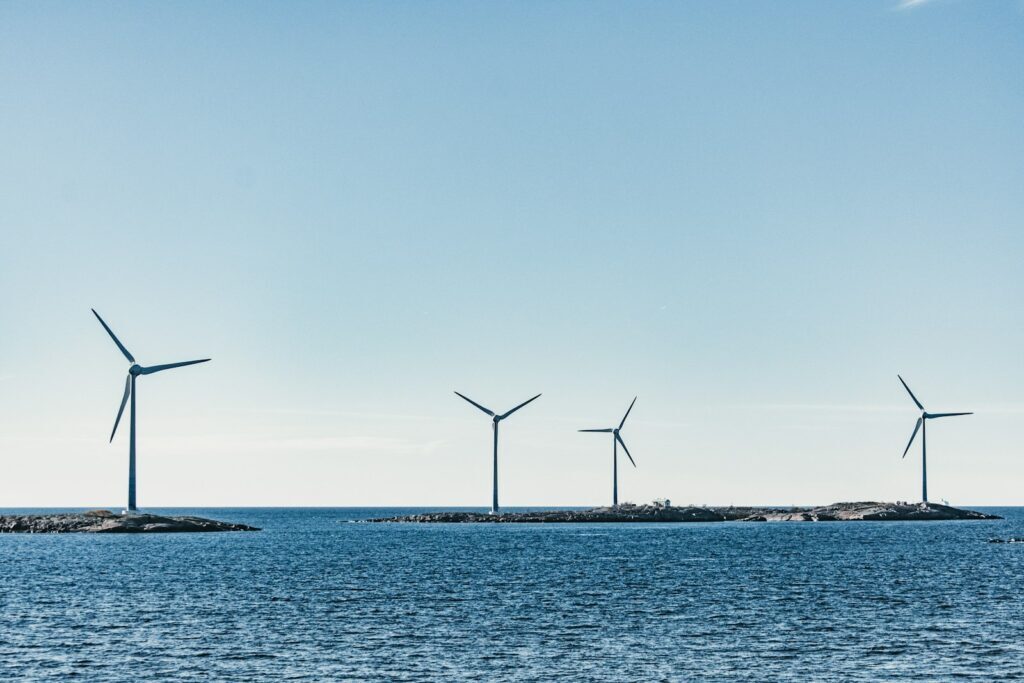
The European Commission has approved a €5 billion Danish offshore wind scheme to accelerate the deployment of large-scale renewable energy.
The move signals renewed urgency in Europe’s energy transition as geopolitical risks and climate targets converge.
For markets and policymakers, it highlights how state-backed financing can unlock infrastructure at scale, offering lessons for emerging economies.
Europe Moves to Scale Offshore Wind, Fast
The European Union has cleared Denmark’s €5 billion state aid scheme to support offshore wind deployment, marking one of the bloc’s most decisive interventions yet in accelerating clean energy infrastructure.
Approved under EU state aid rules, the scheme will enable Denmark to finance new offshore wind farms through competitive tenders, offering long-term price stability and reducing investment risk.
The decision comes at a critical moment: Europe is racing to meet its 2030 climate targets while reducing dependence on volatile fossil fuel imports.
For Denmark, already a global leader in wind energy, the scheme is less about experimentation and more about industrial scaling.
For the EU, it is a signal that speed, scale, and strategic financing now define the next phase of the energy transition.
Financing the Energy Transition at Scale
At its core, the Danish scheme is structured to bridge one of the most persistent gaps in renewable energy: financing certainty.
By guaranteeing revenue through contracts for difference (CfDs) or similar mechanisms, the government reduces exposure to market price volatility, a key barrier to large-scale offshore wind investment. Developers can bid competitively, knowing that long-term returns are stabilised.
This approach aligns with broader EU ambitions under the Green Deal Industrial Plan, which prioritises domestic clean energy capacity as both a climate and economic imperative.
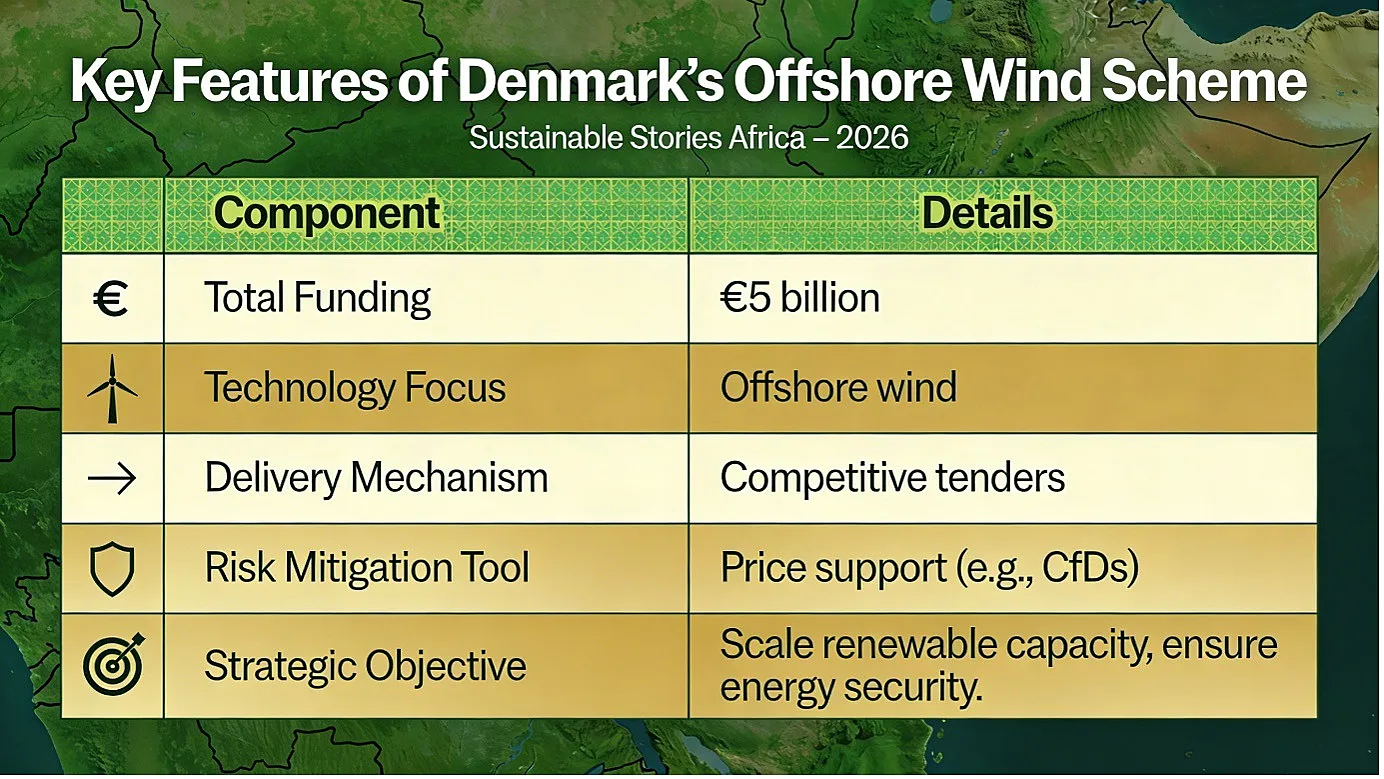
Key Features of Denmark’s Offshore Wind Scheme
Component | Details |
|---|---|
Total Funding | €5 billion |
Technology Focus | Offshore wind |
Delivery Mechanism | Competitive tenders |
Risk Mitigation Tool | Price support (e.g., CfDs) |
Strategic Objective | Scale renewable capacity, ensure energy security |
The implications extend beyond Europe. Across African markets, where renewable potential is high, but financing constraints remain acute, the Danish model offers a replicable blueprint: public capital de-risking private investment.
What Success Looks Like for Markets and Climate
If executed effectively, the Danish scheme could accelerate offshore wind deployment at a pace that reshapes Europe’s energy mix within a decade.
The benefits are multidimensional:
- Energy Security: Reduced reliance on imported gas amid geopolitical uncertainty.
- Price Stability: Lower long-term electricity costs as renewables scale.
- Industrial Growth: Expansion of supply chains, from turbine manufacturing to grid infrastructure.
- Climate Alignment: Faster progress toward EU net-zero targets.
For African economies, the opportunity lies in adaptation rather than replication. Offshore wind may not be universally applicable, but the principle of using public policy to crowd in capital remains highly relevant.
Consider Nigeria’s estimated $410 billion energy transition financing need by 2060. Without structured financing frameworks, capital will remain constrained despite abundant opportunities for solar and gas transitions.
Policy, Capital, and Coordination Must Align
The EU’s approval underscores a clear message: the energy transition is no longer just about targets; it is about execution architecture.
For policymakers, this means:
- Designing bankable frameworks that reduce investor risk.
- Aligning regulatory approvals with financing timelines.
- Building institutions capable of managing large-scale procurement processes.
For investors and developers, it signals confidence in long-term policy stability, arguably the most critical ingredient in infrastructure financing.
And for African markets, it reinforces the need to move from policy ambition to implementation discipline.
Credibility in sustainability now depends on measurable execution, not narrative intent.
Path Forward – Scaling Finance, Unlocking Renewable Markets
The Danish scheme highlights a shift from pledges to structured delivery, where public finance de-risks private capital at scale.
Replicating a model like this in African markets will require improved regulatory clarity, blended finance mechanisms, and institutional capacity.
As energy demand rises across the continent, the priority is clear: build financing systems that convert renewable potential into deployable infrastructure, ensuring both economic resilience and climate alignment.
Culled From: EU Clears €5 Billion Danish Offshore Wind Scheme to Accelerate Large-Scale Renewable Buildout