The Trump administration has approved reimbursement for TotalEnergies to exit U.S. offshore wind projects, redirecting capital toward fossil fuel investments.
The decision marks a sharp policy shift, raising questions about the pace and direction of the global energy transition.
For investors and emerging markets, it underscores how political cycles can reshape capital flows, energy strategy, and climate commitments.
A Policy Pivot Reshaping Energy Capital Flows
In a move that signals a decisive shift in U.S. energy policy, the Trump administration has reimbursed TotalEnergies for withdrawing from offshore wind projects, effectively enabling the French energy giant to redeploy capital into fossil fuel ventures.
The decision answers a critical question facing global energy markets: how durable are renewable investment commitments in the face of political change?
For TotalEnergies, the reimbursement mitigates financial losses tied to regulatory uncertainty and project delays.
For the U.S., it represents a recalibration toward domestic oil and gas expansion. And for global markets, it introduces renewed volatility into an already complex energy transition landscape.
When Policy Risk Becomes Investment Reality
At the heart of the development is a familiar but often underestimated variable: policy risk.
Offshore wind projects in the U.S. have faced mounting challenges, from permitting delays and supply chain inflation to shifting regulatory priorities.
The reimbursement effectively transfers part of that risk from corporate balance sheets to public finance.
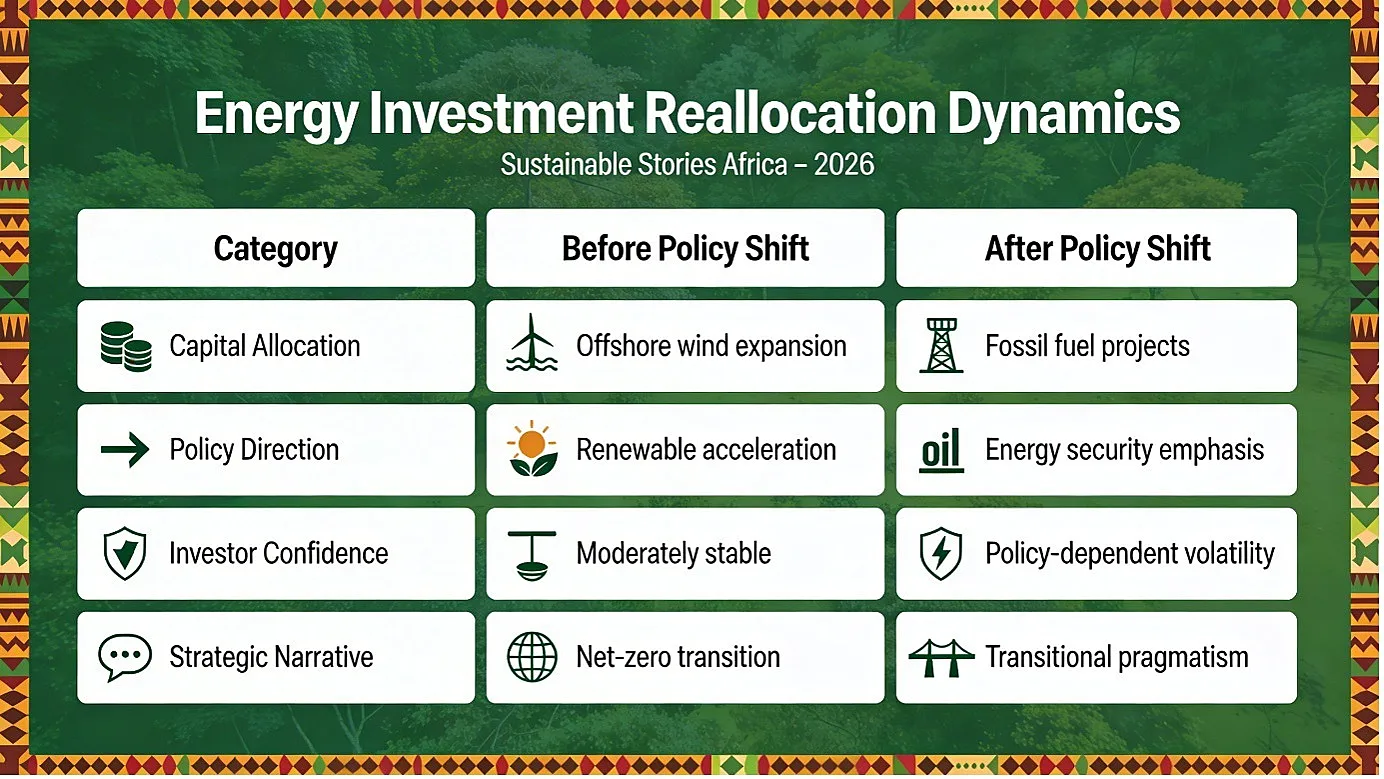
Energy Investment Reallocation Dynamics
Category | Before Policy Shift | After Policy Shift |
|---|---|---|
Capital Allocation | Offshore wind expansion | Fossil fuel projects |
Policy Direction | Renewable acceleration | Energy security emphasis |
Investor Confidence | Moderately stable | Policy-dependent volatility |
Strategic Narrative | Net-zero transition | Transitional pragmatism |
For African markets, the implications are immediate. Many countries are navigating similar tensions, balancing energy access, affordability, and climate commitments.
Nigeria, for instance, continues to rely heavily on gas as a “transition fuel,” even as renewable ambitions grow. The U.S. shift reinforces a reality already understood across the Global South: energy transitions are rarely linear.
As one industry analyst noted, “Capital does not move on ambition alone; it moves on certainty.”
What Stability Could Unlock for Global Energy Systems
If anything, the episode highlights what a more stable and predictable policy environment could achieve.
A consistent framework, whether favouring renewables or fossil fuels, enables long-term planning, reduces capital costs, and accelerates infrastructure deployment.
The real opportunity lies not in choosing one pathway, but in designing systems that manage both transition and continuity.
For Africa, this dual-track approach could be transformative:
- Scaled Renewables: Solar, wind, and mini-grids addressing energy access gaps.
- Pragmatic Transition Fuels: Gas supporting industrialisation and grid stability.
- Blended Finance Models: Public-private structures reducing investor risk.
Without such a balance, the risk is fragmentation, in which capital retreats, projects stall, and energy deficits persist.
Building Policy Credibility in Volatile Energy Markets
The U.S. decision underscores a broader imperative: credibility is now the most valuable currency in energy policy.
For governments, this means:
- Providing clear, long-term regulatory signals.
- Avoiding abrupt reversals that undermine investor confidence.
- Aligning climate commitments with economic realities.
For investors and corporates, it reinforces the need to diversify portfolios across geographies and energy types, hedging against policy swings.
And for African policymakers, the lesson is particularly sharp: the window to design resilient, investment-grade energy frameworks is narrowing.
As outlined in structured ESG reporting approaches, such as the SSA Editorial Guide, execution discipline, not policy rhetoric, will determine credibility in the next phase of the transition.
Path Forward – Balancing Transition With Energy Security
Global energy systems are entering a phase where political decisions increasingly shape capital flows. African markets must respond by building frameworks that attract investment across both renewable and transitional energy sources.
The priority is clear: create stable, transparent policies that reduce risk, mobilise capital, and ensure energy access, while steadily aligning with long-term climate goals.