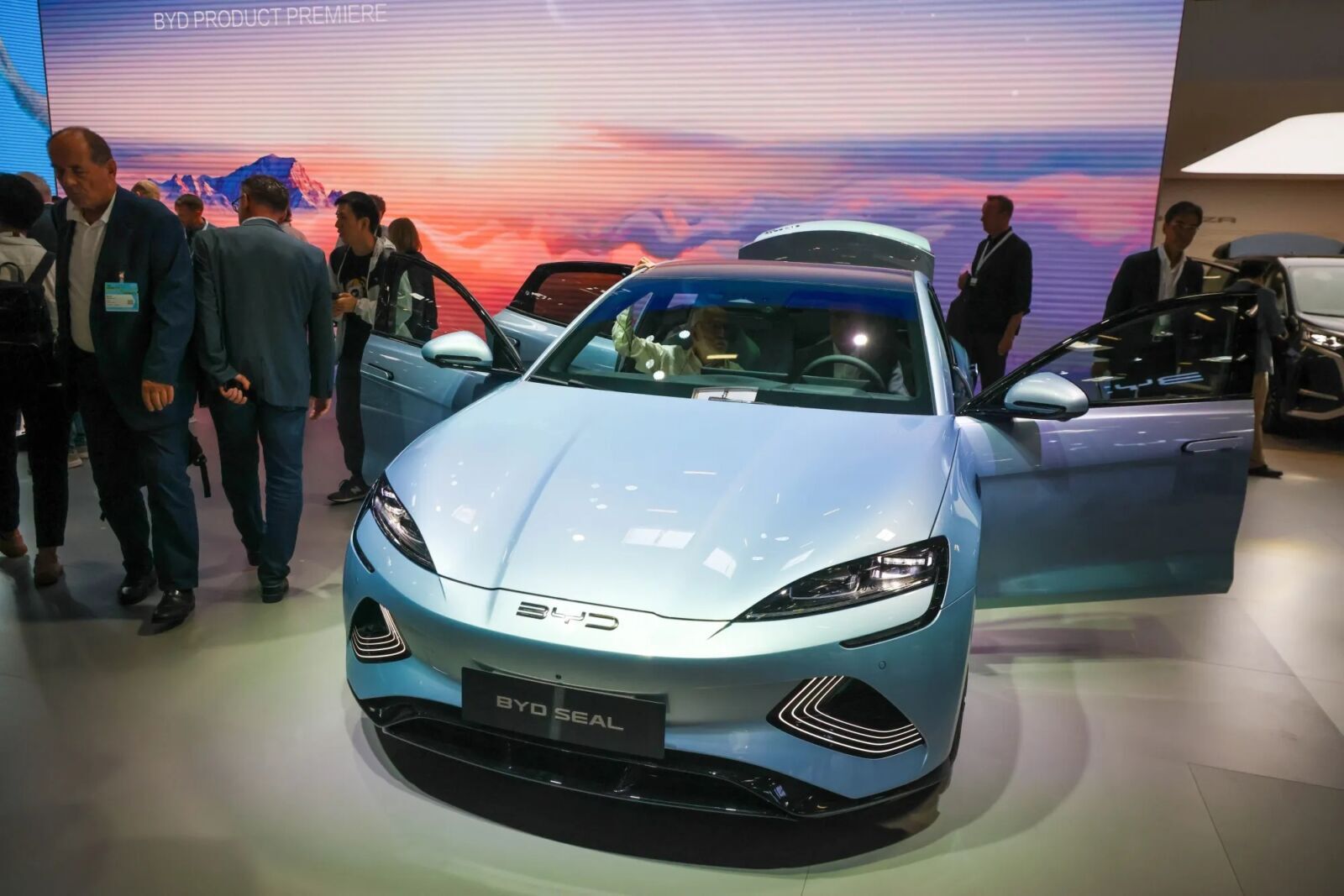
China's electric vehicle industry has overtaken Western automakers in sales, cost, and technology, ending decades of Western automotive dominance.
The shift is structural, not cyclical, and it is accelerating. For Africa and other emerging markets, the question is no longer whether Chinese EVs will arrive, but on whose terms.
The Crown Has Changed Hands
The numbers do not lie. In 2025, China's BYD sold 2.26 million pure battery-electric vehicles, beating Tesla's 1.64 million and becoming the world's first Chinese brand to claim the global BEV crown.
That 620,000-unit gap is not a margin; it is a message: the era of Western automotive supremacy is over.
Chinese EV makers have turned a domestic advantage into a global offensive. They build affordable, software-rich electric vehicles at scale, price them aggressively, and move faster than legacy automakers in Detroit, Stuttgart or Tokyo can respond.
The West is not just losing market share; it is being schooled on cost, speed and industrial vision.
The Cost Gap Is Structural
China's edge is not luck. It is the product of two decades of state-backed industrial policy that treated electric mobility as a strategic priority, investing in battery supply chains, raw material processing, and domestic R&D long before Western governments treated EVs as a serious policy priority.
The result: Chinese EVs sell for roughly $34,400 on average compared to $55,000 or more for Western models, a 37% price advantage that compounds at every income level.
That gap is now visible across trade data. By the end of 2025, Chinese automakers had secured nearly 13% of Europe's EV market, despite the EU imposing countervailing tariffs of between 7.8% and 35.3% on Chinese BEV imports in 2024.
BYD's EU sales surged 272% in September 2025 alone, even as Tesla's European numbers fell 10.5% in the same period.
Between January and February 2026, BEV registrations in Europe were up 22.3% year-on-year, with Chinese brands continuing to expand share.
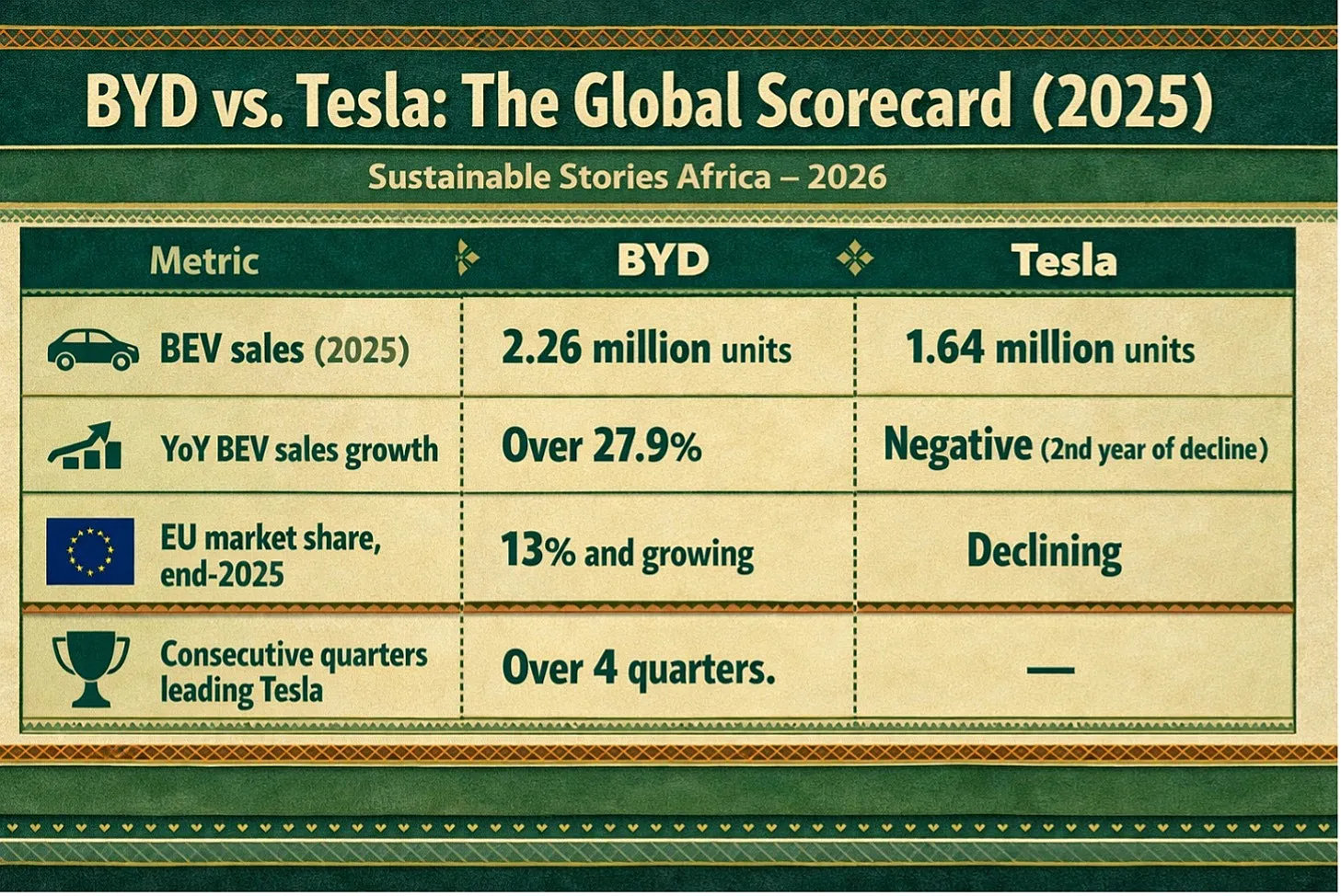
BYD vs. Tesla: The Global Scorecard (2025)
| Metric | BYD | Tesla |
|---|---|---|
| BEV sales (2025) | 2.26 million units | 1.64 million units |
| YoY BEV sales growth | Over 27.9% | Negative (2nd year of decline) |
| EU market share, end-2025 | 13% and growing | Declining |
| Consecutive quarters leading Tesla | Over 4 quarters | — |
The US response has been a 100% tariff wall on Chinese EVs. Europe chose a more nuanced path, replacing blanket tariffs with minimum price commitments in January 2026, a framework that keeps Chinese brands in the market and manages their pricing. Neither approach solves the core problem: Western carmakers are not yet competitive on cost or volume, and tariffs do not build factories.
Africa's Mobility Inflexion Point
For African markets, where fuel costs consume a disproportionate share of household income and urban air quality is deteriorating, cheaper EVs carry life-changing potential.
A small, affordable Chinese EV could cut ride-hailing operating costs between 40 and 60% compared with a petrol counterpart, returning real income to drivers while reducing tailpipe emissions in congested megacities like Lagos, Nairobi and Accra.
Chinese EV makers are already expanding into Latin America and Southeast Asia; Africa is next. If African governments move now, with smart procurement rules, local content requirements and green-grid investment, they can capture jobs in assembly, battery servicing and software, rather than simply replacing oil imports with battery imports. That is the difference between a consumer market and an industrial one.
Negotiate, Don't Just Import
Africa's leaders and policymakers cannot afford a passive stance. Every trade deal, public fleet procurement and investment incentive is a negotiating lever.
The moment to use it is before Chinese and Western brands have locked in supply chains and market channels, not after.
Concrete steps matter now: mandate technology transfer in market-access agreements; prioritise smaller, affordable EV models in public bus and taxi procurement; pair EV incentives with renewable energy grid expansion; and build regional standards, from battery recycling to charging protocols, that give African markets collective bargaining power.
Development finance institutions and climate funds must step in with concessional capital to de-risk early infrastructure investment.
For Western automakers, the survival playbook is equally clear: accelerate lower-cost EV development, abandon premium-first strategies for emerging markets and partner in the Global South rather than retreat from it.
Path Forward – Africa Defines Its EV Deal
The race to electrify transport is being won in China, but the terms of that transition in Africa remain open.
With deliberate policy, regional coordination and development finance, African markets can secure clean, affordable mobility without surrendering industrial agency.
A continent that negotiates boldly: demanding local content, clean grids and fair pricing, can turn China's EV surge from a competitive threat into a climate and development dividend.
Culled From: Western auto companies are getting schooled by China’s EV makers - Climate and Capital Media