The 17 Sustainable Development Goals were never meant to function as a simple checklist.
They form an interconnected system; however, many African governments, companies and financiers still approach them as separate targets. The results are increasingly visible: global progress remains weak, and Africa has recorded measurable progress on only a small share of key targets.
That is why a system-based visual framework matters. By grouping all 17 goals into four-tiered domains, it offers policymakers, ESG investors and development practitioners a clearer way to understand how the goals interact, and what a credible path to 2030 will require, especially for Africa.
Nature First – Rethinking Africa's SDG Architecture
The Sustainable Development Goals were designed in 2015 as a universal call to action, 17 goals, 169 targets, and a deadline of 2030.
What was less clearly communicated then, and remains poorly understood now, is that these goals operate as a layered system: each tier is only as strong as the one beneath it.
A visual framework, a tiered "wedding cake" model, maps the 17 SDGs into four nested domains: Environment as the irreplaceable foundation, Economy as the circular engine built on it, Society as the beneficiary of a functional economy, and Governance as the stabilising crown holding every layer in balance.
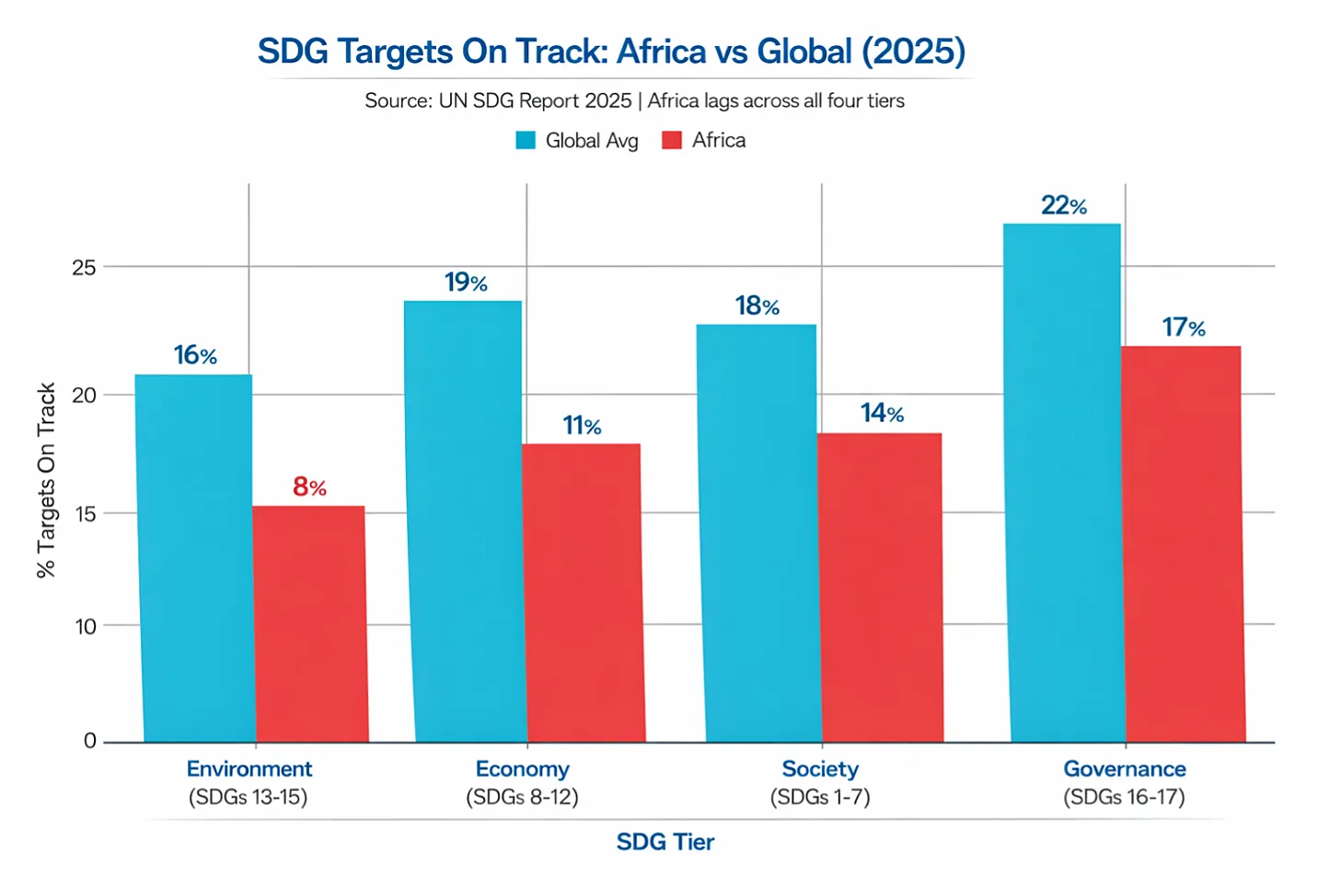
As of 2025, only 18% of SDG targets are on track globally; in Africa, progress has reversed on several critical indicators.
For Africa, where climate shocks, economic exclusion, and governance fragility collide with daily urgency, understanding this architecture is no longer academic. It is operationally critical.
Getting it right could redirect hundreds of billions in climate finance, anchor corporate ESG strategies in genuine systems thinking, and re-orient national development plans before 2030, making them irrelevant.
A Four-Year Window and a Structural Wake-Up Call
Four years from the 2030 deadline, SDG progress remains deeply off track. The UN Sustainable Development Goals Report 2025 says only 18% of global targets are on track or already achieved, while 17% are making only marginal progress, and the rest are stalled or moving backwards.
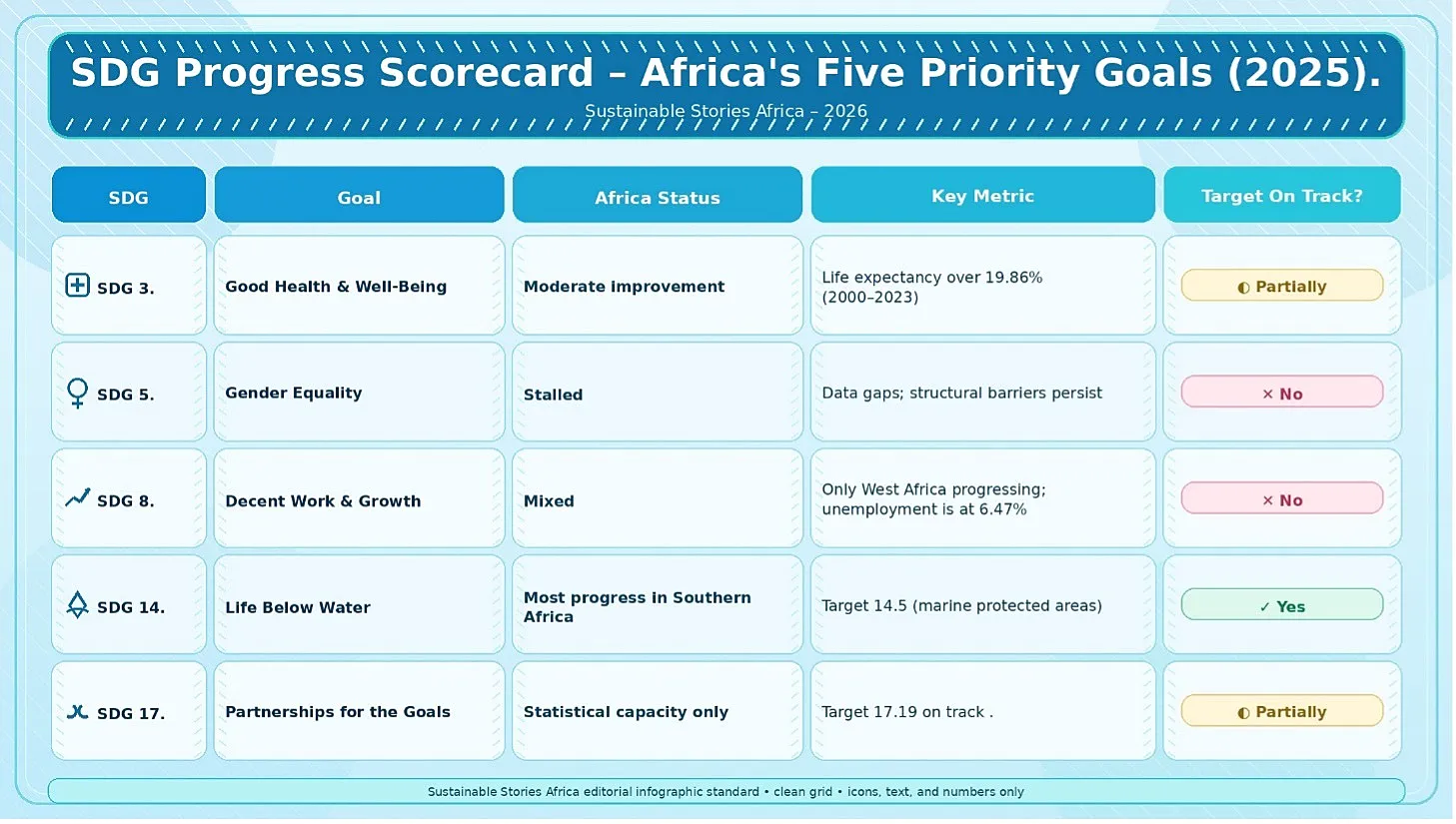
In Africa, progress has been recorded on 12 of the 17 SDGs, but it is too slow to meet the deadline. Across 46 measurable targets under five priority goals, only two are currently on track.
This is not only a funding problem. It is also a structural one. Africa’s annual SDG financing gap is estimated at $670 billion to $762 billion through 2030, while the continent still receives only a small share of global climate finance.
The deeper challenge is systemic misalignment, and that is where the framework becomes important.
Decoding the Four-Tier SDG Architecture
The framework at the centre of this story is not new in theory, but it is gaining fresh urgency in practice.
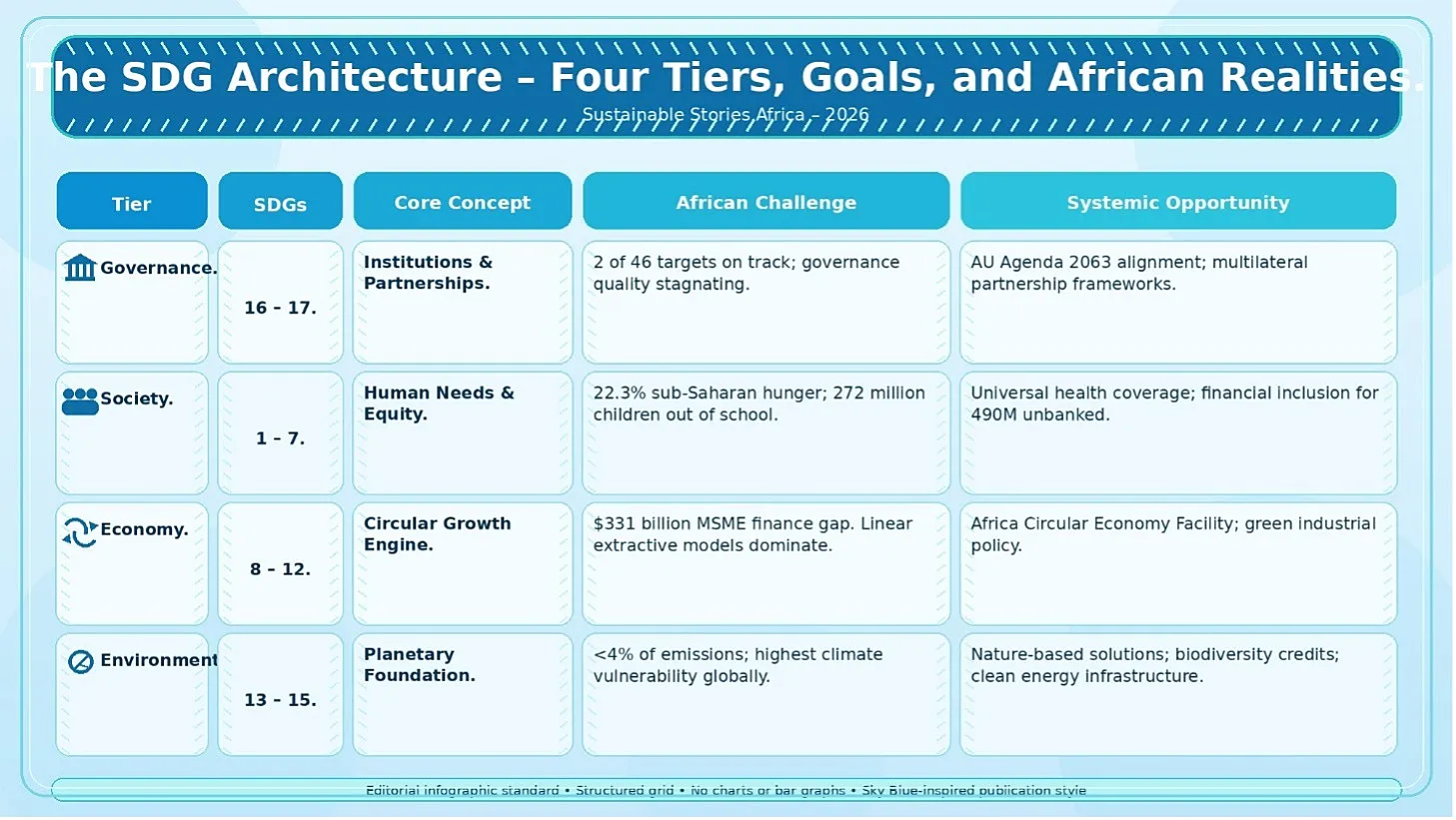
It organises all 17 SDGs into four interdependent tiers, stacked deliberately, each tier depending on the one below it for its own viability.
- The Environment Layer – SDGs 13, 14, 15 – At the base of the framework are three planetary boundary goals: Climate Action, Life Below Water, and Life on Land. Together, they sustain the natural systems on which every higher development goal depends. Without a stable biosphere, neither societies nor economies can endure.
For Africa, this is a lived reality. The continent contributes less than 4% of global greenhouse gas emissions, yet it faces some of the harshest climate risks, including Sahelian drought, coastal flooding in Nigeria and Mozambique, and growing pressure on marine livelihoods.
- The Economy Layer – SDGs 8, 9, 10, 11, 12 – The economy tier covers Decent Work and Economic Growth, Industry and Innovation, Reduced Inequalities, Sustainable Cities, and Responsible Consumption and Production. It frames growth through a circular economy lens, stressing that economic activity must use natural resources carefully and return value efficiently rather than rely on extraction and waste.
For Africa, that poses a structural challenge. Much of the continent’s economy remains linear and resource-extractive, while financing for SDG-aligned circular solutions still falls far short of what is needed.
- The Society Layer – SDGs 1–7 – Society’s seven core goals, from ending poverty and hunger to improving health, education, water, energy and gender equality, depend on both a healthy environment and an economy that works fairly. The framework makes clear that social progress cannot be sustained where ecosystems are degrading and economic systems remain extractive.
That reality is already visible across Africa. Undernourishment remains high across sub-Saharan Africa, while the continent also carries a disproportionate share of the global education crisis. These are not isolated failures but connected signs of a deeper systemic imbalance.
- The Governance Crown – SDGs 16 & 17 – At the top of the framework, Peace, Justice and Strong Institutions and Partnerships for the Goals are not optional extras. They are the governance foundations that make every other SDG possible, from enforcing environmental rules to mobilising finance and coordinating delivery.
- In Africa, this institutional layer remains one of the biggest constraints. The fact that only two priority SDG targets are currently on track for 2030 points not only to policy gaps, but to weak delivery systems and limited institutional capacity.
What a Systems-Aligned Africa Could Achieve
The strength of the layered SDG framework lies in its compounding effect: one well-targeted investment can create impact across multiple tiers at once.
A circular economy project that converts agricultural waste into biogas in rural Nigeria, for example, can simultaneously expand access to clean energy, improve production efficiency, cut emissions, support rural livelihoods, strengthen food systems and reduce the burden of biomass collection on women.
That is systems-thinking in practical terms. It also carries a strong financial case, with circular economy solutions offering major economic value for low- and middle-income countries, especially across Africa’s agriculture, manufacturing and urban infrastructure sectors.
The reverse is equally true: when climate systems deteriorate, the damage spreads upward through economies, societies and institutions.
Aligning Capital, Policy, and Practice with the Architecture
The framework demands more than understanding; it demands restructured action across every stakeholder level. With four years remaining, the following shifts are non-negotiable:
- Policymakers must embed the four-tier hierarchy into National Development Plans and Voluntary National Reviews, treating environmental targets as foundational, not peripheral, because the data confirms that no society or economy tier can be sustained without a healthy environmental base.
- ESG investors and fund managers should adopt a "layered returns" lens, screening not just for SDG label relevance, but for multi-tier systemic impact: does this investment address the environment layer first, or does it assume a healthy foundation without protecting it?
- Corporations reporting under GRI Standards, IFRS Sustainability Disclosures, or the African Corporate Governance Network's frameworks must integrate circular economy principles into their disclosures, mapping Make → Use → Cycle loops as the SDG economy layer demands, not just reporting against isolated goal metrics.
- Development Finance Institutions and multilateral banks must prioritise blended finance structures targeting the environmental and circular economy tiers: nature-based solutions, biodiversity credits, and renewable energy infrastructure are the highest-leverage entry points for multi-SDG impact.
- Civil society and citizens must hold governments and corporations accountable not just for SDG reporting compliance, but for the structural integrity of the system, ensuring nature is treated as infrastructure, not externality.
Path Forward – Anchoring Systems Thinking for Sustainable Progress
Africa cannot afford four more years of fragmented SDG implementation. The layered framework offers a practical reset: environment as foundation, economy as engine, society as beneficiary, and governance as enabler.
Used well, it can help governments, investors, and companies make better decisions and generate more coherent development outcomes.
The message is clear: Africa needs deeper SDG thinking, not more disconnected reporting. Nature remains the non-negotiable base of every economic and human ambition, and alignment must begin now.