Reliable electricity is not just a utility issue. It is the line between industrial expansion and industrial decline in African markets, where factories, farms, hospitals, and digital systems all depend on a steadier power supply.
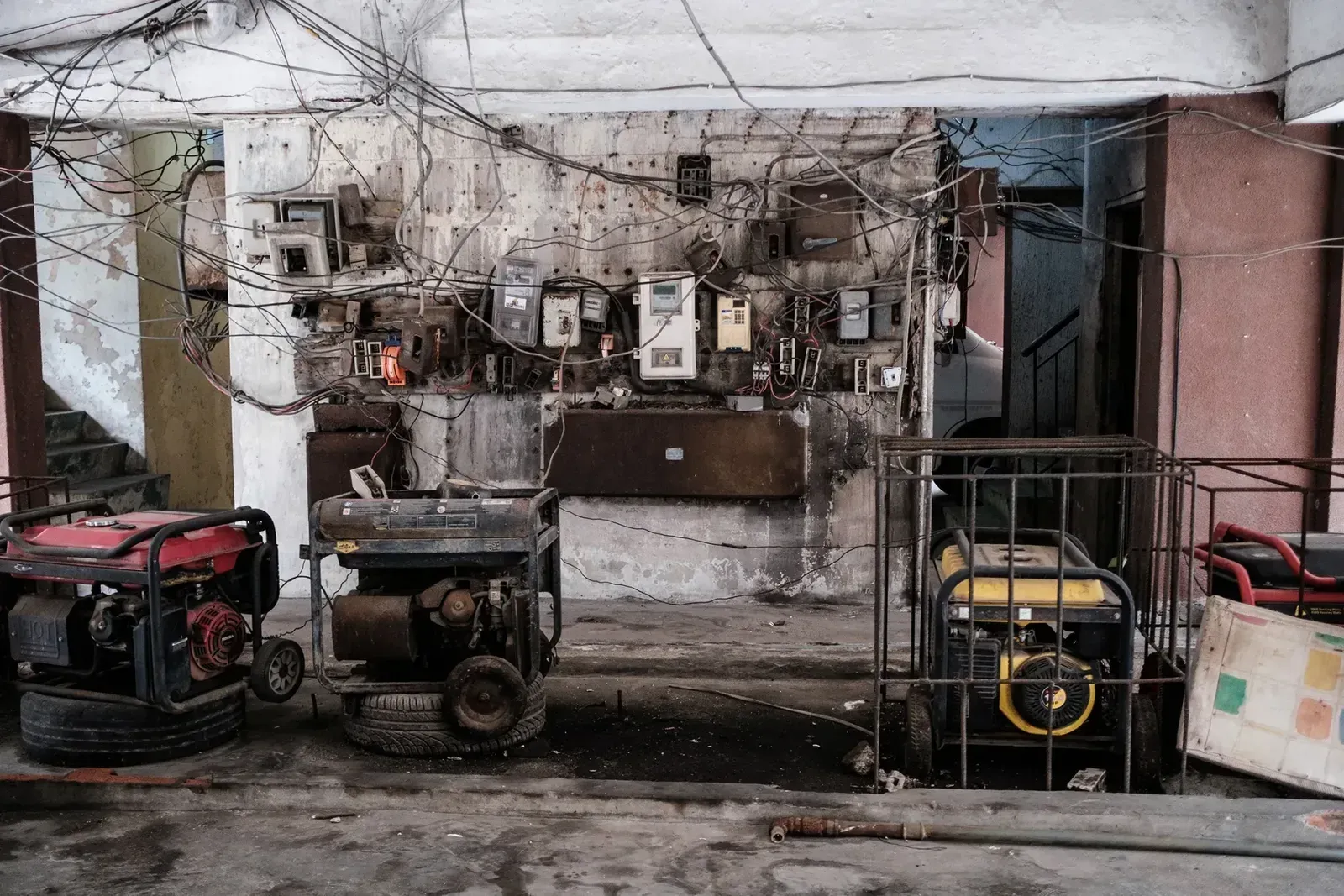
Across Africa, roughly 600 million people still lack electricity, while firms and households continue to pay for backup generation.
The question now is not whether energy matters, but whether governments can make reliability investable.
Power Reliability Now Defines Competitiveness
The uploaded “reliable energy matrix” compresses a sprawling debate over development into a blunt commercial truth: when power is dependable, industries expand, investors commit, jobs rise, and economies compete. When it is not, industrial decline begins long before any recession is formally declared.
That logic is increasingly visible across Africa. Electricity access has improved, but reliability remains uneven, and the pace of progress has slowed.
The result is that businesses are still building private survival systems around a public infrastructure gap, rather than building scale around a dependable power backbone.
For African economies trying to industrialise, deepen digital trade and attract long-term capital, that gap matters now.
Reliable electricity is no longer a sectoral issue sitting inside energy ministries. It is a live test of state capability, regulatory credibility and market readiness.
Reliable Power Now Separates Economic Winners
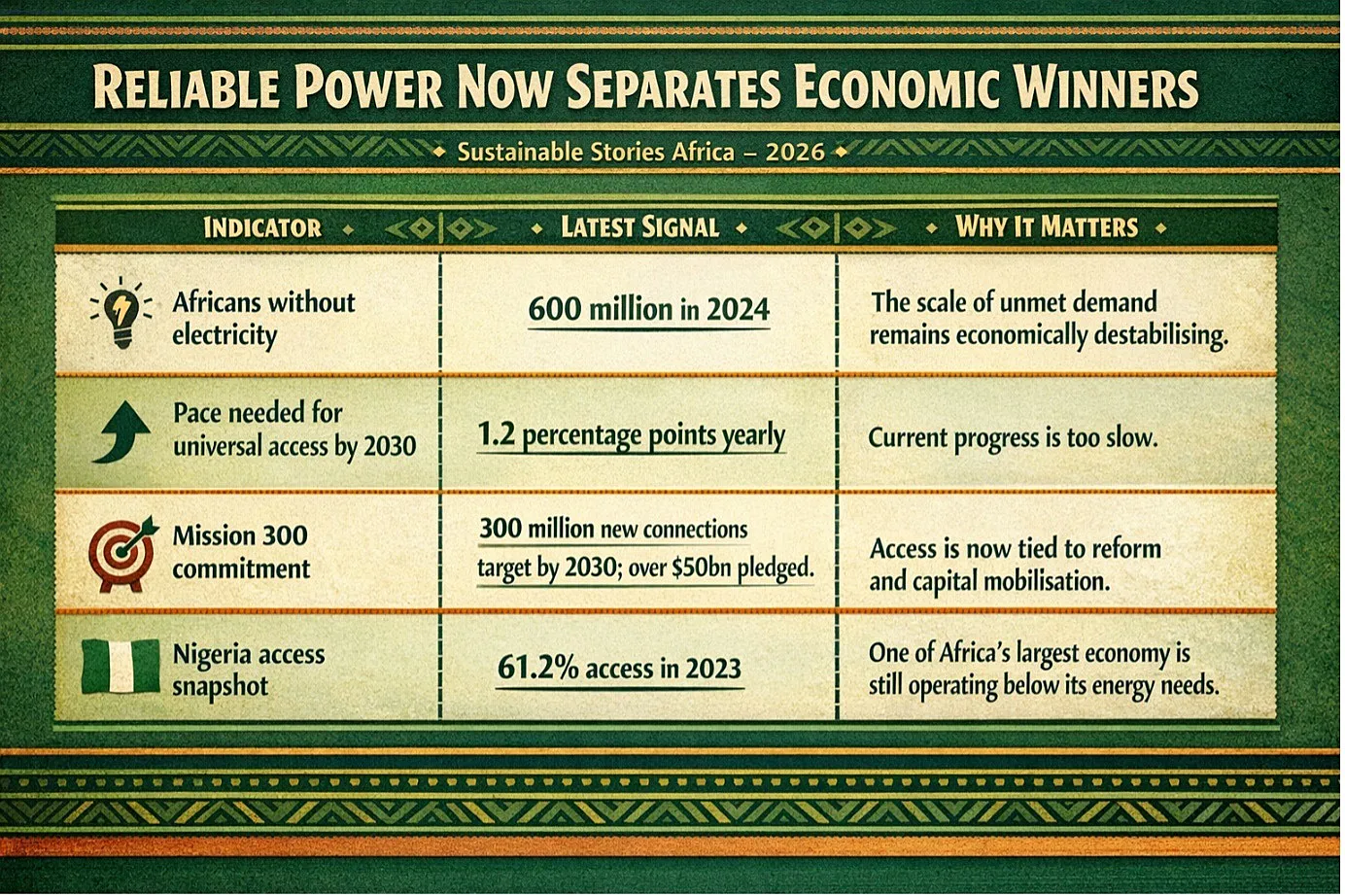
Nearly 600 million Africans still lacked access to electricity in 2024, despite years of policy focus and donor-backed programmes.
SDG 7 tracking shows progress slowed sharply after 2020, leaving the continent needing annual gains of about 1.2 percentage points to achieve universal access by 2030, approximately twice the pace recorded between 2020 and 2023.
However, access alone is no longer the full story. For millions already connected, supply remains too weak, erratic or costly to support households and productive activity.
In Nigeria, where electricity access stood at 61.2% in 2023, unreliable power remains a major constraint on firms.
Over 22 million petrol and diesel generators now serve approximately 26% of households and 30% of MSMEs, with self-generation costs far above costs from the power grid, turning energy reliability into industrial policy.
| Indicator | Latest signal | Why it matters |
|---|---|---|
| Africans without electricity | 600 million in 2024 | The scale of unmet demand remains economically destabilising |
| Pace needed for universal access by 2030 | 1.2 percentage points yearly | Current progress is too slow |
| Mission 300 commitment | 300 million new connections target by 2030; over $50bn pledged | Access is now tied to reform and capital mobilisation |
| Nigeria access snapshot | 61.2% access in 2023 | One of Africa’s largest economy is still operating below its energy needs |
The Data Already Tells a Story
What makes this moment different is that policy is beginning to reflect economic reality. Mission 300, led by the World Bank Group and African Development Bank Group, is framed around reliable, affordable and sustainable electricity, not just connection targets. At the January 2025 Dar es Salaam summit, African leaders backed that shift with the Dar es Salaam Energy Declaration and more than $50 billion in partner pledges.
That shift matters because investors fund execution, not rhetoric. Weak regulation, fragile utilities and poor market signals still limit private capital, even where generation ambitions are high.
Nigeria’s latest regulatory moves underscore the point. Better coordination between federal and state regulators may sound procedural, but without it, fragmented rules can deter investment and weaken reliability.
What Reliable Electricity Makes Possible Next
If governments treat reliable power as a competitiveness strategy rather than a technical afterthought, the upside is substantial.
Factories can run longer production cycles without burning margins on diesel. Agro-processors can cold-store output instead of losing value after harvest.
Digital businesses can expand with lower backup costs. Schools, clinics and transport systems can operate with fewer interruptions and better service quality.
That is why the “yes” branch of the matrix matters. Reliable energy lowers operating uncertainty.
Lower uncertainty improves investor confidence. Stronger investment supports expansion, hiring and productivity.
The chain is not theoretical; it is how industrial ecosystems actually deepen. Once firms can trust energy supply, they start planning for scale, not mere survival.
The reverse is equally true. Unreliable power quietly taxes every stage of economic life: working capital is diverted into generators, maintenance costs rise, inventories become harder to manage, service delivery worsens, and smaller firms are priced out.
Over time, that weakens national competitiveness even when headline GDP figures appear stable.
Africa’s energy challenge, then, is not only about access to justice. It is also about restoring the commercial conditions under which markets can compound.
What Governments And Markets Must Do
- First, governments need to stop separating access from reliability. Grid expansion, mini-grids and standalone solar all matter, but households and firms need electricity that is affordable, usable and sustainable. The IEA warns that without a significant acceleration in both grid expansion and decentralised solutions, sub-Saharan Africa risks falling further behind its access targets.
- Second, regulators must make reliability measurable. That means service-quality enforcement, transparent tariff frameworks, faster approvals for distributed energy, and rules that reduce uncertainty for financiers and operators. AfDB’s regulatory work is clear; stronger outcomes follow when governance, regulation and implementation improve together.
- Third, African states should treat energy reform as a cross-economy productivity agenda. Finance ministries, trade officials, industrial planners and subnational governments all have a stake in whether power works. 0In Nigeria, the post-Electricity Act transition toward state-level market oversight could become an opportunity to align energy planning more closely with industrial clusters, commercial corridors and urban demand growth, provided coordination holds.
- Finally, capital must move differently. Mission 300’s financing signal is important, but public and concessional money will have to crowd in more private investment, especially where utilities are weak and end-user affordability is fragile. The IEA estimates that reaching universal electricity access in Africa will require scaling annual investment to about $15 billion, while keeping progress inclusive and sustainable.
Path Forward – Reliability Must Become Development Doctrine Now
Africa does not need more rhetorical agreement that energy matters.
It needs reliable electricity to be treated as foundational economic architecture, with reform, finance and regulation aligned around quality supply rather than headline connections alone.
The central promise is simple: build power systems people and firms can trust, and industry will do more of the rest.
Delay that shift, and the “no” side of the matrix, industrial decline, investor caution and weaker jobs, will keep repeating itself.