The International Finance Corporation released Version 2.0 of its Environmental and Social Management System (ESMS) Toolkit in August 2025, a comprehensive, practical upgrade providing companies with a step-by-step roadmap to build, improve, and institutionalise their environmental and social (E&S) performance.
For African businesses seeking access to development finance, global supply chains, and international investors, the timing is decisive. IFC's Performance Standards govern nearly 90% of project financing in emerging markets, making ESMS alignment not an optional ESG exercise, but a structural prerequisite for competitive growth.
The Toolkit Closing Africa's ESG Gap
Corporate sustainability in Africa is moving from intention to accountability — and the tools to manage that transition at scale have arrived. The IFC's updated ESMS Toolkit, Version 2.0, published in August 2025, delivers a practical, structured framework aligned with IFC Performance Standard 1 that enables companies of all sizes to systematically integrate environmental and social management into their core business operations.
The urgency of this toolkit for African markets cannot be overstated. Companies operating without a functioning ESMS face growing exposure: exclusion from DFI-backed financing, reputational damage from unmanaged community or environmental risks, legal liability from inadequate E&S disclosures, and restricted access to export markets demanding credible sustainability credentials.
The toolkit addresses this gap directly, offering not philosophy, but process: forms, checklists, templates, risk heat maps, stakeholder engagement plans, grievance logs, and a six-month implementation roadmap aligned to nine ESMS elements that together constitute a complete, continuous improvement management system.
90% of Emerging Market Project Finance Depends on This
IFC's Performance Standards govern nearly 90% of project financing in emerging markets. For African businesses, from mid-size manufacturers in Nigeria to agribusinesses in Kenya and infrastructure developers in Ghana, that figure defines the terms of access to the capital that powers growth, job creation, and climate resilience.
An ESMS that does not meet IFC PS1 requirements is not a minor compliance gap. It is a structural barrier to a vast pool of multilateral, bilateral, and blended finance.
Institutions that cannot evidence a functioning ESMS risk loan covenant violations, DFI facility exclusion, credit rating pressure, and, increasingly, disqualification from global supply chains where buyers require proof of E&S management as a condition of contract.
Nine Elements, One Integrated System
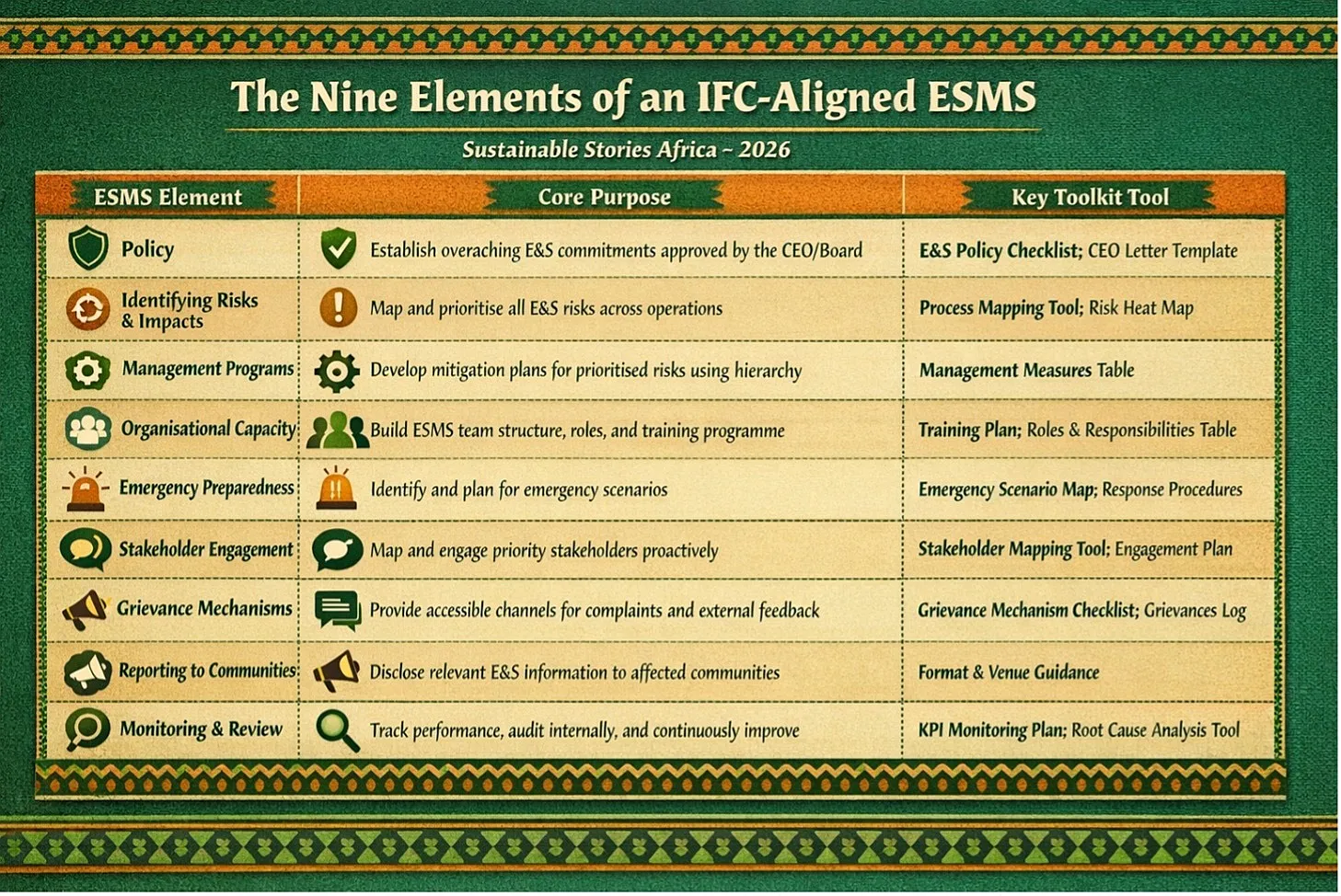
The ESMS framework operates on a Plan-Do-Check-Act cycle, delivered through nine interdependent elements. Each element comes with ready-to-use templates and tools in the IFC toolkit.
The Nine Elements of an IFC-Aligned ESMS
| ESMS Element | Core Purpose | Key Toolkit Tool |
| Policy | Establish overarching E&S commitments approved by the CEO/Board | E&S Policy Checklist; CEO Letter Template |
| Identifying Risks & Impacts | Map and prioritise all E&S risks across operations | Process Mapping Tool; Risk Heat Map |
| Management Programs | Develop mitigation plans for prioritised risks using hierarchy | Management Measures Table |
| Organisational Capacity | Build ESMS team structure, roles, and training programme | Training Plan; Roles & Responsibilities Table |
| Emergency Preparedness | Identify and plan for emergency scenarios | Emergency Scenario Map; Response Procedures |
| Stakeholder Engagement | Map and engage priority stakeholders proactively | Stakeholder Mapping Tool; Engagement Plan |
| Grievance Mechanisms | Provide accessible channels for complaints and external feedback | Grievance Mechanism Checklist; Grievances Log |
| Reporting to Communities | Disclose relevant E&S information to affected communities | Format & Venue Guidance |
| Monitoring & Review | Track performance, audit internally, and continuously improve | KPI Monitoring Plan; Root Cause Analysis Tool |
Two cross-cutting topics are newly integrated throughout the framework. Supply chain and contractor management, a critical gap for African businesses where unmanaged third-party risks frequently migrate into core E&S liabilities, now runs through all nine ESMS elements, from policy to monitoring.
Climate change is equally embedded, recognising that it represents a systemic accelerator of environmental and social risk across all eight IFC Performance Standards: flooding, heatwaves, droughts, and sea-level rise can affect worker safety, community health, water availability, ecosystem stability, and cultural heritage simultaneously.
What a Functioning ESMS Unlocks
An ESMS aligned with IFC Performance Standards delivers four compounding benefits to any business that invests in building one:
- Risk protection – Guards against operational disruptions, legal claims, brand damage, and restricted market access, the category of unmanaged risk that most frequently derails African business growth
- Financial and operational performance – Systematic input management, energy efficiency, and waste reduction improve cost structures and productivity
- Social licence to operate – Community engagement, grievance mechanisms, and ongoing disclosure build the trust that protects long-term operations
International market access – IFC PS alignment opens doors to DFI capital, green bonds, export market qualifications, and global supply chain eligibility that closed ESMS systems cannot access
For communities neighbouring industrial, agricultural, or infrastructure projects, a functioning ESMS is equally consequential.
It embeds accountability for environmental impacts, worker rights, community health, and cultural heritage into everyday business operations, not as a public relations function, but as a managed, documented, and auditable business process.
From Toolkit to Implementation
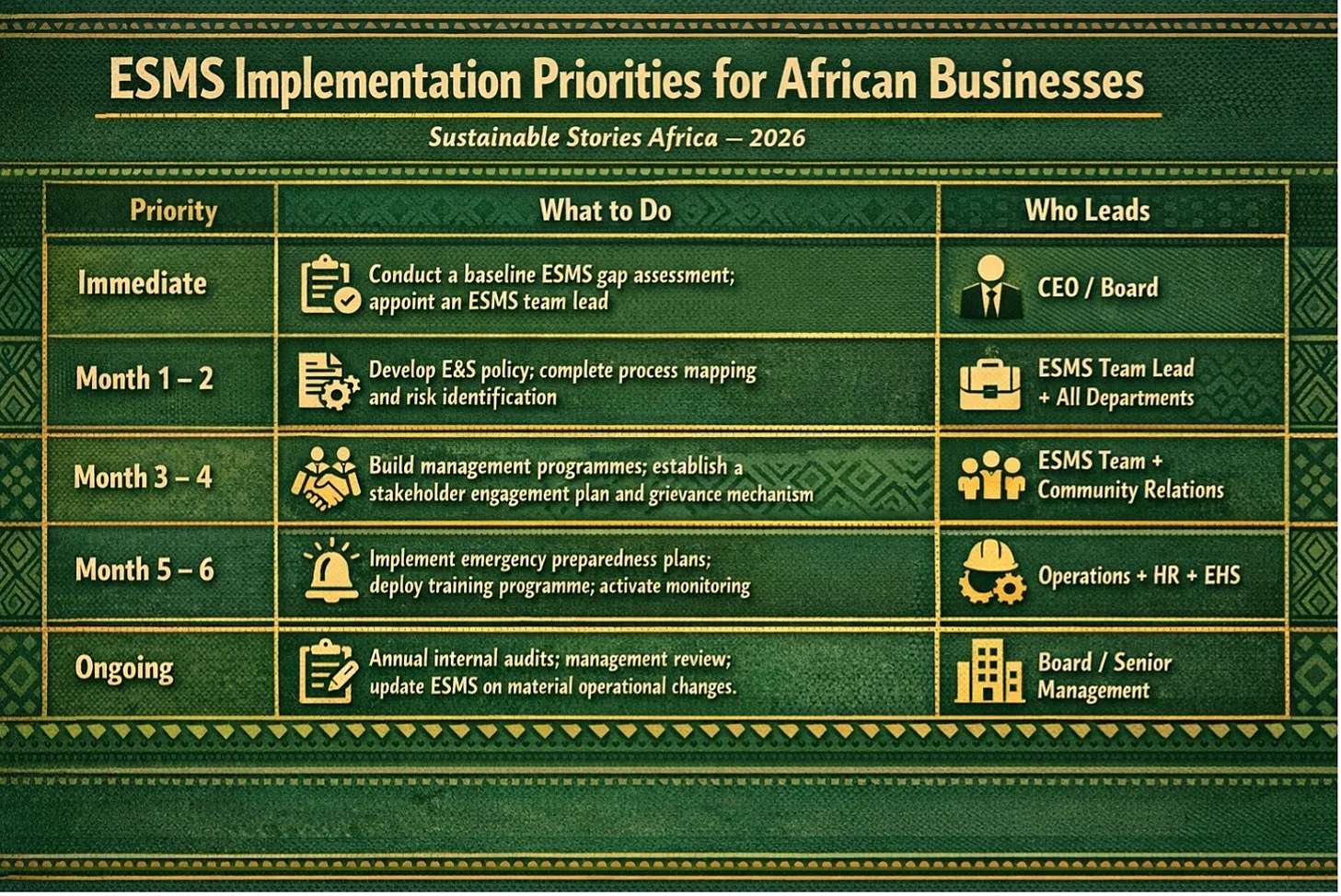
The toolkit provides a six-month ESMS development and implementation roadmap, structured across all nine elements, assigning responsibilities to senior management, middle management, supervisors, and workers at every stage.
Companies must act across three tracks simultaneously:
ESMS Implementation Priorities for African Businesses
| Priority | What to Do | Who Leads |
|---|---|---|
| Immediate | Conduct a baseline ESMS gap assessment; appoint an ESMS team lead | CEO/Board |
| Month 1 – 2 | Develop E&S policy; complete process mapping and risk identification | ESMS Team Lead + All Departments |
| Month 3 – 4 | Build management programmes; establish a stakeholder engagement plan and grievance mechanism | ESMS Team + Community Relations |
| Month 5 – 6 | Implement emergency preparedness plans; deploy training programme; activate monitoring | Operations + HR + EHS |
| Ongoing | Annual internal audits; management review; update ESMS on material operational changes | Board/Senior Management |
Regulators and development finance partners in Africa must invest in making ESMS capacity-building accessible, particularly for SMEs, which constitute the backbone of African economies yet rarely have the in-house resources to build management systems from scratch.
The toolkit's freely available, sector-adaptable tools make this achievable, provided awareness, training, and technical support are systematically deployed.
Path Forward – Beyond Compliance: Institutionalising ESG Performance Systems
Africa's private sector cannot afford to treat environmental and social management as a documentation exercise reserved for loan applications. An IFC-aligned ESMS, built on the nine-element framework and embedded into daily operations, is the foundation for durable market access, community trust, and climate resilience.
The IFC's Version 2.0 Toolkit removes every barrier to complexity. The tools, templates, and roadmap are ready. What remains is leadership commitment, team investment, and the recognition that managing E&S risk well is not a cost; it is a competitive advantage.