On 4 March 2026, Nigeria's Federal Executive Council approved the establishment of the Grid Asset Management Company (GAMCO), the most consequential institutional reform proposed in the country's electricity sector in years.
GAMCO's mandate is direct: unlock stranded generation capacity and modernise a transmission network that has long been the weakest link in Nigeria's power value chain.
With 2,275 megawatts of generation capacity stranded at year-end 2025, a five-year high, and barely 33% of Nigeria's 13,625MW installed capacity reliably delivered to end users, the question is no longer whether reform is needed, but whether GAMCO has the structure, mandate, and capital to deliver it.
Nigeria's Power Gap: Generation Without Delivery
Nigeria's electricity crisis is not primarily a generation problem; it is a transmission problem. The country has an installed grid-connected generation capacity of 13,625 megawatts, yet average available generation in the second quarter of 2025 stood at just 5,395MW, with actual dispatch regularly falling below 4,000MW.
Hundreds of power plants sit idle, not for lack of fuel or generation equipment, but because the national grid cannot physically absorb and evacuate the electricity they produce.
This structural paradox, power generated but not delivered, represents one of the most costly and persistent inefficiencies in Africa's largest economy.
Homes remain in darkness, businesses run on diesel generators at prohibitive cost, and Nigeria's industrial competitiveness erodes daily.
A country with the capacity to power significantly more of its 220 million citizens than it currently does is failing not at the point of generation, but at the point of transmission.
GAMCO is Nigeria's institutional response to this long-acknowledged but under-addressed reality.
The Federal Government's decision to establish a specialised grid asset management company, with a pilot anchored in the Benin-Lagos transmission corridor, signals a structural shift from ad-hoc investment to disciplined, asset-specific grid management.
2,275MW Stranded – A Five-Year High
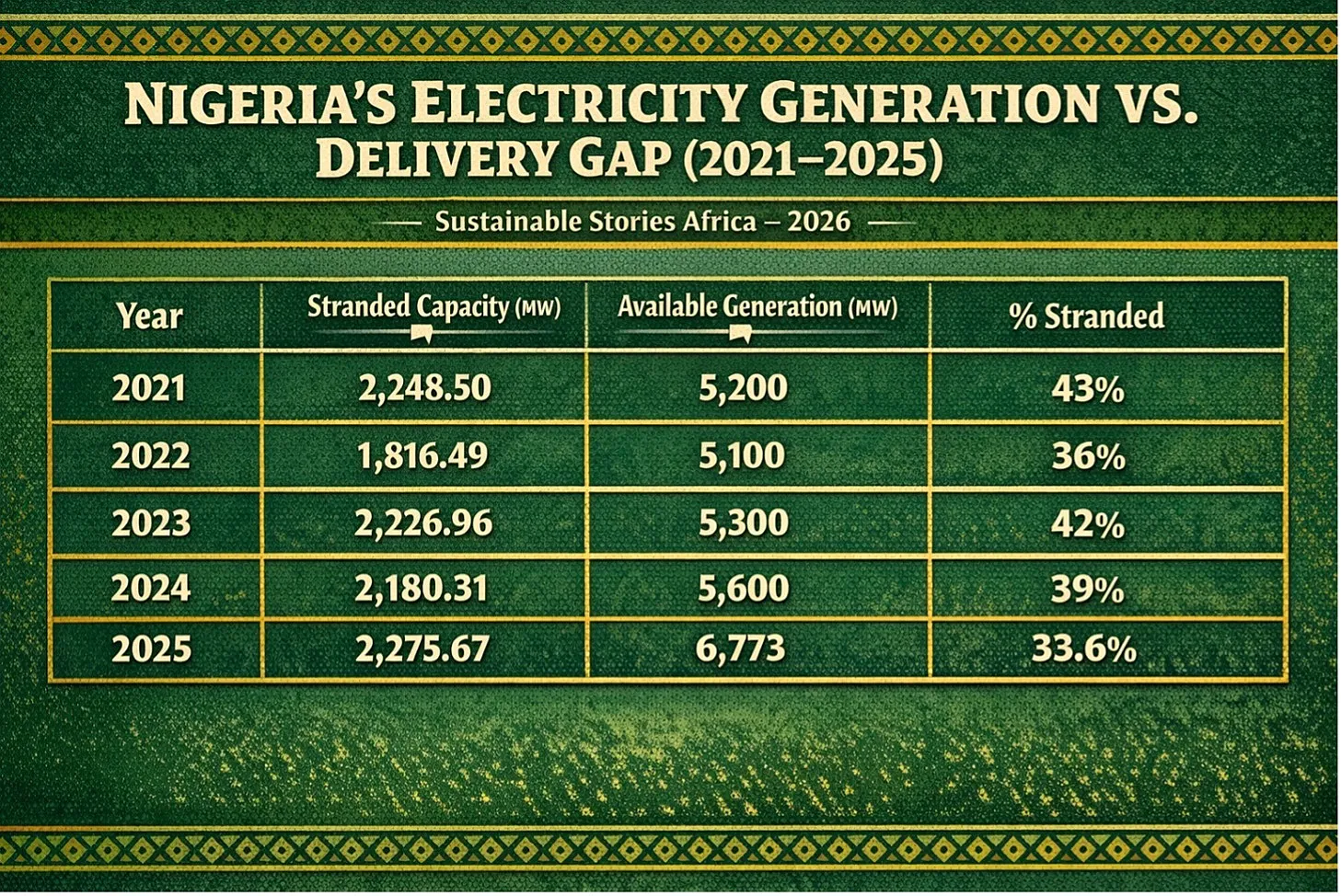
By December 2025, Nigeria's stranded power generation capacity had climbed to 2,275.67 megawatts, the highest level in five years, and equivalent to 33.6% of available generation sitting unused and undelivered.
Generation companies lost an estimated N2.28 trillion in capacity payments in 2025 alone, directly attributable to grid constraints preventing power evacuation to distribution networks and end users.
This is the crisis that GAMCO is designed to address. President Bola Tinubu's administration approved GAMCO at the Federal Executive Council on 4 March 2026, with the stated objective of resolving "once and for all" the transmission bottleneck that has anchored Nigeria's power supply failure for decades.
An 11-member inter-ministerial committee, chaired by the Chief of Staff to the President and spanning the ministries of Power, Finance, Works, Petroleum, Communications, Science and Technology, and Aviation, has been inaugurated to design GAMCO's operational and legal framework.
What GAMCO Is and What It Must Do
GAMCO is a specialised institutional vehicle with a mandate distinct from that of the Transmission Company of Nigeria (TCN) and the Nigerian Electricity Regulatory Commission (NERC).
Where TCN has historically operated the transmission network under chronic underfunding and governance constraints, GAMCO is designed for a focused mission: asset optimisation, grid infrastructure expansion, and strategic capital mobilisation.
Nigeria's Electricity Generation vs. Delivery Gap (2021–2025)
| Year | Stranded Capacity (MW) | Available Generation (MW) | % Stranded |
|---|---|---|---|
| 2021 | 2,248.50 | 5,200 | 43% |
| 2022 | 1,816.49 | 5,100 | 36% |
| 2023 | 2,226.96 | 5,300 | 42% |
| 2024 | 2,180.31 | 5,600 | 39% |
| 2025 | 2,275.67 | 6,773 | 33.6% |
GAMCO's pilot phase will focus on the Benin-Lagos transmission corridor, where TCN is expected to grant GAMCO the right to develop, finance, and operate a new 330KV+ double-circuit independent power transmission line.
The pilot targets the recovery and optimisation of currently stranded generation in NIPP (National Integrated Power Project) assets, substantial federal investments that are currently operating well below their potential due to transmission evacuation constraints.
Powering Progress – Mobilising Capital for Grid Resilience
Three strategic mechanisms define GAMCO's mandate.
- First, grid infrastructure modernisation: upgrading ageing transmission infrastructure with digital monitoring tools, automated protection systems, and real-time asset performance analytics to improve grid stability.
- Second, unlocking stranded generation capacity: by strengthening transmission corridors around major generation clusters, GAMCO could deliver more megawatts to consumers without requiring new power plant construction.
- Third, transmission investment mobilisation: attracting private capital through public-private partnerships, infrastructure concession models, and performance-based asset management contracts — breaking the cycle of purely public-sector financing that has chronically underfunded grid expansion.
What a Functioning Grid Delivers
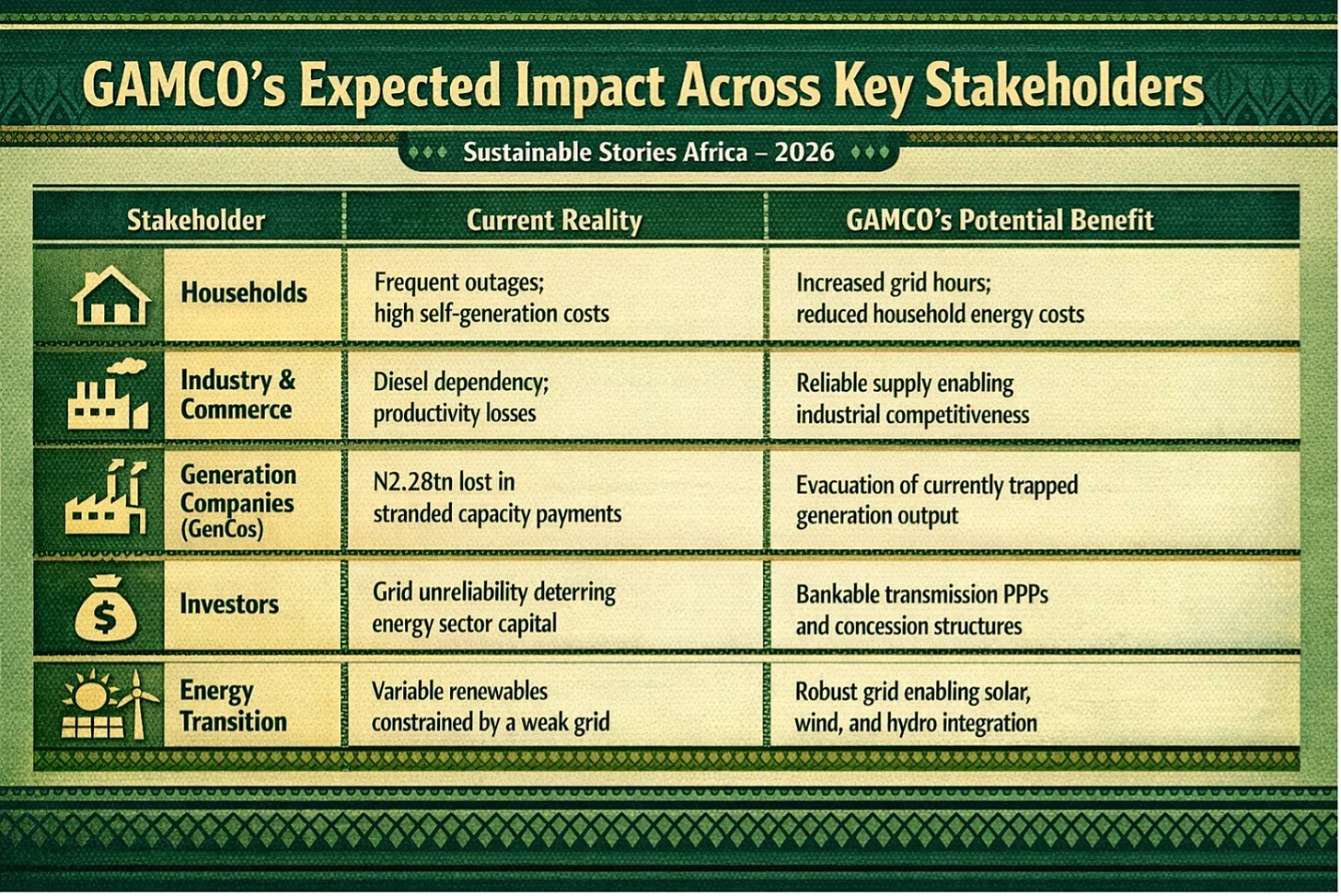
GAMCO's Expected Impact Across Key Stakeholders
| Stakeholder | Current Reality | GAMCO's Potential Benefit |
|---|---|---|
| Households | Frequent outages; high self-generation costs | Increased grid hours; reduced household energy costs |
| Industry & Commerce | Diesel dependency; productivity losses | Reliable supply enabling industrial competitiveness |
| Generation Companies (GenCos) | N2.28tn lost in stranded capacity payments | Evacuation of currently trapped generation output |
| Investors | Grid unreliability deterring energy sector capital | Bankable transmission PPPs and concession structures |
| Energy Transition | Variable renewables constrained by a weak grid | Robust grid enabling solar, wind, and hydro integration |
The downstream economic stakes are enormous. Nigeria's GDP growth, industrial output, and job creation are directly throttled by unreliable electricity.
Businesses that are currently spending between 30% and 40% of their operational costs on diesel self-generation would redirect that capital to productive investment if grid reliability improved, a structural shift that would permeate every sector of the Nigerian economy.
Equally compelling is GAMCO's role in Nigeria's energy transition. As renewable energy capacity, including solar, wind, and hydro, expands across the country, a strengthened transmission grid becomes essential infrastructure for integrating variable generation sources.
GAMCO is therefore not only a short-term fix; it is a foundational investment in Nigeria's long-term energy transition architecture.
What Must Happen for GAMCO to Succeed
The FEC approval and the inauguration of the inter-ministerial committee mark the beginning of the process, not the end. Three conditions are critical for GAMCO to deliver on its mandate:
- Regulatory clarity and institutional alignment – the inter-ministerial committee must produce a clear statutory framework that defines GAMCO's authority relative to TCN and NERC, eliminates overlap, and establishes enforcement mechanisms. Institutional duplication has historically diluted sector reform in Nigeria's electricity market.
- Sustained capital commitment and private sector mobilisation – GAMCO must be structured to attract private capital at scale. The approval of the “Transmission Infrastructure Fund, (TIF) by the NERC in 2025, providing approximately N82.7 billion for priority grid projects between 2025 and 2027, establishes a parallel financing mechanism that GAMCO's PPP model should align with and complement.
- Performance accountability and transparent reporting – GAMCO's effectiveness must be measured by verifiable outcomes: megawatts evacuated, transmission losses reduced, and grid availability hours improved. A performance-based governance framework, with independent monitoring and public disclosure, is essential for investor confidence and public accountability.
Path Forward – Transmission Turnaround: Financing Nigeria’s Power Backbone
GAMCO represents Nigeria's most purposeful institutional response to its electricity transmission deficit in decades.
The Benin-Lagos pilot, if structured with clear governance, credible financing, and performance accountability, can establish a scalable grid reform that extends to every major transmission corridor in the country.
Nigeria's economic competitiveness, energy transition ambitions, and the quality of life for its 220 million citizens ultimately depend on whether GAMCO moves from approval to implementation with the urgency, discipline, and investment that the crisis demands.