Carbon footprint accounting, the structured measurement of all greenhouse gas emissions a company generates directly and across its value chain, is rapidly becoming the defining competency of credible corporate sustainability in Africa.
However, most African businesses are measuring only a fraction of their real emissions footprint.
With the GHG Protocol's three-scope framework now embedded in IFRS S2, CBN reporting requirements, and AfDB project lending conditions, the ability to account for all seven greenhouse gases across every tier of the value chain is no longer a specialist skill; it is a business fundamental.
Counting Carbon – Africa's Accountability Moment Arrives
Corporate emissions accounting has moved from the margins to the mainstream, and Africa's businesses face a defining moment of reckoning. GHG accounting, commonly known as carbon footprint measurement, is the structured process by which companies calculate, report, and ultimately reduce the greenhouse gases they are responsible for generating, both directly and indirectly, across their supply chains, products, and investments.
What that calculation encompasses is broader and more technically demanding than most African companies currently recognise.
Seven distinct greenhouse gases, including:
- Carbon dioxide (CO₂)
- Methane (CH₄)
- Nitrous oxide (N₂O)
- Hydrofluorocarbons (HFCs)
- Perfluorocarbons (PCFs)
- Sulphur hexafluoride (SF₆)
- Nitrogen trifluoride (NF₃)
All contribute to the corporate carbon footprint, each convertible to a common unit of CO₂ equivalent (CO₂e) to ensure meaningful comparison and aggregation.
The framework governing this accounting, the GHG Protocol's three-scope structure, organises emissions by their source and proximity to the company.
Together, Scope 1, Scope 2, and Scope 3 form a complete emissions inventory. The challenge for most African businesses is that they stop at Scope 1 and 2, missing the largest, most consequential, and most rapidly regulated portion of their footprint entirely.
Most of Your Carbon Footprint Is Invisible – Until Now
Here is the data point that should be the focus in every African boardroom:
- Scope 3 value chain emissions represent more than 70% of the average company's total carbon footprint.
For manufacturers, retailers, financial institutions, and agribusinesses, which together constitute the backbone of Africa's formal economy, the vast majority of their climate impact occurs not within their own facilities, but across the chain of suppliers, logistics partners, customers, and investors connected to their operations.
This is not an accounting technicality. For institutions seeking access to AfDB project financing, IFC-backed capital, or international supply chain contracts, the ability to evidence a complete, methodology-compliant GHG inventory, covering all three scopes, is rapidly becoming a baseline market requirement.
Three Scopes, One Complete Picture
The three-scope structure provides the architecture for a complete carbon footprint. Each scope is distinct in what it measures, who owns the emissions, and how material it is likely to be for different African sectors.
GHG Accounting Scopes – What They Cover and Why They Matter for Africa
| Scope | Emissions Type | What It Covers | African Sector Priority |
|---|---|---|---|
| Scope 1 | Direct | Company facilities, company vehicles, and on-site fuel combustion | Manufacturing, oil & gas, mining, cement, heavy generator-dependent industries |
| Scope 2 | Indirect (Energy) | Purchased electricity; purchased heating and cooling | All sectors — critical given Africa's grid variability and high off-grid dependence |
| Scope 3 Upstream | Indirect (Value Chain) | Purchased goods and services; capital goods; fuel and energy-related activities; transportation; waste; business travel; employee commuting; leased assets | Agribusiness, retail, banking, and informal supply chains with no emissions data |
| Scope 3 Downstream | Indirect (Value Chain) | Transportation and distribution; processing of sold products; use of sold products; end-of-life treatment; leased assets; franchises; investments | Consumer goods, energy, and financial institutions (financed emissions) |
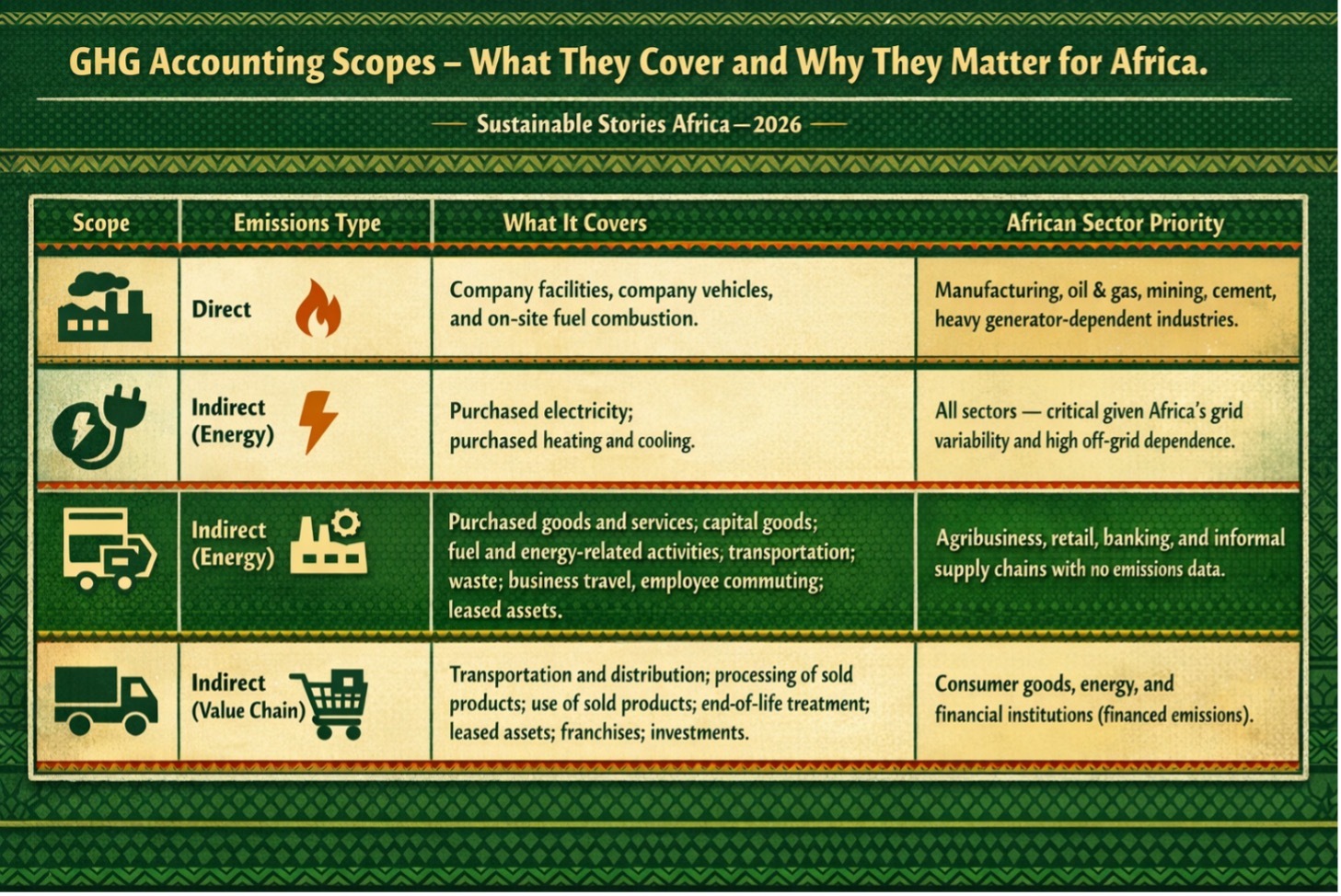
For Africa, the upstream-downstream split within Scope 3 is especially important. Upstream emissions expose weaknesses in informal supply chains, where many suppliers still lack emissions data and credible GHG baselines.
Downstream emissions, particularly financed emissions under Category 15, are often the most material Scope 3 source for African financial institutions because they cover loans, equity holdings and project finance tied to carbon-intensive activity.
That pressure is growing. The African Development Bank requires borrowers to estimate project-level gross GHG emissions, while the PCAF standard gives banks a recognised framework for measuring financed emissions linked to those activities.
What Rigorous GHG Accounting Unlocks
Business Benefits of Complete GHG Accounting
| Benefit | Who It Serves | Impact in the African Context |
|---|---|---|
| DFI capital access | Banks, corporates, infrastructure developers | AfDB, IFC, and DFIs require GHG estimates for project financing approvals |
| Supply chain retention | Manufacturers, Agri-exporters | EU CBAM and CSRD require African exporters to provide Scope 3 data to EU buyers |
| Investor credibility | Listed companies, bond issuers | ISSB-aligned investors screen out companies with incomplete GHG inventories |
| Cost and efficiency gains | All sectors | Emissions hotspot identification drives energy and resource efficiency |
| Regulatory compliance | All regulated entities | FRCN, CBN, SBP, SEC, and ESG rules increasingly require GHG data submissions |
For African communities, accurate GHG accounting delivers an often-overlooked benefit: accountability. When companies map their full carbon footprint, including emissions generated in their supply chains, they are simultaneously mapping environmental pressure on the communities, ecosystems, and water systems that those supply chains touch.
Four Steps to a Complete Carbon Footprint
African businesses that have never built a GHG inventory can begin with a structured, four-stage approach:
- Set your boundary – Define which entities, facilities, and activities are in scope using the GHG Protocol's operational or equity control approach. Document your organisational and operational boundaries before collecting any data
- Collect activity data for Scope 1 and 2 – Gather fuel consumption records, energy bills, fleet data, and grid electricity usage; apply country-specific emission factors for Scope 2 electricity consumption
- Map and prioritise Scope 3 categories – Identify which of the 15 upstream and downstream categories are material for your business; begin with the highest-impact categories (purchased goods, transportation, investments) using spend-based proxy data where primary supplier data is unavailable
- Calculate in CO₂e, disclose, and set targets – Convert all activity data to CO₂e using IPCC-aligned global warming potential values; disclose in line with IFRS S2, CBN SBP, or GRI standards; establish a baseline year and reduction target aligned with science-based trajectories.
For financial institutions, the PCAF Global GHG Accounting Standard provides a parallel, asset-class-specific methodology for calculating financed emissions, the single most important Scope 3 category for African banks and development finance providers.
Path Forward
Africa's carbon footprint accounting journey must begin now, not when regulations tighten further, but because incomplete emissions inventories represent both a risk and a missed competitive opportunity.
Businesses that build complete, methodology-aligned GHG accounting systems today access capital, supply chains, and markets that will otherwise be closed to them.
Governments and regulators must prioritise the publication of country-specific emission factors and sector guidance that give African companies the technical inputs a credible GHG inventory requires.