The African Development Bank has backed an $11.3 million facility to finance off-grid renewable energy in fragile African states.
It matters because the facility tests a new approach to accelerating climate finance into mini grids where conventional capital is scarce.
For underserved communities, the move could turn corporate sustainability spending into first-time access to electricity, jobs and local economic resilience.
A small facility with an outsized ambition
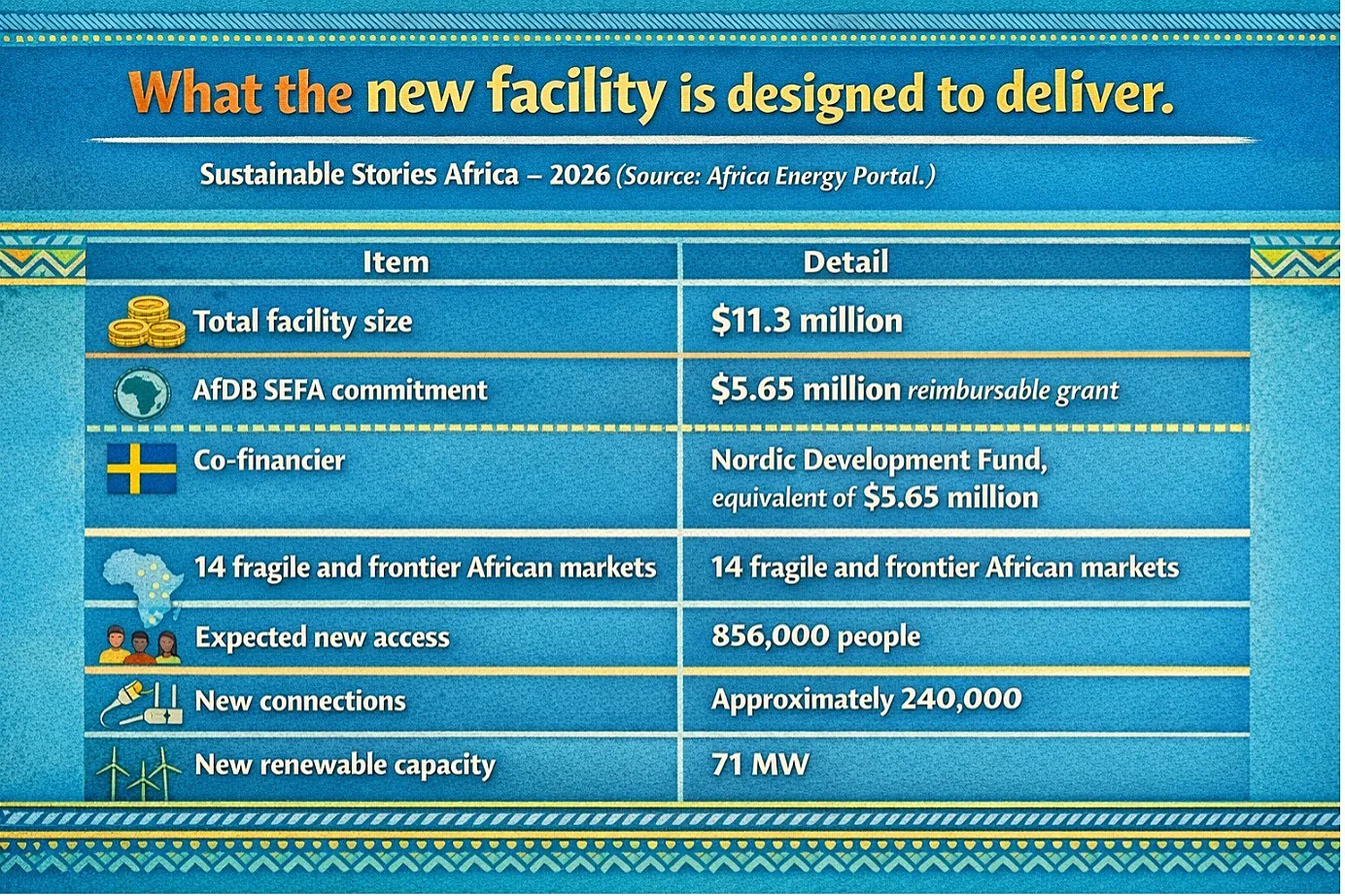
The African Development Bank Group has approved a $5.65 million reimbursable grant from its Sustainable Energy Fund for Africa to pilot the Peace Renewable Energy Certificate Aggregation Facility, a new climate-finance instrument designed to support mini-grids in some of Africa’s most fragile and energy-poor countries.
With an equivalent $5.65 million commitment from the Nordic Development Fund, the total facility reaches $11.3 million. Camco Clean Energy and Energy Peace Partners are tasked with managing the grant.
What makes the structure notable is not just the money, but the mechanism. The facility will use renewable energy certificates from small-scale mini-grid projects as a funding tool, allowing developers in hard-to-finance markets to receive upfront cash in exchange for future certificate revenues.
The certificates will then be sold to global corporate buyers looking to direct sustainability spending toward projects with social and environmental impact.
The pilot targets 14 frontier markets:
- Burundi
- Central African Republic
- Chad
- The Democratic Republic of Congo
- Ethiopia
- Liberia
- Mali
- Niger
- Nigeria
- Sierra Leone
- Somalia
- South Sudan
- Sudan
- Uganda.
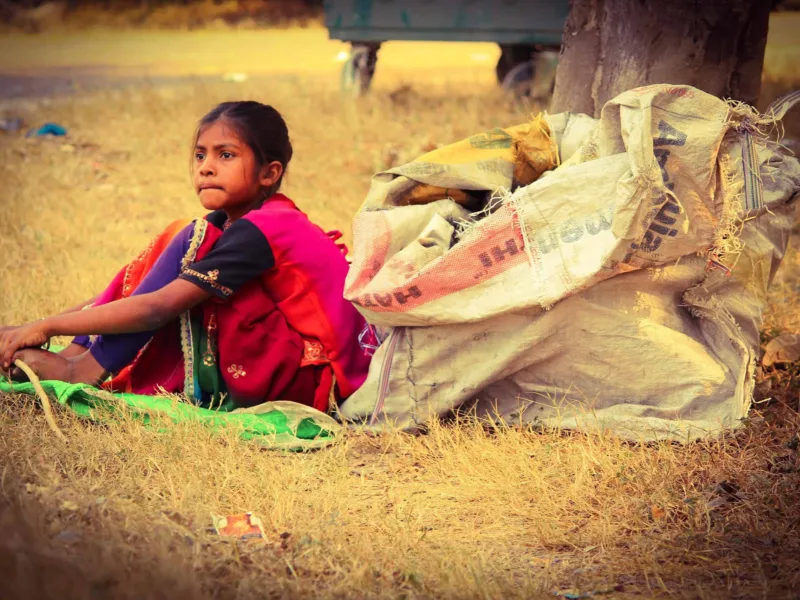
The Bank says the facility is expected to provide first-time reliable access to electricity to about 856,000 people, roughly half of them women, through approximately 240,000 new connections and 71 megawatts of renewable energy capacity.
Why this matters far beyond one transaction
Africa still has the world’s largest electricity access gap. The International Energy Agency said in October 2025 that nearly 600 million people on the continent still live without electricity, with progress falling behind both African and global targets.
The World Bank and AfDB’s Mission 300 initiative aims to connect 300 million Africans to electricity by 2030, with the World Bank supporting 250 million connections and AfDB another 50 million.
That is why this deal matters. In fragile and conflict-affected states, the problem is rarely just technology. Solar mini grids already work.
The real bottleneck is finance:
- Currency risk
- Weak balance sheets
- Limited long-term debt
- High perceived fragility.
This facility is trying to solve part of that problem by converting environmental attributes into bankable cash flows. In simple terms, it is an attempt to make corporate climate demand work harder for communities that are usually last in line for capital.
There is also a wider policy signal here. AfDB’s 2024 SEFA annual report said the fund had reached record levels of approvals and that SEFA-backed work to date has helped create more than 3 million new electricity connections.
The new pilot builds on that role by testing a financing structure that could be replicated in other underserved markets if it performs.
What success could unlock for African markets
If the model works, the gain compounds that of a single off-grid portfolio. It could show that climate finance can be structured to reach the hardest places, not just the easiest ones.
- For households, that means lighting, phone charging, refrigeration, cleaner livelihoods and longer business hours.
- For clinics and schools, it means more reliable basic services.
- For local economies, it can mean small enterprises that no longer operate entirely around diesel, darkness or uncertainty.
- For investors and policymakers, the upside is equally practical.
A credible demonstration could help prove that small mini-grid projects in fragile markets are not inherently unfinanceable; they are often mismatched with traditional capital structures.
If certificate-backed finance can lower that barrier, it may create a new route for corporate buyers, development financiers and local energy firms to work together more effectively.
The Africa Energy Portal report explicitly frames the instrument as aligned with Mission 300, linking a niche innovation to a continental electrification goal.
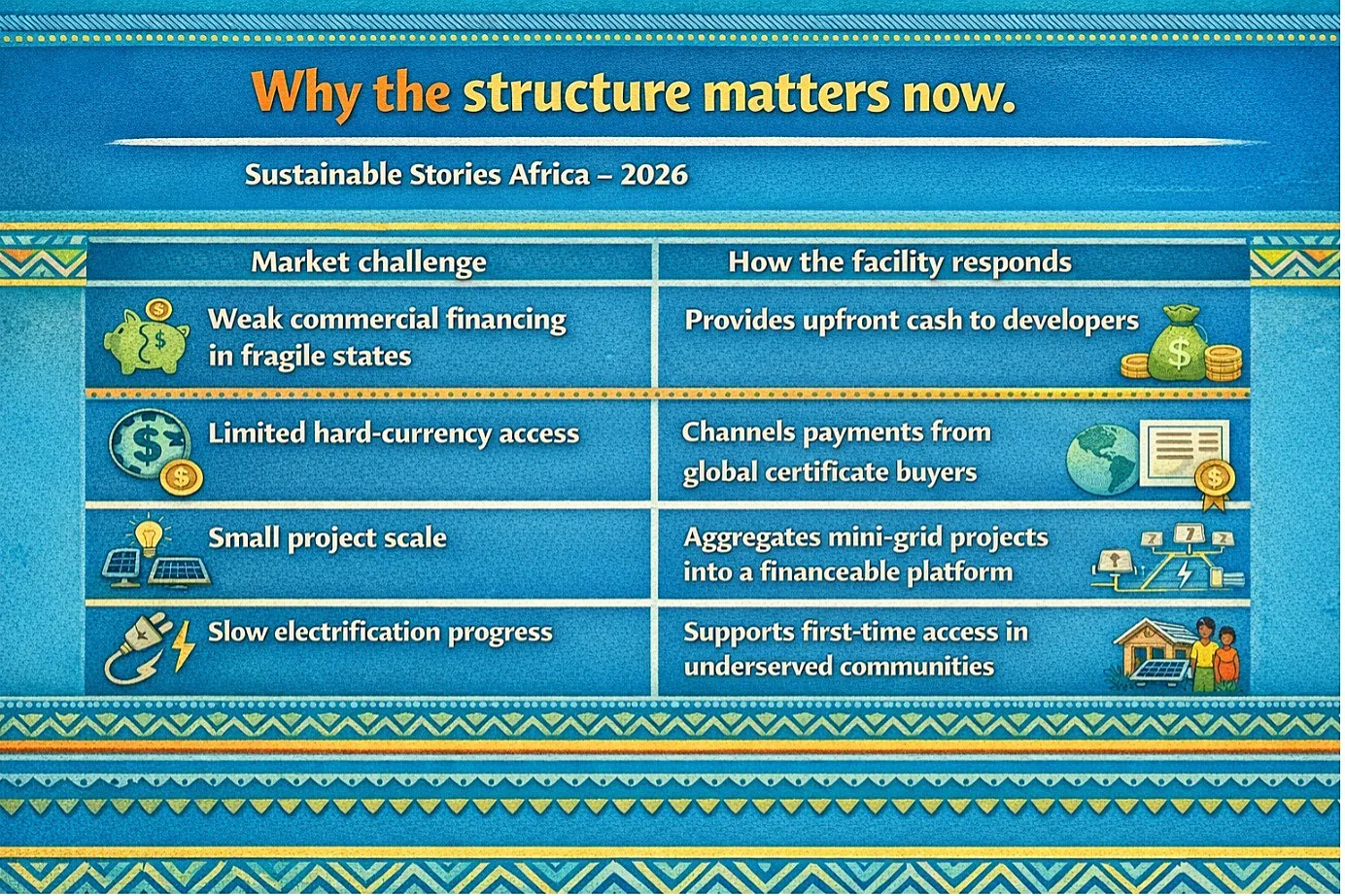
The structure does not eliminate execution risk, but it does try to align finance with where unmet demand is greatest.
The next test is execution, not announcement
The hardest part starts now. The promise of the facility will depend on whether projects are deployed on time, whether certificate demand from corporate buyers proves durable, and whether developers in fragile markets can translate this capital into reliable connections at scale.
Policymakers will also need to do their part. Stronger mini-grid regulation, currency-risk solutions and local market coordination remain essential if innovative facilities are to move from pilot stage to system-level impact.
The AfDB-backed Electricity Regulatory Index report argues that stronger regulation is necessary to meet access and transition goals.
Still, the direction is important. Off-grid power is no longer a side story in Africa’s energy future; it is a core part of how the continent closes an access gap that central grids alone cannot solve quickly enough.
This facility is modest in size, but it speaks to a bigger truth: solving Africa’s electricity challenge will require not only more money, but smarter money.
Path Forward – Scale Smart Capital for Energy Access
The immediate priority is delivery: get projects financed, connections built and certify revenues flowing in the countries where access gaps are deepest. If the pilot performs, it could widen the pool of capital available to mini grids in fragile markets.
For African markets, the broader promise is clear: combine regulatory reform, blended finance and innovative demand signals to turn off-grid energy from a stopgap into a durable pillar of inclusive growth.
Culled From: African Development Bank Backs $11.3 Million Off-Grid Energy Facility