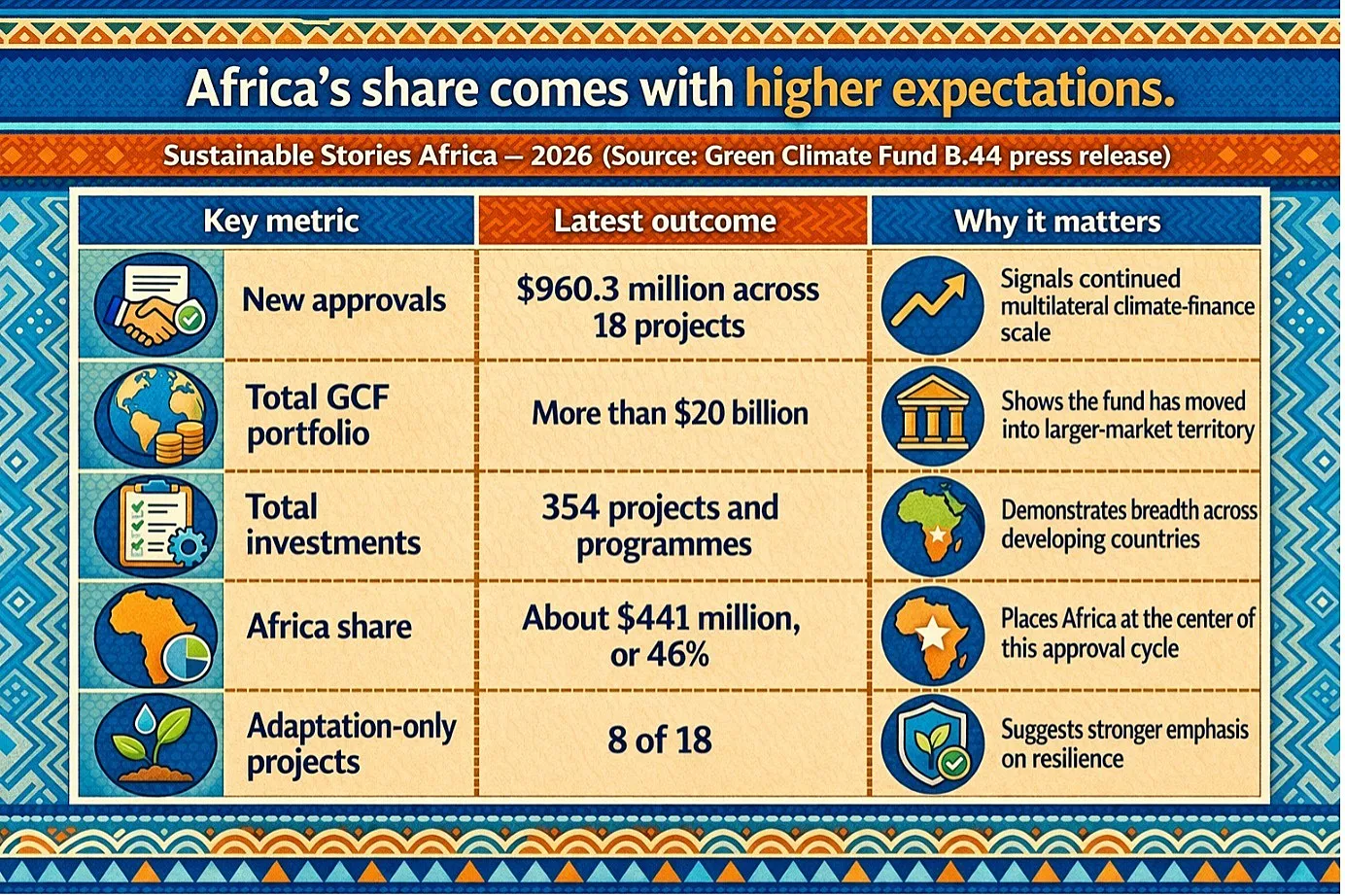
The Green Climate Fund has approved $960.3 million for 18 new climate projects, increasing its portfolio to over $20 billion across 354 investments.
The move matters now because Africa captured nearly half of the new funding, while new regional offices promise faster delivery.
For vulnerable communities, financiers and governments, the signal is hard to miss: scale is rising, but speed, local access and execution now matter just as much.
A bigger fund, closer to the frontline
The Green Climate Fund has approved $960.3 million in new climate finance for 18 projects at its 44th Board meeting in Songdo, South Korea, held from March 25 to 28, lifting its total portfolio past $20 billion across 354 projects and programmes.
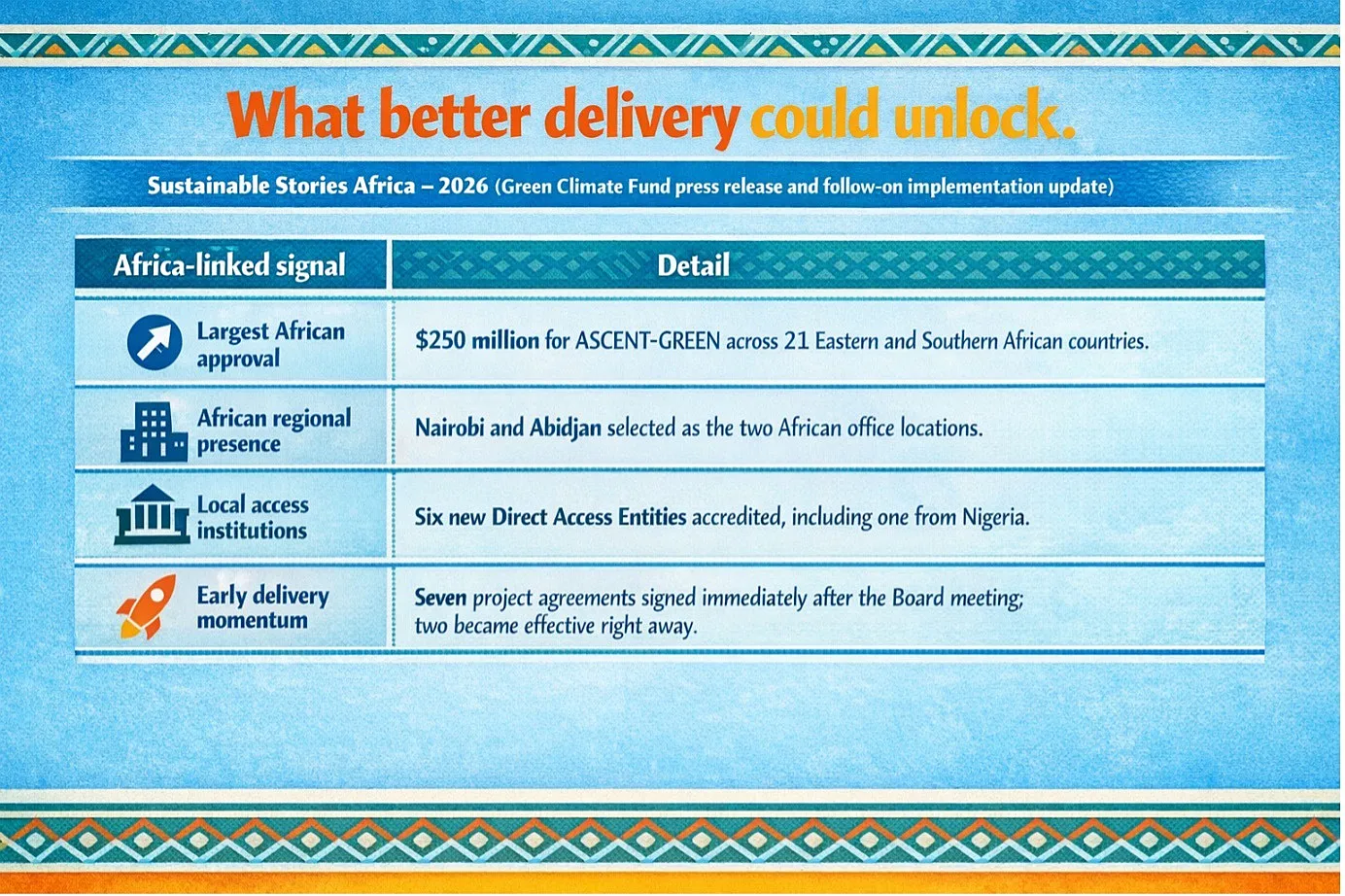
The Board also selected host cities for new regional offices, including Nairobi and Abidjan for Africa, in a move designed to bring the fund physically closer to the countries and institutions it supports.
That matters beyond the headline number. Approximately $441 million, or 46% of the latest approvals, went to seven African projects, giving the continent the biggest regional share of the new package.
For African markets that have long argued that climate finance is too slow, too distant and too hard to access, the latest decision reads like a shift from promise to presence.
Africa’s share comes with higher expectations
The package was not just large; it was also tilted toward resilience. Eight of the 18 newly approved projects are adaptation-only, and adaptation accounts for 56% of the approvals in grant-equivalent terms.
The Board also accredited 10 new entities, six of them Direct Access Entities, including one from Nigeria, extending the network through which countries can access capital more directly. GCF says it now works through 168 partner agencies in more than 130 countries.
One reason the African allocation stands out is where the money is going. The largest single project approved at the meeting was the World Bank-backed ASCENT-GREEN, a $250 million programme to support resilient energy access across 21 countries in Eastern and Southern Africa.
That fits squarely into a continent-wide reality: nearly 600 million people in Sub-Saharan Africa still live without electricity, while Mission 300 aims to connect 300 million people by 2030.
The approvals also widened the map of who gets seen. It backed the first-ever single-country investments in Chad, Jamaica and The Bahamas, signalling a stronger push toward countries that have often sat outside the main flow of large-scale climate capital.
That is important for credibility: climate finance cannot keep talking about vulnerability while repeatedly funding only the easiest markets to structure.
What better delivery could unlock
If the money moves quickly, the upside is tangible. It can mean stronger early-warning systems, more resilient cities, climate-smart finance for farmers and small businesses, and cleaner, more reliable energy for communities that still live at the edge of blackout economics.
Among the approved projects are urban resilience work in Ethiopia, rural renewable-energy access in Mozambique, climate-smart financing for Kenyan MSMEs and farmers, and risk protection for Zambian smallholders.
Climate finance works best when it reduces risk for households, firms and public systems. A farmer with insurance, a trader with reliable electricity, a city with stronger drainage, or a rural clinic with stable power all sit at the meeting point of adaptation, productivity and human dignity.
Approval is not the same as impact
The hardest part starts now. Climate funds earn trust not when boards approve projects, but when capital reaches communities fast enough to matter.
GCF’s own follow-on update showed urgency: seven funded activity agreements were signed immediately after the meeting, two projects became effective, and one was expected to receive its first disbursement within days.
Six projects were also approved through a streamlined assessment route, a deliberate effort to reduce friction in the system.
That is the real call to action for African policymakers, development banks, project sponsors and private financiers: build stronger pipelines, deepen local institutional capacity, and prepare projects that can move from approval to implementation without losing months to fragmentation.
GCF Co-Chair Seyni Nafo said the Board’s decisions would “deliver climate finance at scale,” while Executive Director Mafalda Duarte described the regional expansion as a “landmark moment.”
Path Forward – Finance Must Move Faster, Closer, Fairer
The message from Songdo is clear: climate finance is growing, but delivery must become more local, more responsive and easier to access.
Regional offices, direct-access entities and faster approvals now need to translate into measurable results.
For African markets, the priority is straightforward: turn global capital into bankable local projects that strengthen energy access, resilience and institutional credibility.
The money is getting bigger; execution must now catch up.