Universities are moving sustainability education beyond theory and into real-world operational work.
That shift matters as businesses face growing pressure to measure emissions, manage transition risk and report more credibly.
For Africa, the stakes are practical: the next green economy will need skilled local talent, not just imported expertise.
Universities Turn Campuses Into Climate Talent Labs
Universities are starting to do something the climate economy urgently needs: train students for real sustainability jobs before they graduate.
Rather than teaching climate and ESG concepts only as abstract policy ideas, some institutions are turning campuses into living laboratories where students work on emissions accounting, procurement analysis, reporting systems and transition planning.
That change comes at an important moment. Companies across global markets are facing rising pressure from investors, regulators and customers to explain how they manage climate risk, measure carbon emissions and prepare for a lower-carbon future.
The demand is no longer just for sustainability ambition. It is increasingly important for practical skills.
For African markets, the lesson is especially relevant. As climate disclosure, clean energy investment and supply-chain scrutiny grow, higher education may become one of the most important places where the next generation of sustainability professionals is being formed, not later, but already.
The climate workforce is being built on campus
The strongest signal in this story is that universities are no longer sitting on the edge of the sustainability transition. They are becoming part of its labour pipeline.
A recent Climate and Capital Media article, “How universities are already building the next-gen sustainability workforce,” argues that students are increasingly being trained through practical assignments that mirror the work now expected inside companies, consultancies and financial institutions. Instead of discussing carbon accounting only in theory, students are learning how to gather institutional data, assess material issues, review supplier-related emissions and translate findings into reporting outputs that resemble real-world sustainability disclosures.
That is a meaningful shift. It suggests the sustainability workforce is no longer something employers will need to build from scratch after hiring.
That preparation is already happening, inside academic institutions that are adapting to the realities of a changing economy.
Why this matters now for business and markets
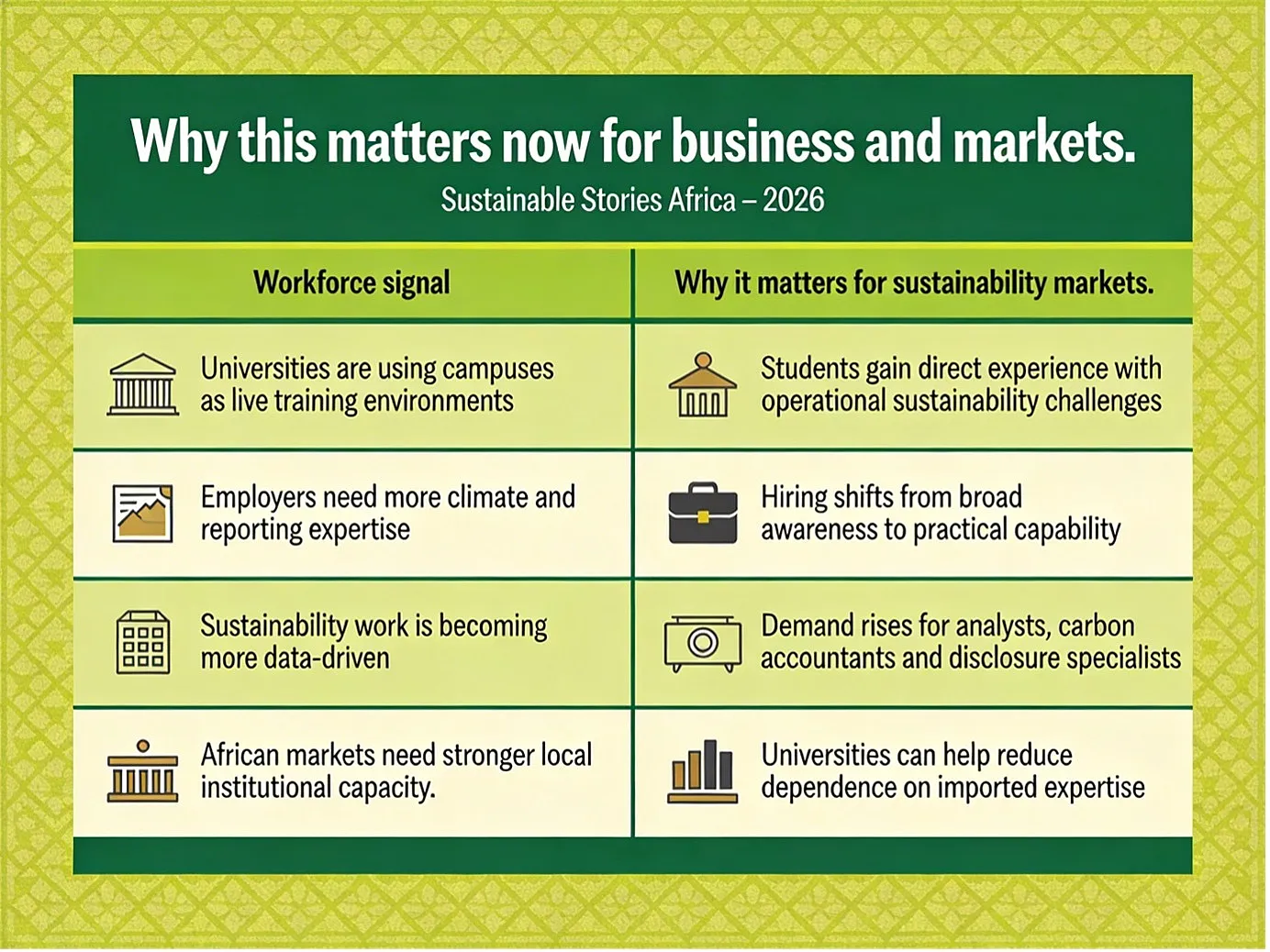
The broader labour market helps explain why this shift matters now. Employers are navigating rapid skills disruption as climate regulation, supply-chain due diligence, energy transition planning and ESG governance demands become more complex. Sustainability work is no longer peripheral.
It is becoming more operational, with businesses needing people who can handle emissions measurement, data verification, supplier engagement, risk analysis and disclosure support.
That is why university-based practical training is becoming so relevant.
When students work on campus carbon profiles, procurement systems or institutional sustainability risks, they build capabilities that map directly to emerging roles such as carbon accountants, sustainability analysts, transition planners and climate-risk advisers.
For Africa and the wider Global South, this is not a minor education story. It is a story of competitiveness tied to access to capital, readiness of disclosure and stronger domestic expertise.
The African relevance is bigger than compliance
For African economies, the implications go far beyond preparing graduates for corporate ESG roles.
As the continent tries to industrialise, expand energy access, attract investment and adapt to a tougher global trade and finance environment, talent development is becoming inseparable from climate strategy.
Without people who can manage data, verify impacts, understand standards and implement plans, transition ambitions will struggle to hold.
That is why universities matter in the transition conversation. They sit at the intersection of knowledge, labour and institutional reform.
If they modernise sustainability education around applied work rather than theory alone, they can help build a workforce better equipped for business, finance, infrastructure and clean energy.
What stronger training pipelines could unlock
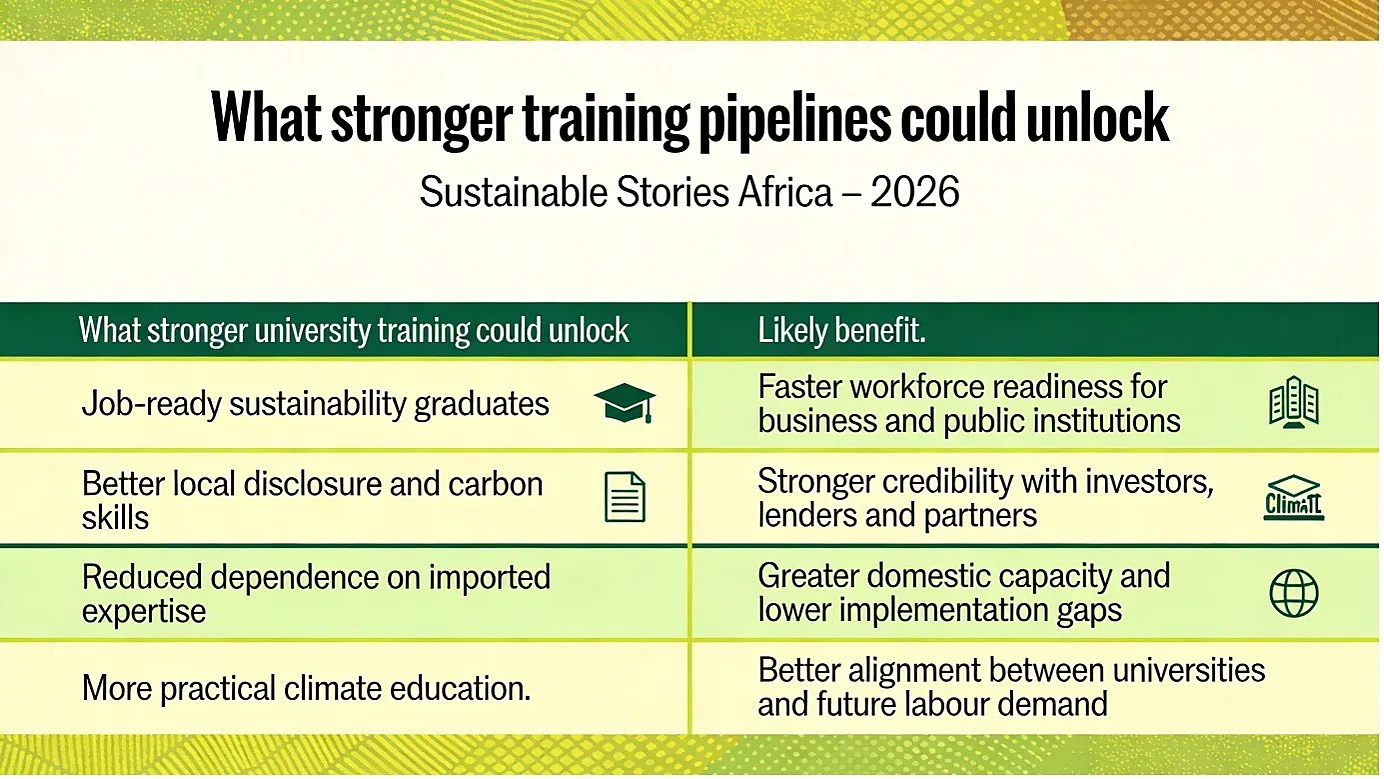
If this approach scales, the gains could be substantial.
Businesses would spend less time retraining entry-level hires. Universities would become more directly relevant to the labour market. Students would graduate with more confidence and clearer career pathways. Regulators and investors would benefit from a larger pool of professionals to support better-quality sustainability data and decision-making.
For African markets, the upside is even more strategic. Better sustainability training could help improve the quality of corporate disclosure, strengthen transition planning, deepen local advisory capacity and support the growth of green jobs in energy, agriculture, finance, infrastructure and manufacturing.
Just as important, it could make the sustainability agenda feel more tangible. Too often, ESG and climate language sounds distant, elite or externally imposed. But when universities turn sustainability into practical problem-solving, measuring waste, understanding energy use, analysing procurement systems, modelling transition choices; it becomes more rooted in everyday economic life. It starts to feel less like imported jargon and more like workforce development.
What should happen next?
The next step is not simply to create more sustainability degree titles. It is to redesign learning around real capabilities.
- Universities should deepen partnerships with companies, industry groups, investors, local governments and development institutions so students can work on actual transition-related problems.
- Coursework should increasingly include carbon accounting basics, reporting logic, climate-risk interpretation, supply-chain analysis and sustainability governance.
- Employers, in turn, should engage earlier with universities to help shape curricula around real hiring needs.
Policymakers have a role to play. If African governments want stronger green industries and more resilient economies, higher education must be treated as enabling infrastructure, rather than a side issue.
The message is urgent: sustainability skills are already a current market need, not a future one.
Path Forward – Build talent before demand overwhelms
Universities are proving that sustainability training works best when students engage with real systems, real data and real institutional challenges.
The next priority is to scale that model across more campuses, sectors and regions.
For African markets, this means linking higher education more closely to climate finance, disclosure readiness and green industrial development.
The workforce for the transition is already being formed. The opportunity now is to make sure it is large enough, local enough and practical enough to matter.