Africa’s economy is forecast to grow at 4.0 per cent in 2026, but the report argues that headline growth alone will not be enough.
The real question is whether frontier technologies can raise productivity fast enough to change how African economies grow.
From services and AI to renewables and e-government, pages 27 – 120 show a continent moving beyond technology hype.
However, they also make clear that without skills, financial discipline and sector-specific policy, innovation will remain visible rather than becoming transformative.
Productivity, Not Adoption, Is The Test
Drawing on pages 27 – 120 of the United Nations Economic Commission for Africa’s Economic Report on Africa 2026: Growth through innovation: Harnessing data and frontier technologies for Africa’s economic transformation, the message is blunt:
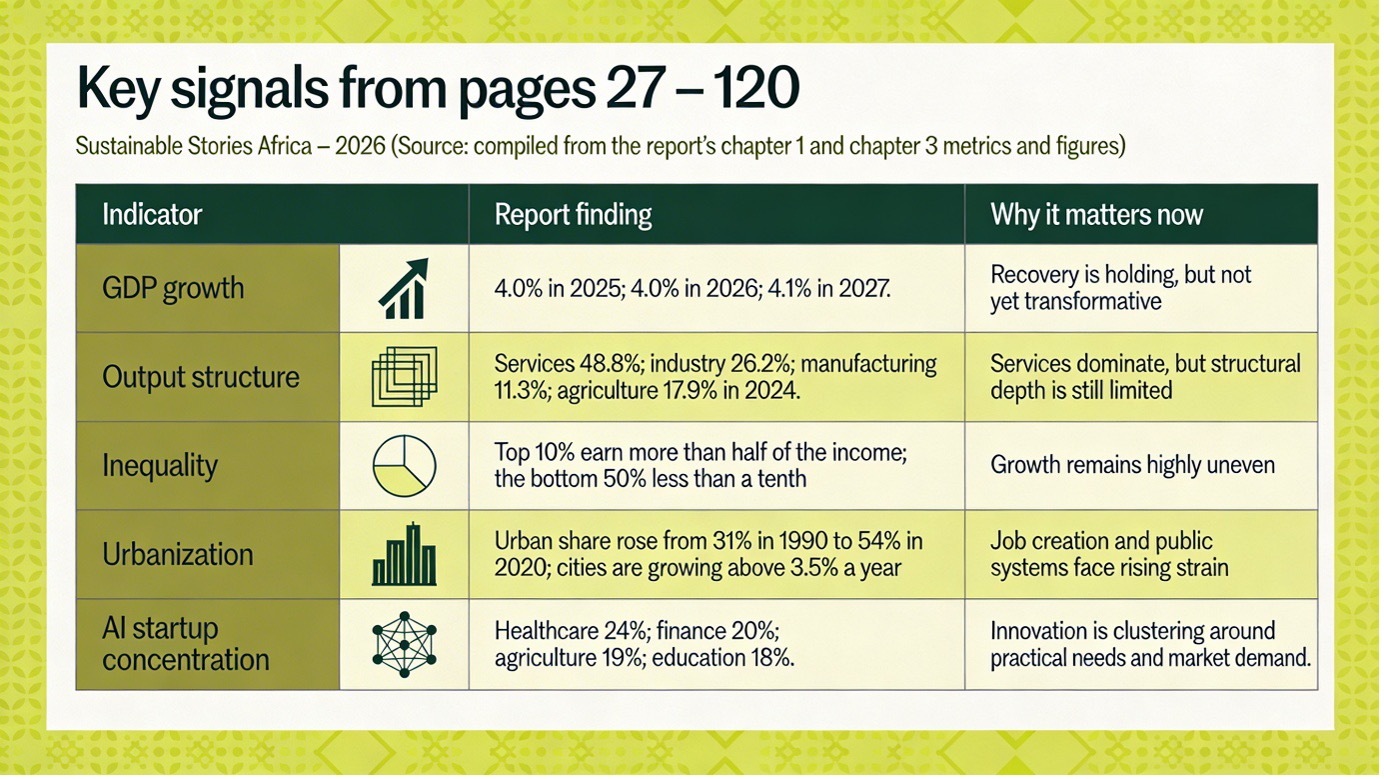
- Africa’s rebound is real, but its growth model remains under pressure. Real GDP growth is estimated at 4.0 per cent in 2025, projected to stay at 4.0% in 2026, and edge up to 4.1% in 2027.
That matters because these chapters do not treat technology as a branding exercise. They connect innovation to the continent’s toughest economic questions: how to raise productivity, how to absorb rapid urban growth, and how to create value beyond extractive or low-efficiency activity.
The social backdrop is hard to ignore: more than half of Africa’s income goes to the top 10 per cent, while the bottom 50 per cent earns less than a tenth.
Across the selected pages, the report’s evidence points in one direction. Africa will not gain more from simply using more digital tools than from making those tools productive in manufacturing, smarter in services, and practical in agriculture, public administration, and energy systems.
That is why this is not really a story about technology uptake. It is a story about economic transformation.
Growth Is Recovering, Productivity Is Not
Africa can post 4% growth and still fall short if that expansion continues to depend more on factor accumulation than on efficiency.
Chapter 2 states plainly that the continent’s growth over the past three decades has largely been input-driven.
Chapter 1 shows that services already account for nearly half of output. The tension is clear: economic activity is happening, but deep structural transformation remains limited.
Where The Report Gets Specific
One of the report’s clearest insights is that innovation does not automatically produce growth.
Conventional measures focused mainly on inputs are weaker guides than the Frontier Technology Readiness Index, which better captures whether economies are actually prepared to absorb and use new technologies.
The chapter also warns that financial deepening often still flows into short-horizon, low-learning sectors rather than productive upgrading.
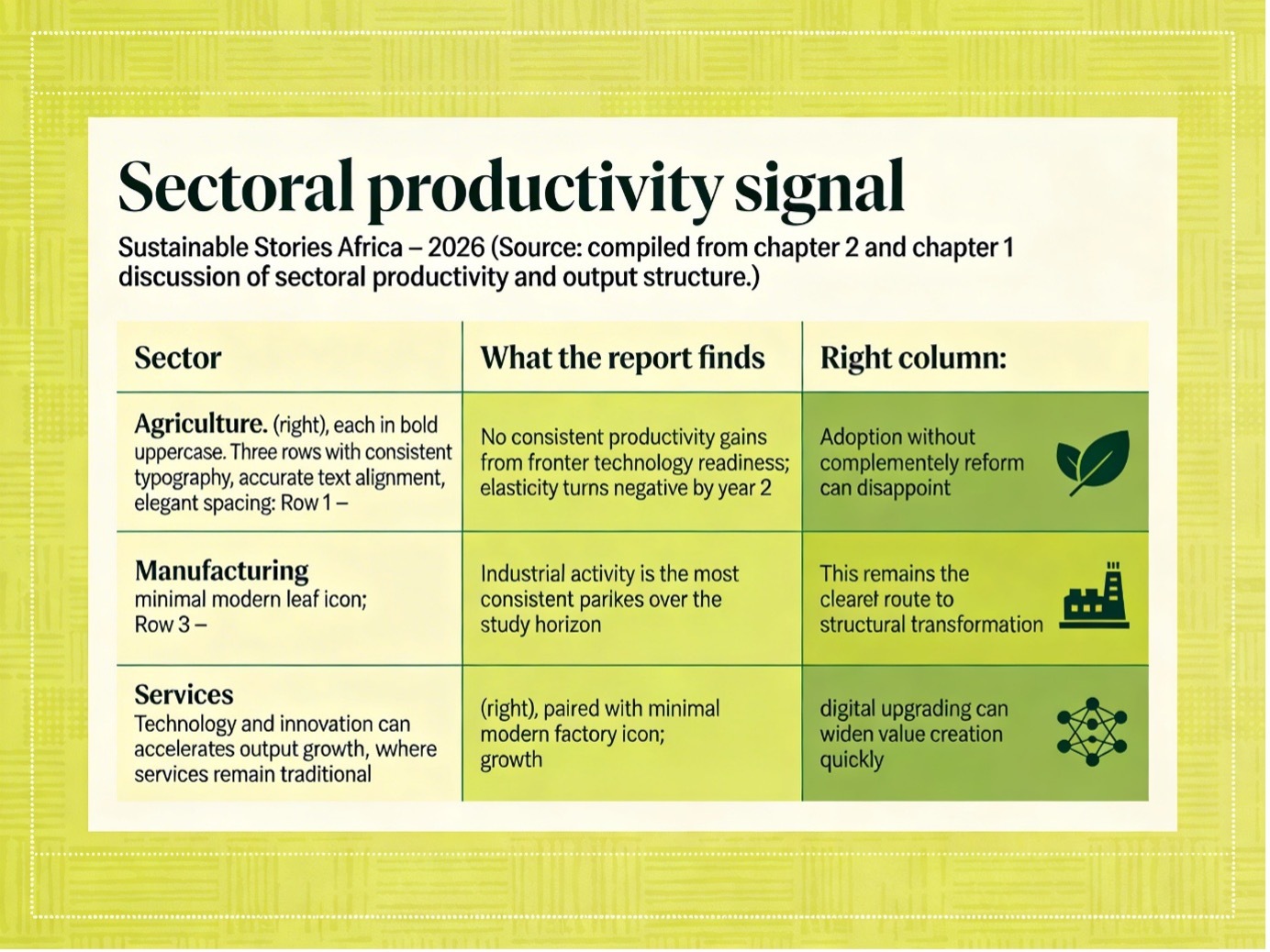
That is why sector detail matters. Agriculture shows no consistent productivity gains from frontier technology readiness, with elasticity turning negative by 0.17 percentage points in year two.
Manufacturing and services perform differently, showing stronger gains where firms can scale, learn, cluster, and connect to logistics, finance, and markets.
The AI chapter strengthens that argument. It says Africa’s AI market is expected to expand rapidly through 2030, with healthcare accounting for 24% of AI startups, finance 20%, agriculture 19%, and education 18%.
Public infrastructure also matters: Rwanda’s IremboGov shows how usable digitisation can process millions of applications, save time, and create jobs.
What A Better Growth Model Looks Like
The strongest parts of the report are the case studies, which show that innovation is working in the real economy. Morocco’s renewable energy strategy is not presented as climate symbolism.
It is framed as an industrial transformation. The country is aiming for 52% renewable energy by 2030 and 70% by 2050, backed by major investments in solar, wind, grid, and storage assets. By 2023, wind and solar together made up nearly 20% of Morocco’s electricity mix.
Namibia’s green hydrogen programme goes even further. The report estimates the sector could add $4.1 billion to GDP by 2030 and create 280,000 jobs, rising to an additional $6.1 billion and 600,000 jobs by 2040.
What makes that important is not just scale. It is the design: power, industry, agriculture, transport, manufacturing, ports, and infrastructure are being integrated into one industrial ecosystem rather than treated as isolated projects.
What Should Be Done Now
The policy direction emerging from these pages is disciplined rather than flashy.
- First, Africa needs stronger skills and industrial capability, because those are the channels through which frontier technologies turn into sustained growth.
- Second, ICT expansion has to support productive use, not just consumer access. Third, financial systems must be reoriented to fund technology adoption, upgrading, and firm learning rather than short-term circulation.
The bigger implication is that policymakers, regulators, investors, and development financiers should stop treating innovation as a single-sector conversation.
- Agriculture needs productivity-focused reform that takes climate risk seriously.
- Manufacturing needs clusters, corridors, and reliable energy.
- Services need digital systems that cut friction and expand inclusion.
In other words, Africa does not need more technology theatre. It needs more technology that changes output, incomes, and resilience.
Path Forward – Build Capability Before Chasing Continental Scale
Africa does not need less ambition. It needs better sequencing: productive skills, reliable energy and digital infrastructure, targeted finance, and institutions that help firms absorb technology rather than merely import it.
When innovation solves real African problems, it stops being a trend.
Rwanda’s public platforms, Morocco’s renewables push, and Namibia’s green industrial planning show what transformation looks like when policy and productivity finally meet.