COP30 in Belém has sharpened a global shift from climate pledges to delivery, with new signals on adaptation finance, fossil-fuel transition and the credibility of disclosure.
For Africa, the stakes are practical as well as political: investor confidence, financial access and corporate competitiveness now depend increasingly on measurable outcomes, not sustainability language alone.
From summit signals to boardroom strategy
COP30 has left African markets with a clearer message than many previous climate summits: implementation is no longer optional. The uploaded paper, COP30 and the Future of Corporate Sustainability in Africa, by Onyekwere, Chika Ugochi, frames the Belém outcome as a turning point, arguing that the “Belém Package” delivered 29 decisions that shift the global conversation from ambition to execution.
That matters for Africa because climate diplomacy is now feeding directly into market expectations. Companies are being judged not only by what they promise, but by what they can measure, disclose and assure.
For Nigeria and other emerging markets, this is no longer a niche ESG issue. It is becoming a question of access to finance, resilience planning and long-term corporate relevance.
Onyekwere’s central argument is that corporate sustainability in Africa must move beyond descriptive narratives into data-driven, globally aligned disclosures.
That line, highlighted visually on page 4 of the uploaded PDF, is perhaps the most important takeaway for business leaders trying to interpret what COP30 means in practice.
COP30’s real message is being delivered
A summit only matters if its outcomes change behaviour. COP30 appears to have done exactly that.
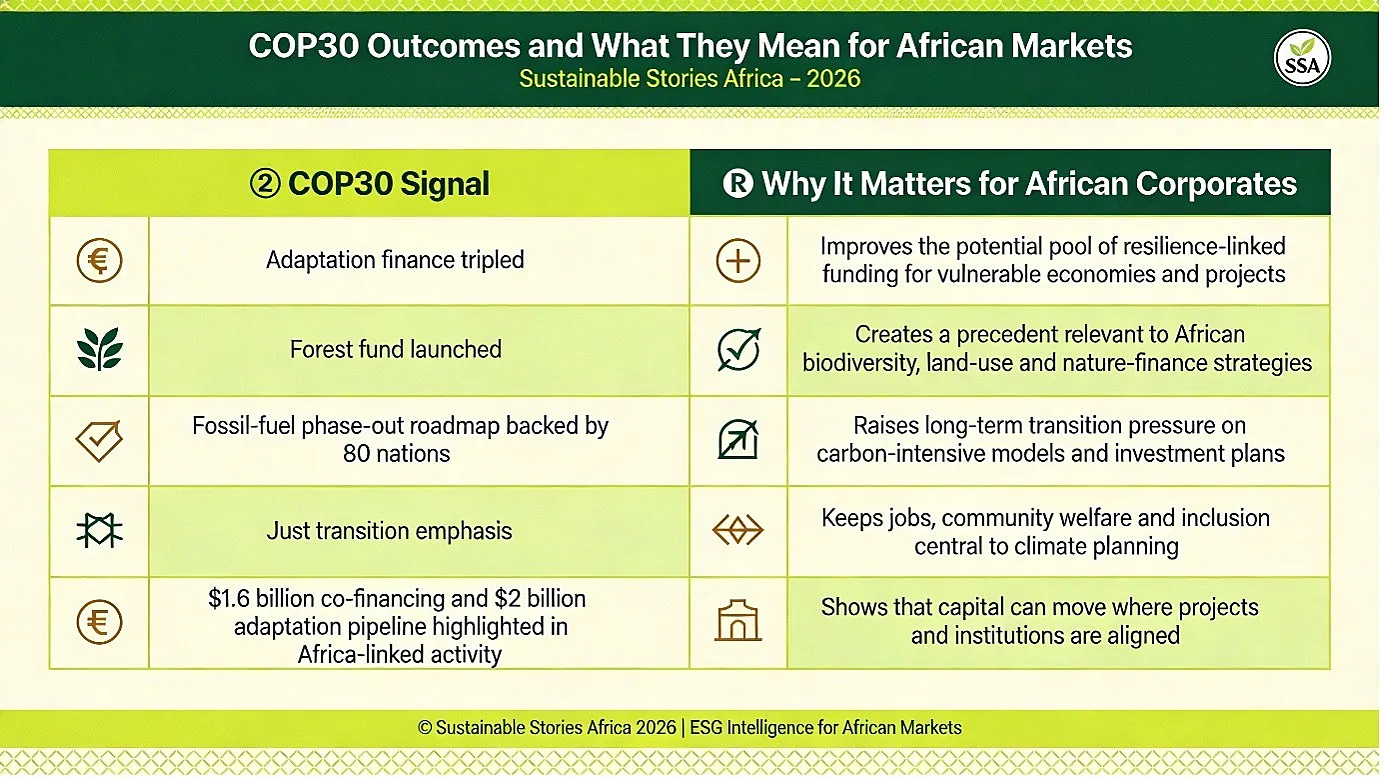
According to the uploaded brief, the most notable developments included a tripling of adaptation finance, the launch of a forest fund, a roadmap for a fossil-fuel phase-out supported by 80 nations, and a stronger focus on just transition, aimed at ensuring workers, communities and vulnerable groups are not left behind.
On page 3, the paper also notes that Africa-focused side events helped mobilise $1.6 billion in co-financing and build a $2 billion adaptation pipeline, with emphasis on conflict-affected regions.
That mix of decisions matters because it connects capital, transition policy and social inclusion into a single frame.
For African companies, especially in energy, agriculture, infrastructure and finance, the signal is clear: the climate agenda is now more tightly tied to project bankability, investor trust and evidence-backed reporting.
The urgency is not abstract. Africa remains highly exposed to climate shocks, yet many firms across the continent still approach sustainability as a narrative exercise rather than an operational one. COP30 suggests that the era is ending.
Why Africa and Nigeria cannot treat this as distant diplomacy
The strongest value of the uploaded paper is that it translates summit language into corporate implications.
On page 5, Onyekwere identifies three immediate implications for Africa and Nigeria:
- Financial access
- Investor expectations
- Strategic positioning.
The insights further note that:
- First, firms in energy, agriculture and infrastructure may be able to leverage new adaptation-finance streams.
- Second, ESG disclosures must increasingly include measurable outcomes if companies want to attract capital and build trust.
- Third, Nigeria has an opportunity to position itself as a hub for climate finance and innovation if local corporate strategies align more seriously with global commitments.
This is where the story becomes especially relevant for African boardrooms. Sustainability is often treated as a compliance burden imported from Europe or global lenders.
However, the more useful reading is commercial. Companies that can explain their climate exposure, adaptation needs, governance structures and emissions trajectory are more likely to win investor confidence than those relying on polished but vague sustainability language.
The visual on page 2 of the PDF captures the shift: COP30’s outcomes are presented not merely as diplomatic milestones, but as developments with “profound implications for corporate sustainability, investor confidence, and long-term competitiveness.”
Those phrasings matter. Competitiveness is the bridge between climate policy and business reality.
The paper’s other important contribution comes on page 6, where it links COP30 to the UK Financial Reporting Council’s release of ISSA (UK) 5000 on November 12, 2025.
The argument is not that Africa should copy UK practice, but that global markets are raising the bar for credibility, consistency and investor-readiness in sustainability reporting.
Aligning with assurance and disclosure frameworks such as ISSA, ISSB, GRI and CSRD is therefore framed as a competitiveness issue, not just a reporting exercise.
What stronger sustainability systems could unlock
There is a constructive opportunity here if African companies respond early.
Better reporting can improve access to capital by helping firms present transition and resilience plans in ways that investors can understand and compare. Better climate governance can also improve internal decision-making, because companies are forced to connect sustainability promises to risk management, spending choices and operational performance.
In practical terms, this could mean energy companies presenting clearer transition pathways; agribusinesses quantifying climate risks and adaptation needs; infrastructure developers designing projects that are both resilient and finance-ready; and financial institutions building climate considerations into credit, portfolio and disclosure systems.
For citizens and communities, the upside is equally tangible. A climate strategy grounded in data and just-transition thinking is more likely to protect jobs, strengthen resilience and direct investment into projects with real economic and social value.
A weaker approach, by contrast, risks leaving Africa with ambitious rhetoric but limited delivery.
What should happen next
The article points toward a pragmatic agenda.
- First, companies need to treat sustainability as a board-level strategy issue rather than an annual report appendix. That means linking targets to capital allocation, operational plans and decision-useful metrics.
- Second, regulators and exchanges across African markets should continue encouraging disclosures that reward measurable performance rather than generic claims.
- Third, financiers and development institutions need to help build pipelines that can absorb rising adaptation finance and translate global commitments into local projects.
Assurance is also becoming unavoidable. The lesson from page 6 is that credibility increasingly depends on systems that can withstand scrutiny.
Companies do not need to become perfect overnight, but they do need a progression path: stronger data controls, more transparent assumptions, better scope coverage and gradual movement toward external assurance.
Governments, too, have a role in making the shift workable. If climate finance is to scale, project pipelines must be structured.
If the transition is to be real, workers and vulnerable groups must be part of the design. And if African markets want to position themselves competitively, they need local institutions that can translate global rules into investable practice.
Path Forward – Build trust before capital shifts
COP30 has widened the gap between sustainability language and sustainability proof. African firms now need clearer data, stronger assurance and more credible transition strategies to stay competitive.
The opportunity remains substantial: more adaptation finance, better investor confidence and stronger market positioning.
However, the winners will be companies that turn global climate commitments into measurable local execution.