
Climate promises are everywhere, but their meanings are not equal. From “carbon neutral” to “climate positive”, the labels often rest on very different levels of emissions cuts, offsets and verification.
That matters for African firms and investors now, because capital markets are evolving from broad ESG language to harder questions about evidence, boundaries and execution.
When climate language outruns reality
The climate economy has entered a more exacting phase. What once passed as a bold sustainability headline is now being tested against deeper questions: Were emissions cut, or merely offset? Were Scope 3 emissions included? Was the claim independently verified? And does the label describe real operational change, or a polished communications strategy?
That shift matters well beyond Europe and North America. African companies, banks, manufacturers and exporters are being drawn into a disclosure environment, in which environmental claims increasingly affect access to capital, procurement credibility, trade relationships and reputational resilience.
In that setting, the difference between “carbon neutral”, “net zero”, and “climate positive” is no longer semantic. It is strategic.
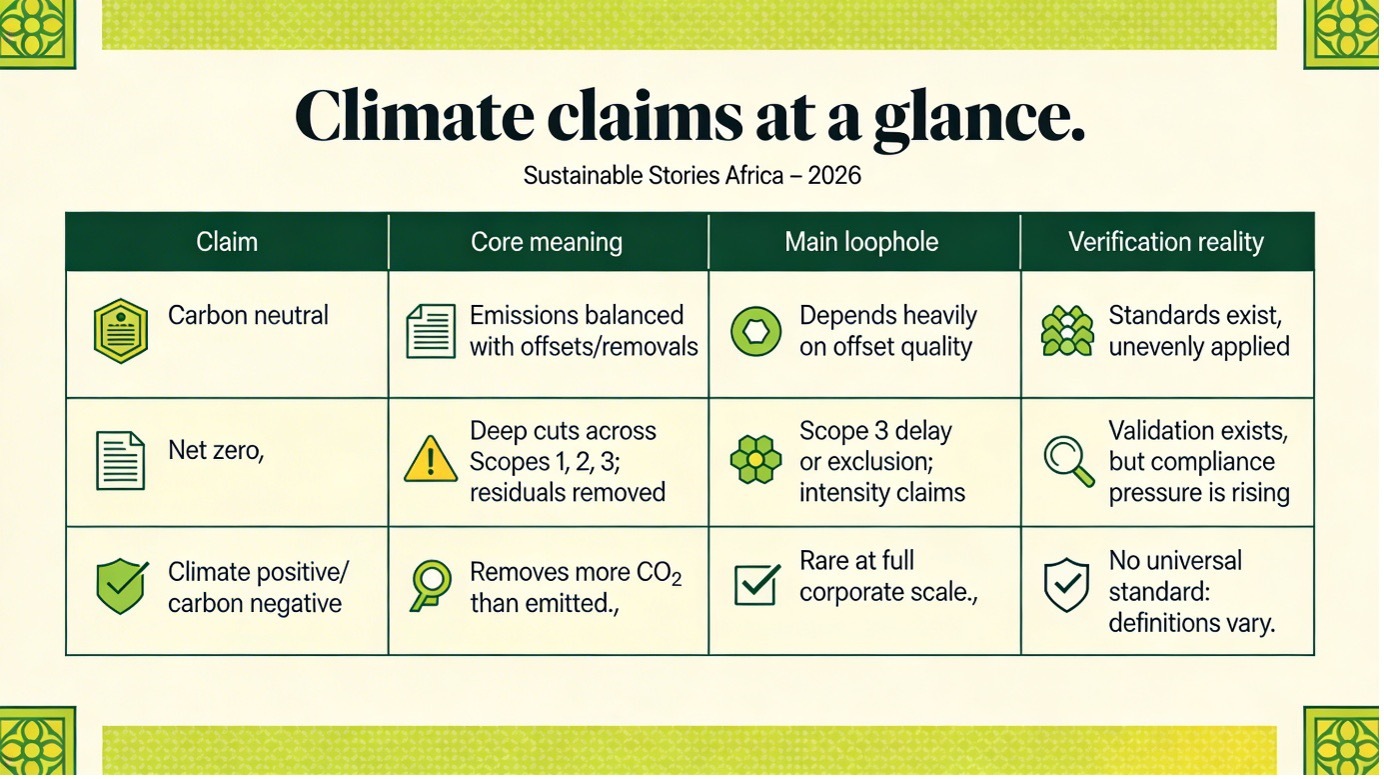
A breakdown captures the problem clearly: the label may be marketing, but the credibility lies in boundaries, assumptions and verification. That is the real story now.
Three labels, three very different burdens
The most immediate insight is simple: not all climate claims carry the same level of ambition or integrity.
“Carbon neutral” usually means that emissions produced equal the offsets or removals.
It remains widely used across sectors, including airlines, banks and consumer brands.
However, its weakness is equally clear. The claim often relies heavily on offset quality, and poorly verified projects can quickly erode credibility.
“Net zero” carries a much stricter implication. It points to deep absolute emissions cuts across Scope 1, 2 and 3, with only a small residual share left to be permanently removed.
However, even here, loopholes persist. Intensity targets can create the appearance of progress without sufficient absolute reduction, while Scope 3 emissions are often delayed, narrowed or excluded.
“Climate positive” or “carbon negative” sounds strongest of all because it suggests removing more carbon dioxide than is emitted.
However, in practice, very few companies can credibly make that claim at full value-chain scale. The label remains aspirational more often than operational.
Why the detail now matters in African and emerging markets
This distinction matters because sustainability reporting is moving away from general pledges toward more auditable claims. Investors, regulators and counterparties increasingly want to know how a target was set, what emissions boundary it covers, what assumptions underpin it, and who verified it.
The graphic’s breakdown also highlights a verification challenge. For carbon-neutral claims, standards exist but are inconsistently applied. For net-zero plans, third-party validation frameworks such as SBTi exist, but credibility can still weaken when deadlines are missed or value-chain emissions are inadequately addressed. The image notes that 239 commitments were removed in 2024 for missing deadlines, underscoring how scrutiny is intensifying. For climate-positive claims, definitions vary widely and no universal standard has yet settled the field.
That matters for African businesses in particular because many operate in value chains where disclosure expectations are imported through lenders, multinational buyers and export rules rather than domestic regulation alone. A food producer, telecoms group, bank or industrial company may find that the real test of its climate language comes from financiers, assurance providers, procurement teams or international reporting partners.
What stronger integrity could unlock
A more disciplined climate-claims culture would do more than prevent greenwashing.
It could help credible African firms differentiate themselves in crowded markets, improve trust with investors and regulators, and support access to lower-cost capital over time.
It would also sharpen internal decision-making. Once companies move beyond slogans, they are pushed toward better emissions data, stronger board oversight, clearer transition planning and more realistic capital allocation.
That benefits communities too. A company that measured its actual emissions reduction is more likely to invest in energy efficiency, cleaner logistics, renewable power, supplier engagement and resilient operating systems than one focused mainly on reputational optics.
In other words, better labels do not solve the climate problem. However, better discipline around labels can push companies toward the real work.
What companies, regulators, and markets should do next
The practical response is not to ban ambition. It is to raise the standard of proof.
- First, companies should separate claims based on actual emissions reduction from those based mainly on offsets.
- Second, net-zero pathways should clearly disclose whether Scope 3 emissions are included, when they will be addressed, and what portion of the target depends on permanent removals rather than temporary balancing measures.
- Third, boards and sustainability teams should treat verification as a governance function, not a communications add-on.
Regulators and exchanges in African markets also have a role. They do not need to invent an entirely new language, but they can encourage clearer definitions for claims, more consistent disclosure templates and stronger assurance expectations.
Financiers can reinforce that shift by asking harder questions before rewarding broad sustainability branding.
The underlying message is straightforward: climate language should become more specific as climate risk becomes more material.
Path Forward – Make claims earn trust
The priority now is clarity. Companies should define their claims precisely, disclose boundaries openly and align public statements with measurable transition plans.
For African markets, the opportunity is to build credibility early: stronger verification, better data and fewer vague promises.
In a tougher disclosure era, trust will increasingly belong to firms that can prove what they say.