Climate loss and damage have long been politically charged but financially hard to pin down. A new paper in Nature tries to change that by linking specific emissions to monetised damages across time and geography.
For African and other Global South economies, that matters because climate harm is no longer only a moral argument.
It is increasingly becoming a measurable balance-sheet issue for states, firms and high emitters.
Climate Debts Are Becoming Countable
A new Nature paper, “Quantifying climate loss and damage consistent with a social cost of carbon,” by Marshall Burke, Mustafa Zahid, Noah S. Diffenbaugh and Solomon Hsiang, offers one of the clearest attempts yet to price the economic harm caused by specific carbon emissions.
Published on 26 March 2026, the study develops a framework that links past and present emissions to discounted, location-specific damages over time.
That matters well beyond academic debate. The authors argue that loss and damage can be treated as the net present value of climate-related impacts attributable to greenhouse gas emissions, net of adaptation.
In practical terms, that helps connect climate science, finance, liability and compensation within a single accounting structure.
For African markets, the stakes are immediate. The paper’s damage maps show heavy burdens concentrated across many tropical and mid-latitude economies.
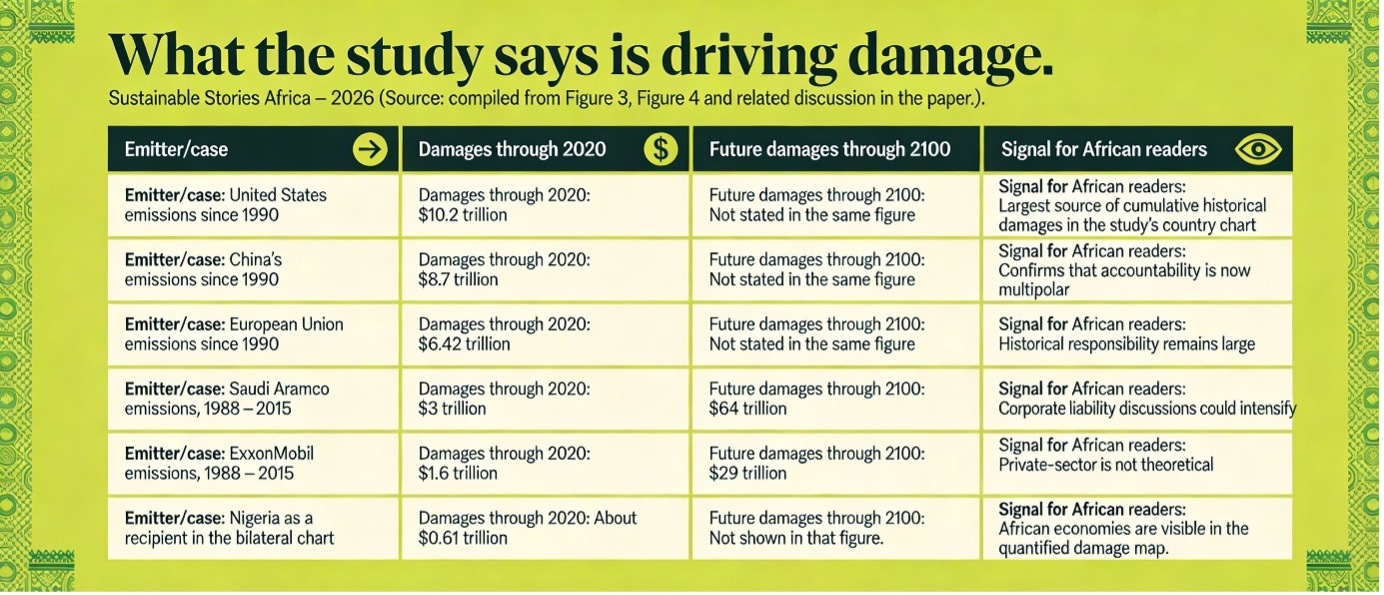
Its bilateral attribution chart lists Nigeria among notable recipient countries of cumulative historical damages through 2020.
That gives African policymakers, negotiators and investors a stronger quantitative lens for debates over accountability, climate finance and adaptation gaps.
The Future Bill Is The Bigger Story
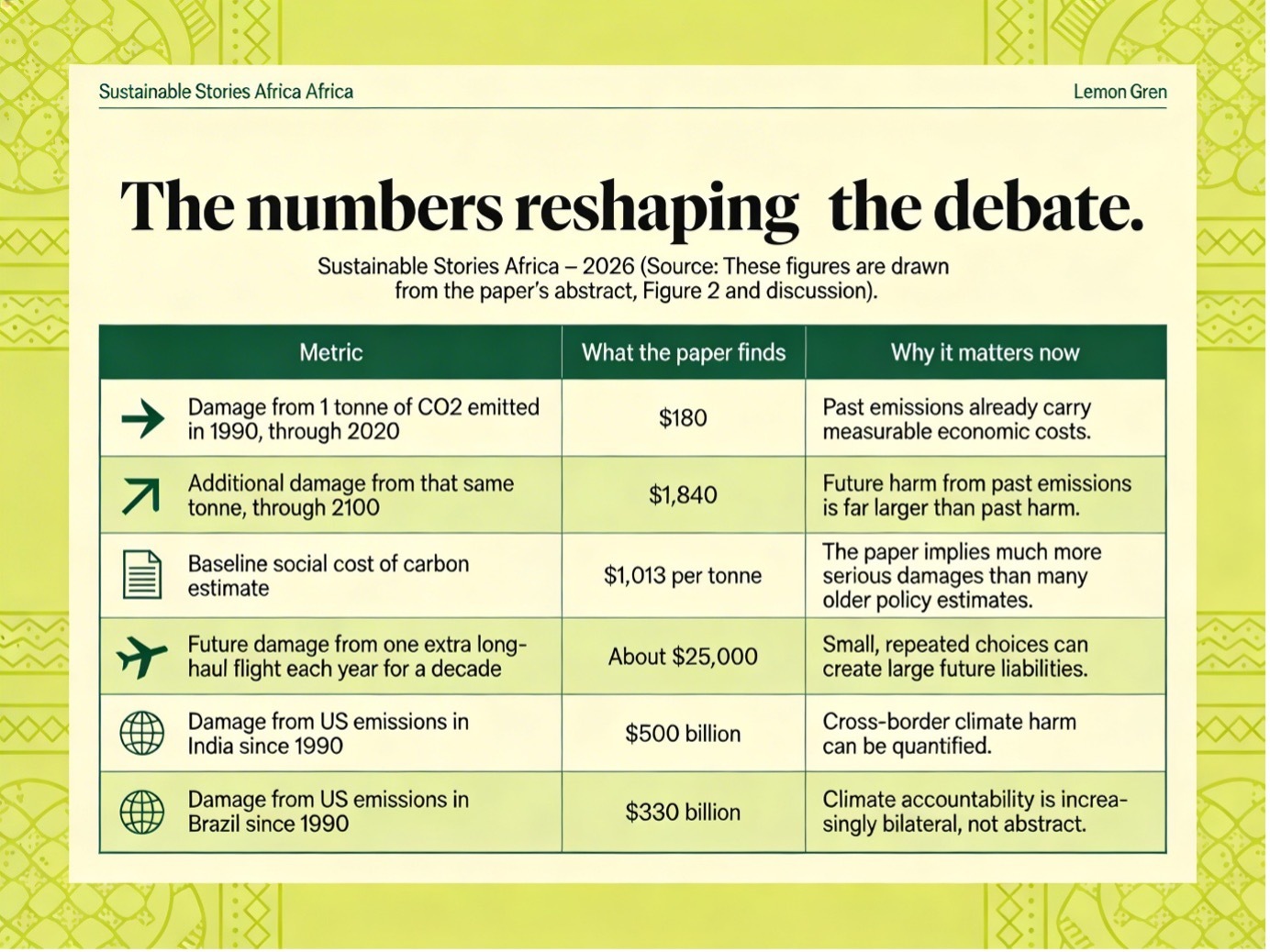
The paper’s central finding is difficult to ignore: future damages from past emissions are at least an order of magnitude larger than historical damages from those same emissions.
In the authors’ example, one tonne of CO2 emitted in 1990 caused about $180 in discounted global damages by 2020, but is expected to cause an additional $1,840 through 2100. Their conclusion is blunt: settling debts for past damages does not settle debts for past emissions.
That is the real hook. Climate loss and damage are no longer framed only as a historical grievance.
It is becoming a forward liability stream that keeps accumulating as warming persists and economies remain exposed.
From Abstract Justice To Priced Harm
The study combines emissions inventories, climate modelling, temperature projections and economic analysis to estimate total loss and damage from past emissions and the future effects of past, present and future emissions.
Its estimates are politically explosive: under conservative assumptions, the social cost of carbon is about $1,013 per tonne, but under alternative assumptions, increase to above $3,000 and even $7,000.
The paper translates climate accountability into personal choices: one extra long-haul flight a year over the past decade creates about $25,000 in damages, while lower-emission lifestyle shifts each deliver roughly $6,000 in benefits.
At the company level, the figures are staggering: Saudi Aramco’s emissions from 1988 to 2015 caused about $3 trillion in damages by 2020 and an additional $64 trillion by 2100, while ExxonMobil’s comparable totals reach $1.6 trillion and $29 trillion.
Why Better Measurement Could Improve Justice
There is a constructive side to this paper. Better quantification can make climate finance debates more credible, more targeted and harder to dismiss.
The authors note several possible avenues for establishing damages that have already occurred, including lump-sum international payments, debt-for-climate swaps, and even direct low-cost transfers to households in developing countries.
They also examine carbon dioxide removal as an alternative way to address future damages from past emissions.
However, the timing is critical. The paper shows that immediate removal can eliminate damages, while a 25-year delay cuts damages by only about half through 2100. In other words, delay still destroys value.
For African countries, this opens a more strategic conversation. If climate damages can be more easily attributed, then adaptation finance, sovereign climate negotiations, debt restructuring and even litigation can rest on firmer numbers rather than broad rhetoric alone.
That does not answer every legal or ethical question, but it makes evasion harder.
What Policymakers And Markets Should Do Next
African governments, development finance institutions, insurers and corporate boards should read this study as an early warning.
- First, they need a stronger national capacity to track emissions, economic exposure and attribution.
- Second, they should push for climate finance mechanisms that reflect both historical harm and future locked-in losses.
- Third, companies with carbon-intensive operations should treat climate liability as a material strategic risk, not just a disclosure issue.
These are reasonable inferences from the paper’s framework and its quantified results.
The authors are equally clear about the limits. Their estimates do not fully capture damages to health, ecosystems, cultural homeland, sea-level rise, tropical cyclones or other extremes that are poorly reflected in GDP data.
That means the true bill is likely higher, not lower.
Path Forward – Turn Attribution Into Finance Reform
African negotiators now need better damage accounting, better adaptation finance and stronger legal-financial tools that will translate climate harm into credible claims and smarter policy.
The bigger promise is clarity: once loss and damage become countable, it becomes harder for major emitters, investors and institutions to treat it as someone else’s problem.