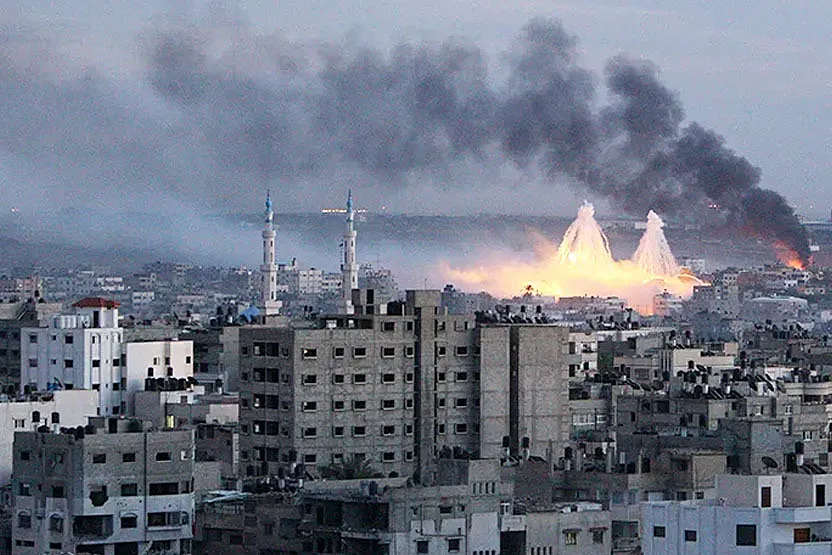
A new research snapshot argues that just two weeks of war involving Iran, the US and Israel generated more carbon pollution than Iceland emits in a year.
The deeper significance is methodological as much as political: conflict is increasingly becoming a blind spot in climate accounting, despite its high and lasting environmental costs.
When war enters carbon accounting
Climate policy usually measures power plants, factories, transport fleets and supply chains. It rarely measures bombardment, destroyed fuel depots, shattered housing stock or the reconstruction that follows.
That gap is what makes this research snapshot so striking.
In two weeks of war in Iran unleashed more carbon pollution than Iceland does in a year, authors Patrick Bigger, Benjamin Neimark and Fred Otu-Larbi set out an estimate of the direct and indirect emissions generated in the first 14 days of the 2026 US-Israel-Iran conflict.
Their conclusion is stark: the total climate impact for the period from February 28 to March 14, 2026, reached about 5.054 million tonnes of CO2 equivalent.
For African and emerging-market readers, the importance goes beyond one war.
It raises a significant question about how climate accountability is framed, whose emissions are counted, and why fragile regions often suffer the environmental fallout of conflict without those costs properly reflected in global climate debates.
A hidden emissions source becomes visible
The headline number is large enough to force attention.
According to the snapshot, the first 14 days of the conflict generated 5,054,000 tCO2e across five major categories:
- Destroyed homes and buildings
- Destroyed fuel
- Fuel used in combat and support operations
- Equipment embodied carbon
- Missiles and drones.
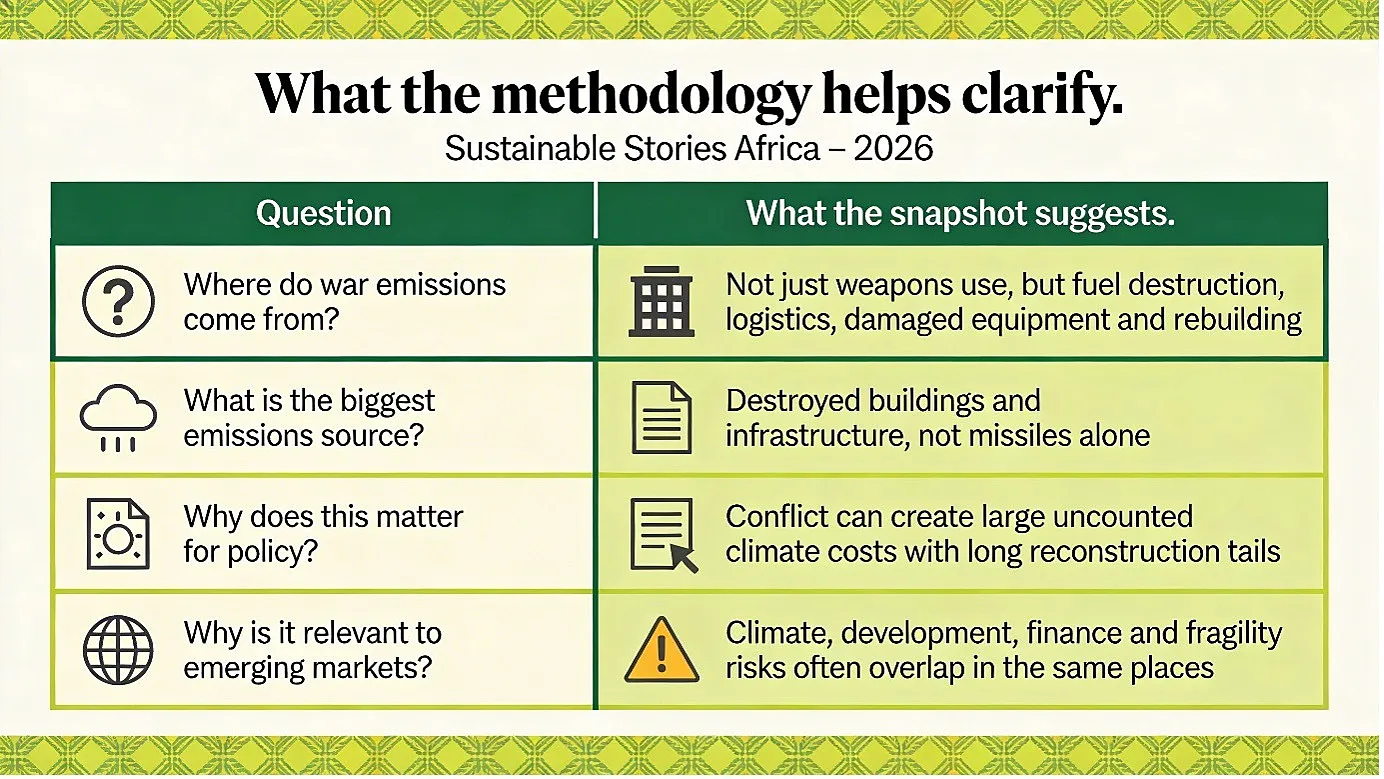
The largest share came from destroyed buildings at 2,415,000 tCO2e, followed by destroyed fuel at 1,883,000 tCO2e.
Those rankings matter. It suggests that the climate burden of war is not only about jets in the sky or missiles in flight. It is also about what gets blown apart on the ground and what must later be rebuilt.
The authors are explicit that their work focuses on both direct and indirect emissions from warfare.
On page 2, they explain that the methodology follows earlier work by Neimark et al. and De Klerk et al., combining estimates of munitions use, combat fuel burn, destroyed fuel, equipment loss and reconstruction-related embodied emissions.
Emission factors were drawn from the cited methodology and from IPCC guidance.
This is important because it frames war as an emissions event with multiple layers. The bombs themselves matter.
So do the logistics, the damaged aircraft and ships, the oil storage fires, and the carbon locked into schools, homes and clinics that must be rebuilt.
How the estimate was built
The methodology is one of the most valuable parts of the paper because it shows how researchers are trying to quantify what is often treated as uncountable.
On page 2, the authors say they estimated emissions for five activity categories.
- First, they counted embodied emissions in missiles and drones used by the US, Israel, Iran, and other affected Gulf countries.
- Second, they estimated fuel used by combat aircraft, support operations, naval vessels and troop transport.
- Third, they counted fuel destroyed in bombed storage sites, refineries and tankers.
- Fourth, they estimated the embodied carbon in damaged or destroyed military equipment.
- Fifth, they counted emissions associated with destroyed homes, schools and infrastructure that would eventually require reconstruction.
The paper also explains its evidence base. Data on munitions, equipment losses, fuel volumes and infrastructure damage came from media sources, international organisations and independent bodies, while claims from conflict parties were triangulated against other reporting.
Where values varied, the authors used mean estimates from the available range.
That caution matters because war-zone accounting is inherently difficult. Damage is contested, reporting is incomplete, and some assets are hidden or politically sensitive. The snapshot should therefore be read as an informed estimate, rather than a final inventory.
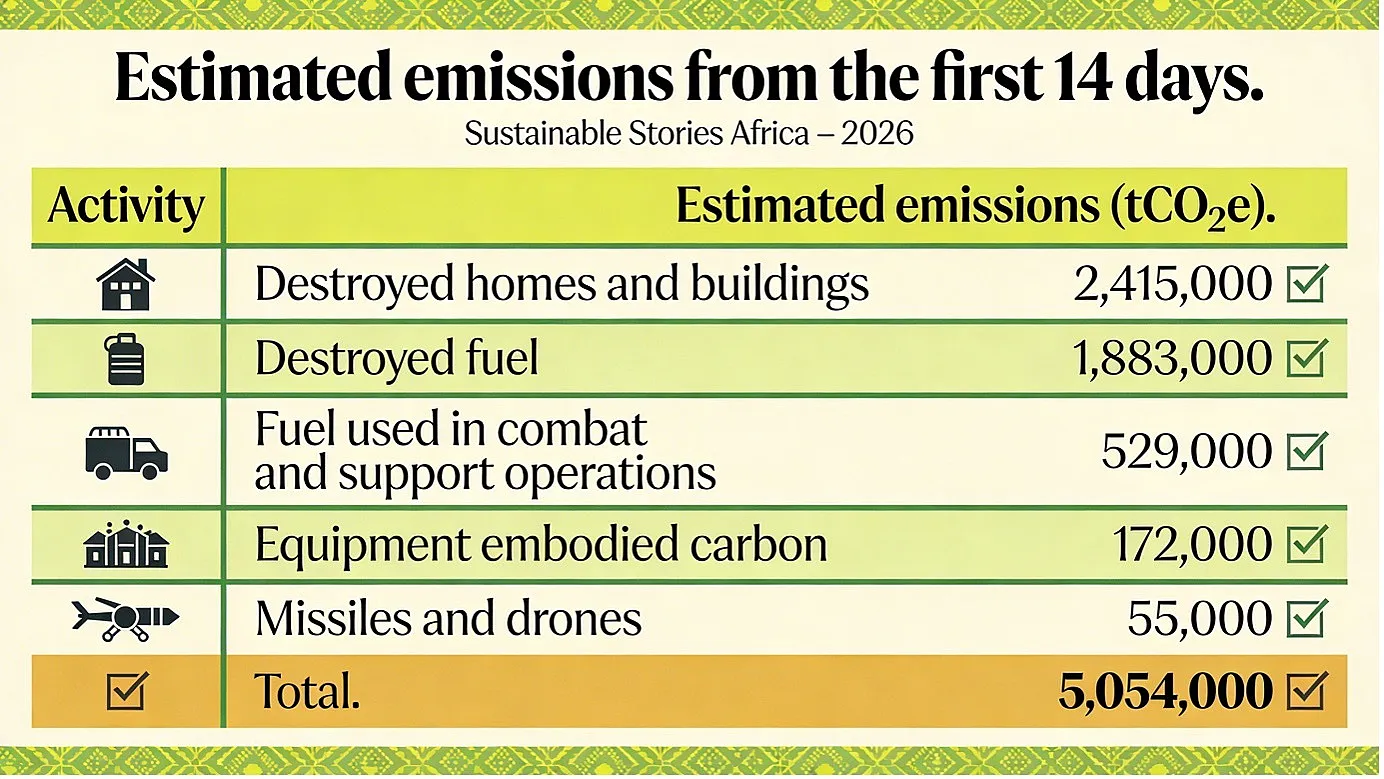
The largest categories are revealing. The study says that destroyed buildings included about 20,000 affected units, among them homes, shops, medical centres and schools, with an estimated embodied carbon of 2.415 million tCO2e.
Destroyed fuel was another major source. The authors estimate that 2.5 to 5.9 million barrels of oil were lost across struck facilities and tankers, with a mean result of 1.883 million tCO2e.
Combat and support operations added 529,000 tCO2e, driven by flights, logistics and naval activity.
Why does this matter beyond one conflict?
Conflict emissions are often overlooked in mainstream climate policy, even though they can erase mitigation gains, destroy low-carbon infrastructure pathways and impose reconstruction burdens on already vulnerable societies.
For developing and emerging economies, that is especially relevant. The environmental cost of war is rarely isolated from the developmental cost; however, in practice, the two are tightly linked.
When homes, schools and medical centres are damaged, emissions are not just added to the atmosphere. Social systems are weakened. Reconstruction funds are diverted, as insurance and sovereign risk rise. Supply chains are disrupted. Public health burdens deepen. In that sense, war-related emissions are not only an environmental issue.
They become a development finance, a governance issue and a resilience issue.
For African markets, this matters because many countries already sit at the intersection of climate vulnerability, debt stress, infrastructure gaps and geopolitical exposure.
A more serious treatment of conflict emissions could help reshape how climate justice, loss and damage, reconstruction finance and security policy are debated.
What should happen next?
The most practical lesson is that climate accounting needs to widen its field of vision.
- Researchers should continue refining conflict-emissions methodologies, including uncertainty ranges, satellite-based validation and stronger reconstruction modelling.
- Multilateral institutions and climate negotiators should begin taking conflict-related emissions more seriously in discussions around climate justice, adaptation finance and post-war rebuilding.
- Governments and investors should also recognise that military destruction creates long-term carbon liabilities that can affect infrastructure planning and recovery costs.
There are also lessons in communication. Climate reporting tends to privilege peacetime sectors because they are easier to count.
However, what is easy to count is not always what matters most. If sustainability is meant to reflect whole-system reality, then the emissions of war cannot remain outside the frame.
The paper’s greatest contribution may be that it makes this omission harder to ignore.
Path Forward – count what conflict destroys
Climate accountability needs to expand beyond conventional sectors to include the carbon cost of warfare, destruction and reconstruction.
This snapshot shows that conflict can generate major emissions in a very short time.
The next step is better methodology, more transparent reporting and stronger links between climate, security and reconstruction policy.
What is not counted will continue to be discounted.