Nigeria’s sustainable cooling drive is emerging as more than an energy story. It sits at the intersection of heat risk, food security, health, investment and climate resilience.
The question now is whether policy, finance and industry can turn cooling from a costly luxury into an efficient, accessible public good.
Cooling is becoming an economic policy
Cooling is often treated as a household convenience. In Nigeria, it is increasingly a development necessity.
In The Energy Efficiency & Sustainable Cooling Project: A Review, author Chika Onyekwere argues that Nigeria’s cooling challenge is now large enough to shape public health, productivity, emissions, food systems and investment strategy.
The paper places the country among the “Critical 9” identified by SEforALL’s Chilling Prospects work as facing severe cooling challenges, while linking the response to Nigeria’s climate commitments and rising urbanisation.
Those framing matters. As temperatures rise and cities expand, sustainable cooling is no longer just about comfort or consumer appliances.
It is becoming part of the broader question of how African economies protect people, preserve food and medicines, lower pressure on strained power systems and build more resilient growth.
The heat burden is already too large to ignore
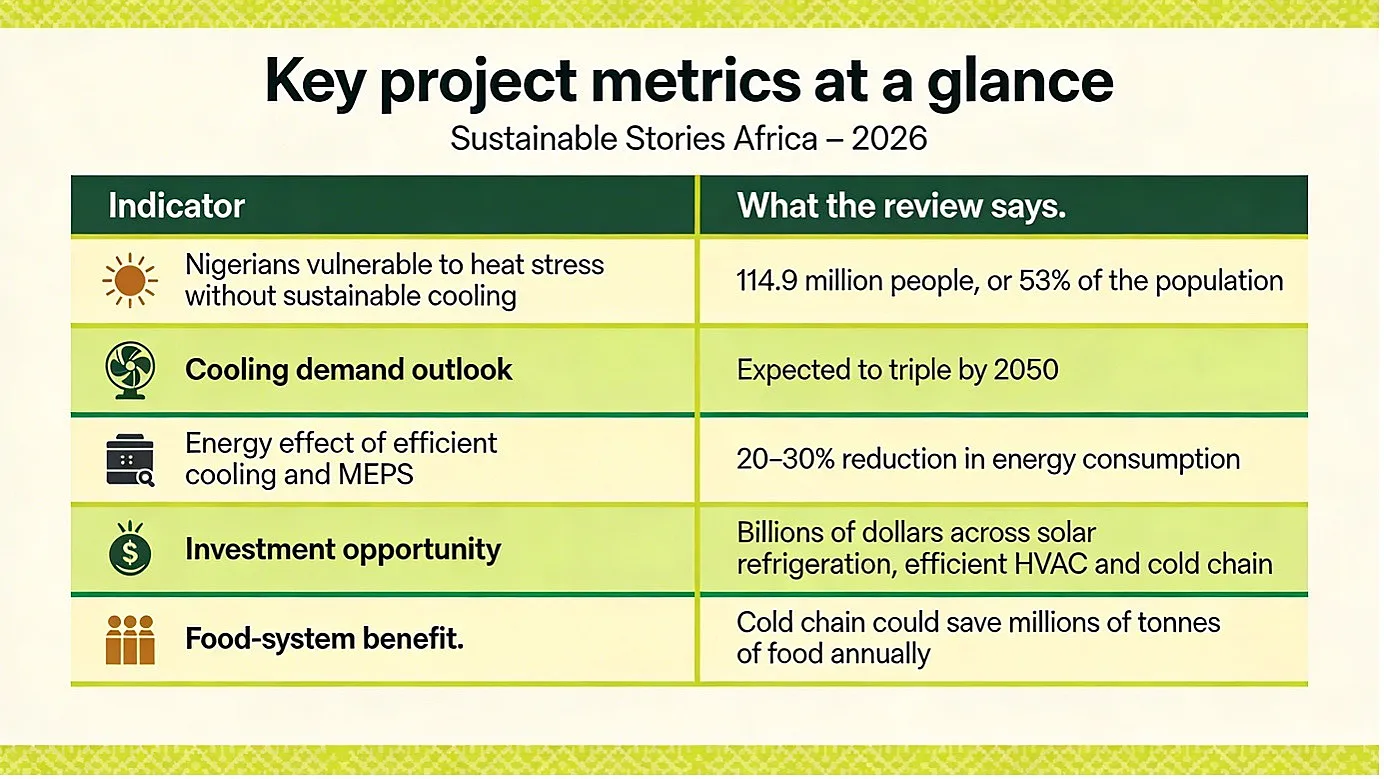
The sharpest number in the review is also the most revealing: 114.9 million Nigerians, or 53% of the population, are vulnerable to heat stress without sustainable cooling.
The report also says Nigeria’s cooling demand is expected to triple by 2050, driven by rising temperatures and urbanisation.
This project matters beyond the energy sector because cooling sits at the centre of several national pressures at once, from overloaded electricity systems and food spoilage to hospital resilience, worker productivity and climate adaptation.
When cooling is inefficient or inaccessible, the costs are borne by households, businesses and public services.
The review says the project emerged from the Mission Efficiency Marketplace, launched by SEforALL and localised in Nigeria through a partnership with the National Council on Climate Change.
It also builds on the AGORA Project and UNEP’s U4E programme. At its core, Nigeria is trying to solve two linked problems: limited access to cooling and heavy reliance on inefficient systems.
Why efficient cooling now matters for sustainability and growth
The review’s goals show how broad the issue really is. It frames the project around five priorities:
- Closing the cooling access gap
- Improving efficiency
- Through Minimum Energy Performance Standards for appliances such as air conditioners and refrigerators, cutting emissions from inefficient systems,
- Making cooling more affordable for low-income and rural communities
- Mobilising climate finance and private investment.
That makes sustainable cooling unusually important in African markets. It is both a climate and inclusion issue, as well as an industrial policy and consumer protection issue.
The review says efficient cooling and MEPS could cut energy use by 20% – 30%, ease pressure on Nigeria’s grid, unlock billions in investment, strengthen cold-chain logistics, reduce food loss, and improve health, productivity and everyday resilience.
The project’s stakeholder map on page 5 is also telling. It includes government actors such as the NCCC, the Ministry of Environment and regulators, global partners, including SEforALL, Mission Efficiency and UNEP’s U4E; private investors, manufacturers and innovators; and end users, including households, schools, hospitals and businesses.
What success could unlock for Nigeria and other African markets
The strongest case for this project is that its benefits are not narrow. They spread across the economy.
On page 6, the review outlines five economic and social impacts:
- Energy savings
- Job creation
- Health and productivity gains
- Food security
- Climate resilience.
Each of those is significant on its own. Together, they show why cooling policy can no longer be treated as a secondary technical issue.
A better cooling system would reduce pressure on the grid and lower costs for households and businesses. It could create jobs in manufacturing, installation and maintenance.
It could reduce heat-related illness and improve workplace productivity. It could strengthen food and medicine preservation. And it could help Nigeria adapt more effectively to rising temperatures.
There is also a wider African lesson here. Cooling demand will rise across many fast-urbanising, warming economies. Countries that move early on efficiency standards, market design and affordable access could avoid locking themselves into wasteful, high-emission cooling systems later.
In that sense, Nigeria’s project is not only national. It is potentially regional in relevance.
What must happen next?
The review is optimistic, but it also implies a demanding implementation agenda.
- First, MEPS enforcement must become real, not symbolic. Standards matter if poor-quality appliances are pushed out of the market, and consumers can clearly identify efficient products.
- Second, finance needs to move beyond pilot language. If the sector is to unlock billions in investment, then project pipelines, local manufacturing capacity and de-risking tools must improve.
- Third, cooling access must be treated as an equity issue. Without targeted support, efficient systems may remain out of reach for low-income and rural households even if the market expands.
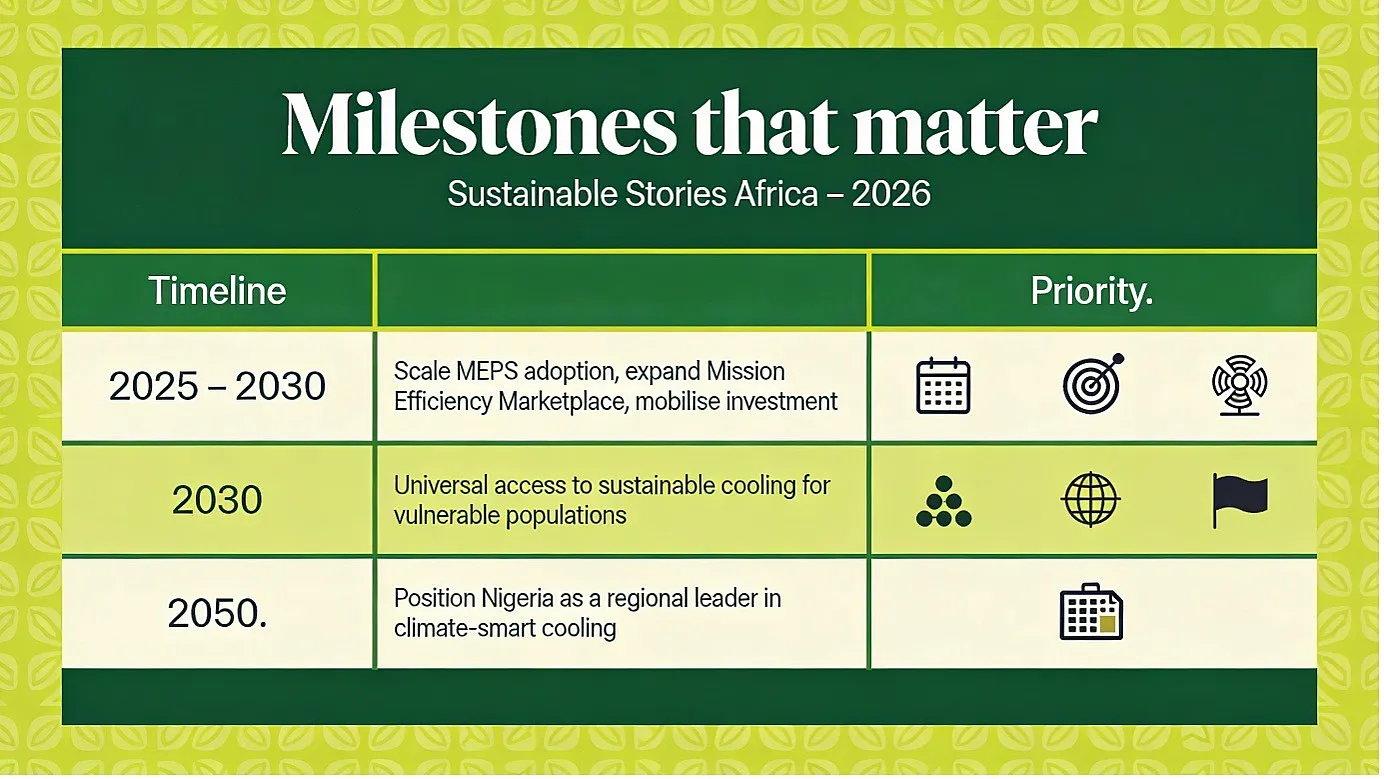
The timeline in the review is useful here. On page 7, it sets out a 2025 – 2030 period for scaling MEPS, expanding the Mission Efficiency Marketplace and mobilising investment; a 2030 goal of universal access to sustainable cooling for vulnerable populations; and a 2050 vision of Nigeria as a regional leader in climate-smart cooling with a resilient energy system and thriving green economy.
That is ambitious. However, the desired achievement on page 8 captures the policy logic well: by 2030, Nigeria aims to reduce its cooling access gap, cut emissions and unlock green investment, turning cooling from a luxury into a universal necessity for health, productivity and sustainable growth.
Path Forward – Make cooling a public-good strategy
Nigeria’s cooling project should now be treated as infrastructure for health, productivity and resilience, not as a niche energy programme.
That means stronger standards, better finance and wider access.
The bigger prize is clear: lower energy waste, stronger food systems, more jobs and a cooling market built for a hotter future.
The test is whether implementation can keep pace with demand.