Nigeria’s power crisis is sharpening the case for mini grids as a faster, more practical route to electricity access.
That matters now because the national grid still underserves homes, clinics, farms and small businesses, even as demand keeps rising.
For households and MSMEs, the real issue is no longer theory. It is whether power can arrive reliably, affordably and close to where people live and work.
A national power gap is creating a local energy market
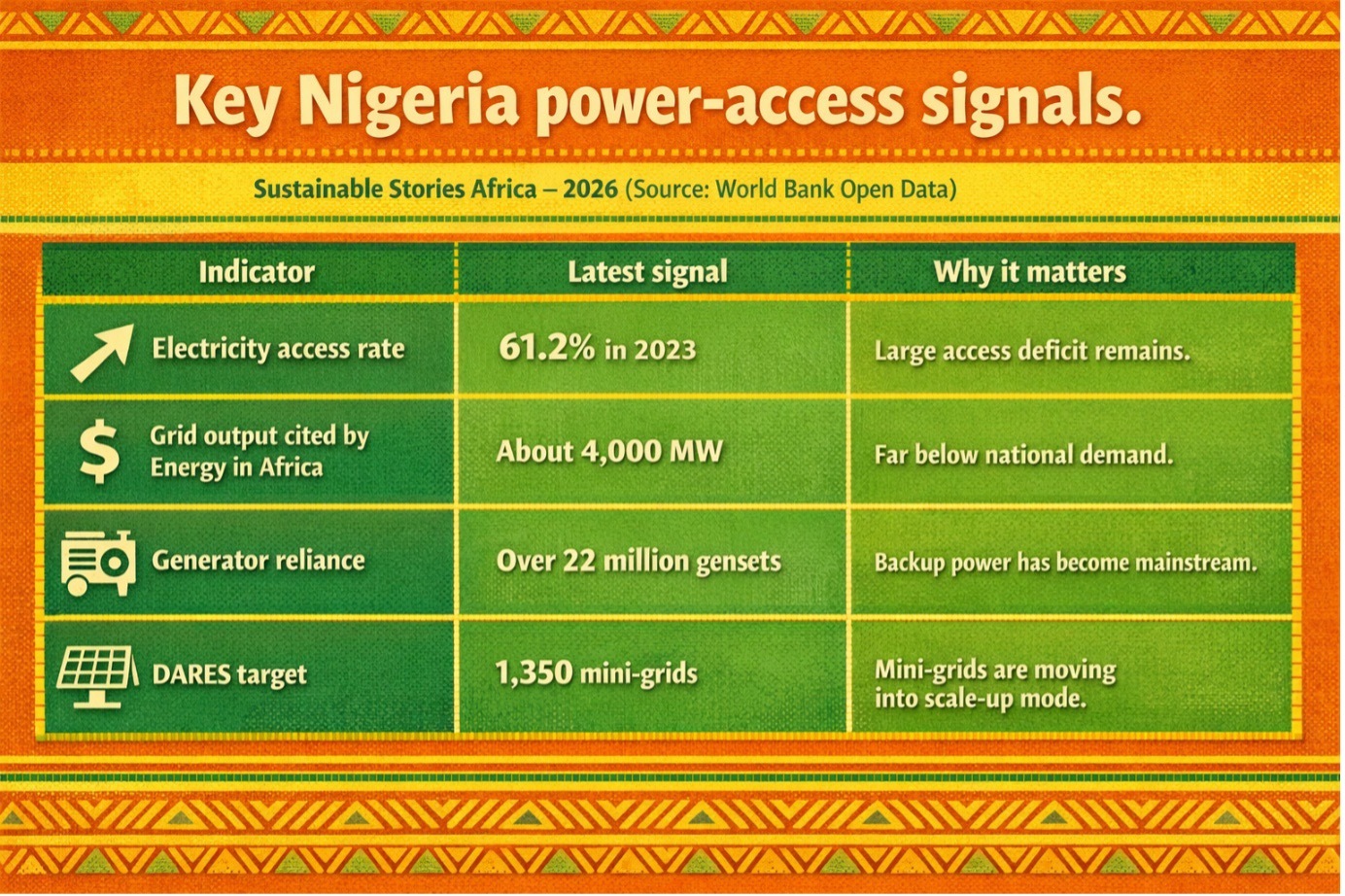
For a country of more than 200 million people, Nigeria still produces only about 4,000 MW from its troubled national grid, according to Energy in Africa’s framing of the crisis.
That mismatch between population, demand and delivered power explains why the country’s electricity debate is shifting from grid repair alone to distributed alternatives that can work now.
The case is not abstract. World Bank data show that only 61.2% of Nigerians had access to electricity in 2023, leaving roughly two in five people without it. Even among those counted as connected, supply is often too weak or too erratic to support productive use.
That is why mini-grids are increasingly being treated not as a side solution, but as a core access strategy for underserved communities and fragile service areas.
Nigeria’s energy reality is already decentralised
Nigeria’s electricity economy has, in practice, long been decentralised. The World Bank estimates that more than 22 million petrol and diesel generators power about 26% of households and 30% of MSMEs, with total genset capacity around eight times the capacity connected to the national grid.
In other words, Nigerians have already built a shadow power system; it is simply expensive, noisy and dirty.
That is where mini-grids enter the story. Unlike small individual solar kits, mini-grids can serve clusters of homes, shops, schools, agro-processors and health centres with more reliable shared infrastructure.
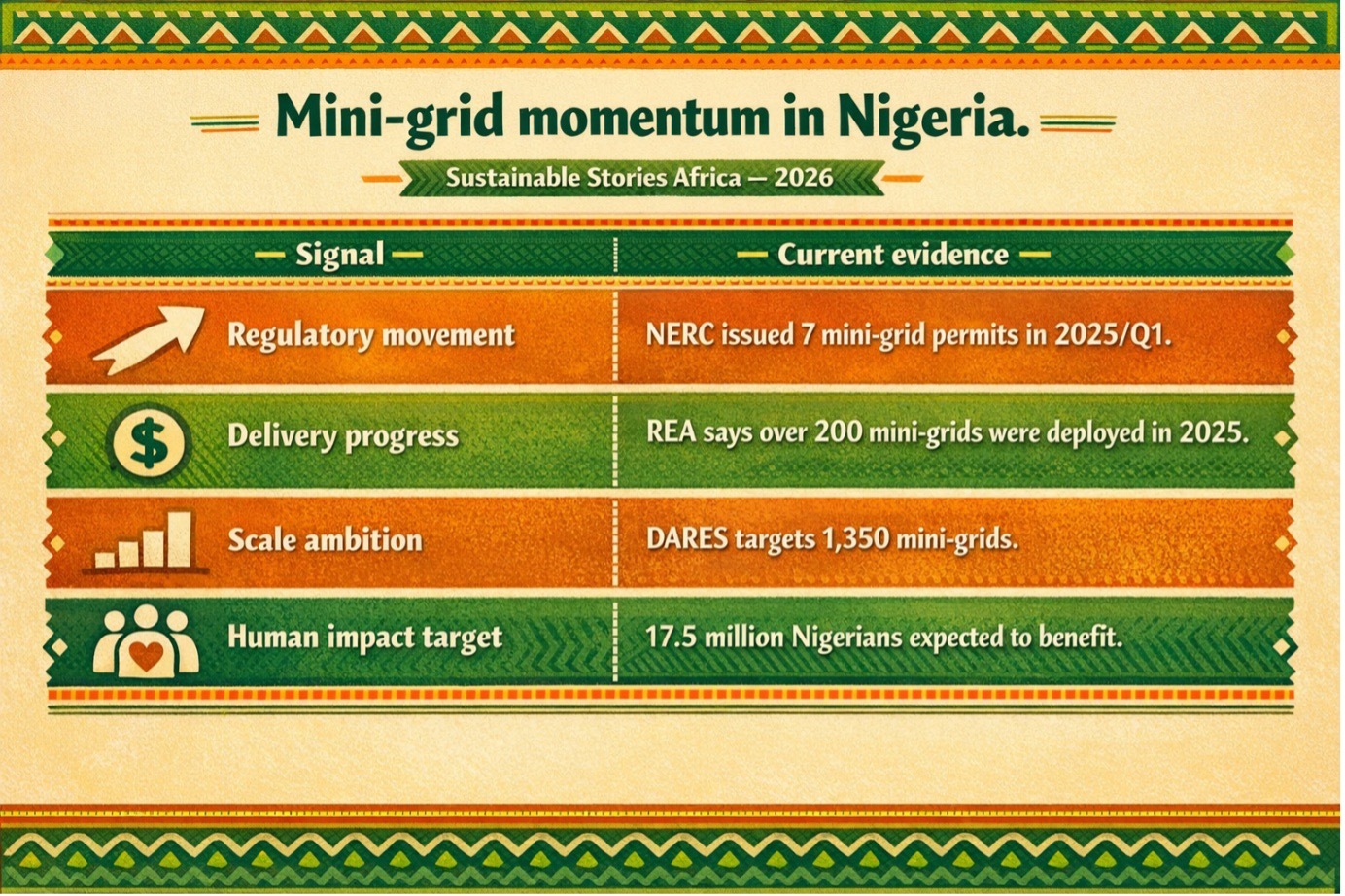
Unlike the central grid, they do not have to wait for every transmission and distribution bottleneck to be fixed first. Nigeria’s regulator, NERC, said it issued seven mini-grid permits with a combined gross capacity of 1.26 MW in the first quarter of 2025.
The Rural Electrification Agency said it deployed more than 200 mini-grids in 2025 and is targeting 1,350 under the DARES initiative.
That policy direction aligns with a broader continental push. Mission 300 aims to connect 300 million people in Africa to electricity by 2030, with a significant share expected to come through off-grid systems such as mini-grids and solar home systems.
For Nigeria specifically, the World Bank says DARES is meant to support solar home systems and mini-grids benefiting more than 17.5 million Nigerians while replacing over 250,000 diesel generators.
What Nigeria gains if mini-grids move from pilots to infrastructure
The strongest argument for mini-grids is not ideological. It is economic. Reliable local power can extend trading hours, reduce diesel costs, improve cold storage, support digital services, and strengthen health and education delivery in places the grid still underserves.
Mission 300’s logic is that some households will be best served through grid expansion, but many others will be reached faster through mini-grids and standalone systems.
The social dividend is equally important. Nigeria’s rural electrification mapping has identified more than 150,000 communities without electricity or with highly unreliable supply.
Mini-grids allow planners to match technology to place, rather than forcing every settlement to wait for a one-size-fits-all grid solution.
As REA’s managing director put it, “We are currently building over 900 mini-grids across the country, and our target is to reach 1,350.”
The next test is scale, finance and execution
Nigeria does not need to choose between fixing the grid and backing mini-grids. It needs to do both; however, with a clearer strategic priority for what can deliver near-term relief.
That means faster permitting, subsidy and stronger tariff, better access to local-currency finance, and tighter coordination between federal and state electrification efforts.
Without that, mini-grids risk remaining trapped in pilot language while diesel continues to dominate real life.
For policymakers, financiers and developers, the signal is clear: mini-grids should now be treated as productive infrastructure, not marginal energy charity.
In Nigeria’s current market, the most credible power reform may be the one that reaches people before the grid does.
Scale Mini-Grids, Fix Markets Faster
Nigeria’s priority should be to move mini-grids from scattered projects to a coordinated national delivery system.
That means:
- Stable rules
- Concessional finance
- Data-led site selection
- Stronger state-federal alignment.
If executed well, mini-grids can cut diesel dependence, widen energy access and improve resilience for communities and businesses.
That would make electrification more inclusive and economically credible.
Culled From: Nigeria’s power crisis shows why mini-grids should be its best bet - Energy in Africa