Central banks are being pushed deeper into climate-risk supervision and stress testing.
But the emissions data beneath those exercises are often built for different jobs.
That mismatch now threatens the way markets, regulators and vulnerable economies manage transition risk.
Climate risk needs cleaner data
Green Central Banking is sharpening a problem many regulators have skirted for too long: central banks are increasingly expected to assess climate-related financial risk, yet the emissions data they rely on are not drawn from one coherent system.
Instead, they often sit across two separate architectures with different purposes, boundaries and governance rules. One is built for regulatory compliance through monitoring, reporting and verification systems tied to carbon pricing.
The other is built for investor-facing corporate disclosure standards such as IFRS S2. Treating them as interchangeable can distort climate stress tests, transition-risk analysis and supervision.
That matters beyond Europe or Asia. In African markets, where climate shocks already affect inflation, food systems, insurance, credit quality and fiscal stability, central banks are under pressure to make climate risk measurable without overburdening still-evolving reporting systems.
Recent discussions among African policymakers have reinforced the same point: climate risk is no longer a side issue for sustainability teams; it is becoming a core financial stability.
Two systems, one widening blind spot
The first emissions data system is compliance-led. It is usually anchored in emissions trading schemes or carbon taxes, where firms report facility-level emissions under strict MRV rules because those numbers trigger legal and financial obligations.
Accuracy is everything because the data determines payments, allowances and regulatory compliance. The second system is disclosure-led. Under ISSB standards, including IFRS S2, companies disclose enterprise-level emissions across scopes 1, 2 and 3 to help investors assess exposure, strategy and transition resilience. Those disclosures are designed for transparency and comparability, not enforcement.
That distinction sounds technical until it reaches a supervisor’s dashboard. A central bank stress test may pull company disclosure data into models built to assess sectoral transition exposure.
A regulator may look at facility-level emissions and assume they reflect a whole firm’s climate footprint. They do not always. The result can be underestimation, overestimation or plain confusion, especially where reporting boundaries differ across jurisdictions and institutions.
NGFS has warned for several years that reliable, comparable climate data are essential to align capital flows, manage risk and prevent greenwashing, yet major data gaps remain.
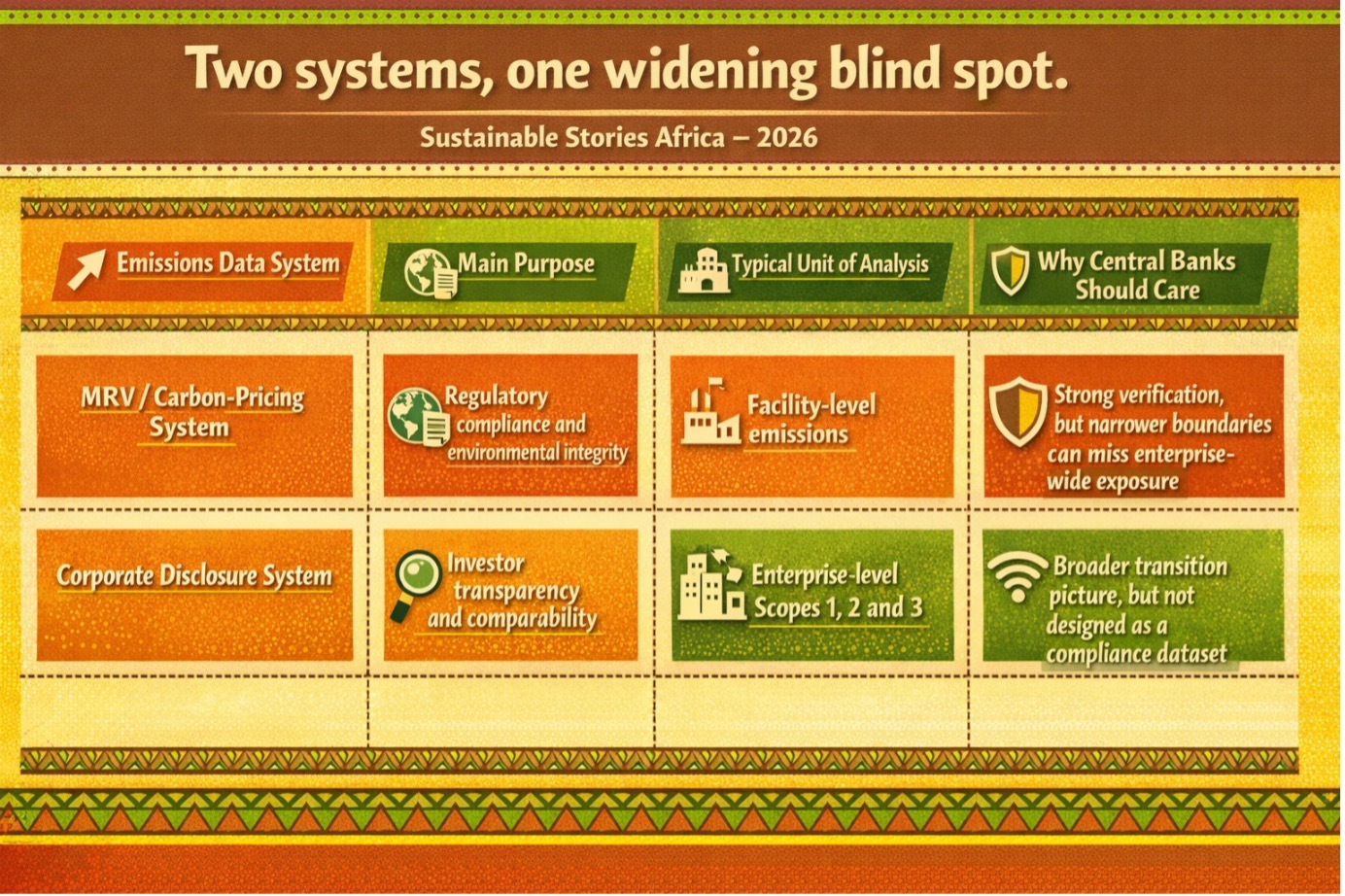
Europe shows the solution is not forced uniformity but structured interoperability. By linking verified ETS data with sustainability disclosures under ESRS E1, the EU preserves distinct functions while improving alignment, a practical lesson for central banks managing disclosure mismatches.
What aligned systems could unlock
Designing alignment early can deliver gains. Central banks get inputs for climate scenario analysis, supervisors compare exposures with fewer gaps, investors receive signals, and governments avoid duplication across environmental, financial, and corporate reporting systems.
For African and Global South markets, early alignment offers a chance to build climate-finance systems before fragmentation hardens into policy debt.
The stakes are human. Weak climate data obscure risks borne by households and small businesses, from flood-damaged farms to heat-stressed cities, disrupted food chains, and insurance gaps. Better-aligned data will not eliminate shocks, but it can guide finance and policy before losses become systemic.
Action: Build coordination before complexity deepens
The policy message is clear. Central banks should stop treating climate data as a downstream technical issue and start treating it as market infrastructure.
That means working earlier with environmental regulators, securities authorities, statistics offices and standard-setters to define interoperable reporting rules, shared identifiers, clearer system boundaries and stronger verification pathways.
This means investing in capacity in many emerging markets, as their main barriers are institutional, rather than technological.
For African markets, the opportunity is to avoid importing fragmented systems just as ESG and climate disclosure expectations rise. The region does not need a perfect climate data architecture overnight.
It needs one trusted spine that lets financial authorities compare risk, firms report consistently and capital move with more confidence toward resilient growth.
That is the difference between climate ambition as language and climate governance as usable market practice.
Path Forward: Build one trusted climate data spine
Central banks, finance ministries and market regulators need to align compliance-grade emissions data with investor-facing disclosure systems before climate supervision scales further. The priority is interoperability, not duplication.
For African markets, early coordination can prevent future fragmentation, improve climate-risk pricing and support more credible ESG implementation across banks, corporates and public institutions. Framed to your uploaded brief and template note.
Culled From: Bridging the climate data gap: why central banks must align emissions data systems - Green Central Banking