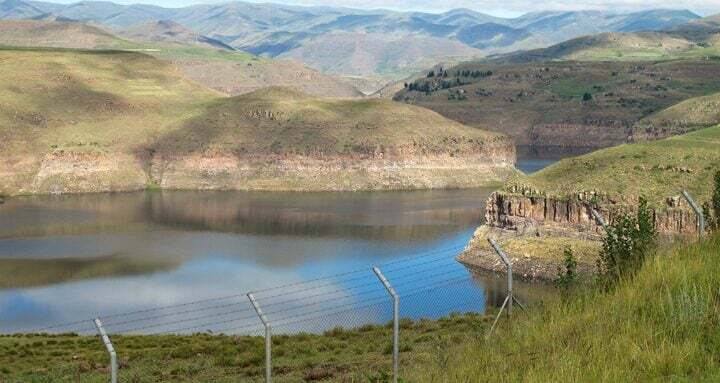
South Africa has launched a nature-linked bond that ties investor returns to water outcomes.
The deal matters because it moves nature finance beyond labelled proceeds into measurable performance.
For households, cities and businesses, it turns catchment health into a live economic issue.
A bond that pays for water
This is not a conventional green bond. In a standard structure, investors know where proceeds are meant to go. In this one, returns are tied to whether the environmental outcome is actually achieved.
The stronger the restoration performance, the stronger the investor outcome; if delivery falls short, financial outcomes weaken. That distinction matters in a market increasingly crowded with sustainability labels but still searching for harder proof of impact.
The project's focus is practical and urgent. South Africa’s water systems are under increasing strain from climate stress, land degradation and the spread of invasive alien vegetation, which reduces streamflow into pressured catchments.
In the Cape system, the bond supports restoration work intended to improve water yield into critical dams rather than funding only pipes, treatment plants or other built infrastructure.
Why the market is watching
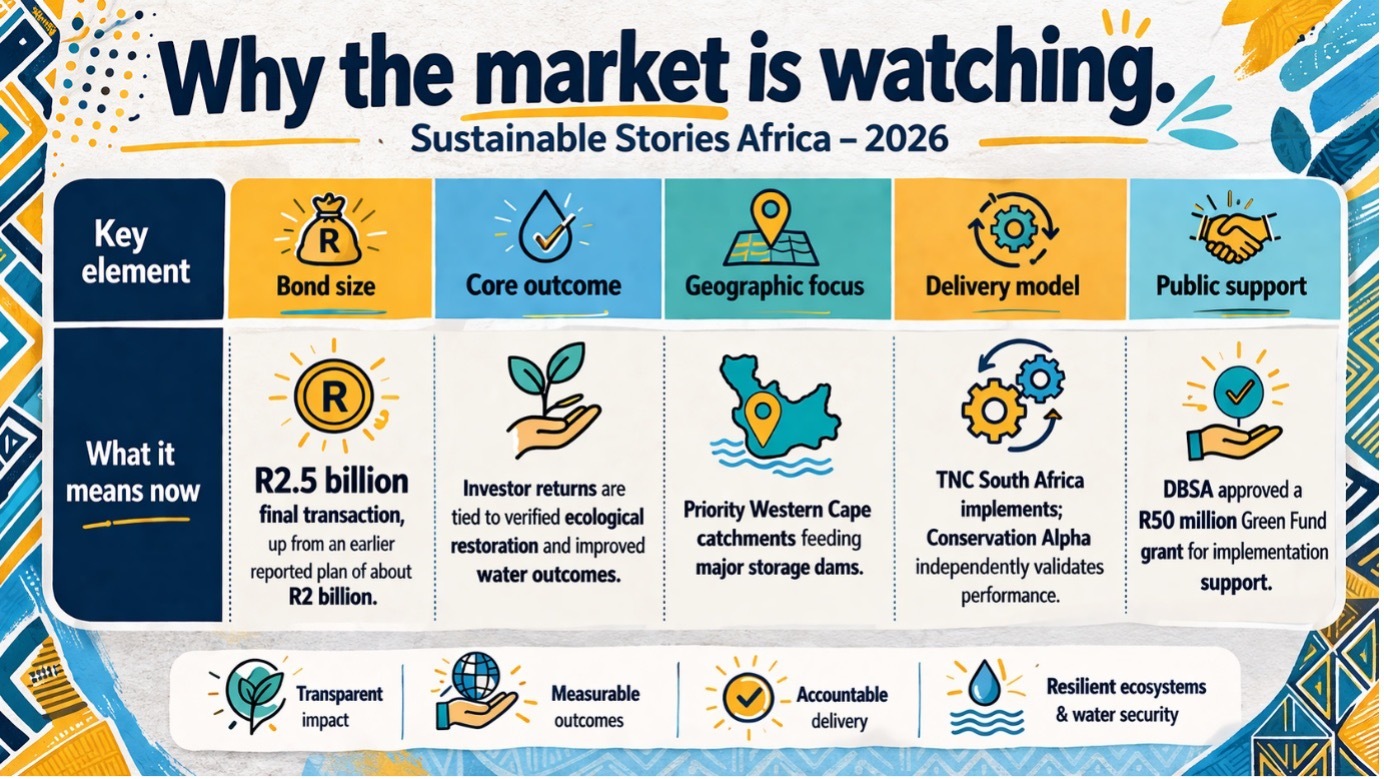
The bond did not appear in a vacuum. Reuters reported in early March that South African financiers were developing a roughly R2 billion water conservation bond; by April, RMB announced a final R2.5 billion transaction, suggesting that investor appetite and institutional support had strengthened as the structure matured.
The Development Bank of Southern Africa later approved a R50 million Green Fund grant to support implementation, with the IFC identified as lead investor.
What makes the transaction especially important is that it treats ecosystems as infrastructure. The Nature Conservancy South Africa is implementing the conservation work, while Conservation Alpha provides independent design and technical oversight to verify results.
That verification layer is central: if markets are to fund natural capital at scale, investors need confidence that environmental performance is being measured credibly, not simply promised in advance.
For African markets, the deeper story is replication. Water insecurity is not unique to Cape Town. Cities across the continent face a familiar pattern: degraded landscapes, rising demand, public funding gaps and climate volatility.
A structure that prices ecological recovery into mainstream capital markets offers a possible bridge between conservation logic and treasury logic.
That is why this deal is being framed not merely as a local financing innovation, but as a blueprint for nature finance in Africa and beyond.
What success could unlock
If the model works, the gains extend well beyond one bond issue. Better-funded catchment restoration can improve water security, protect biodiversity, support jobs and reduce the long-run cost of urban resilience. The programme linked to the broader Cape Town water effort seeks to clear invasive vegetation across 54,300 hectares, and the intervention could deliver the equivalent of roughly two months of Cape Town’s annual water needs at a fraction of the cost of conventional alternatives.
- That promise is why investors are paying attention. In this structure, nature is no longer treated as a soft add-on to infrastructure strategy. It becomes part of the asset logic itself. For banks, development financiers and institutional investors, that creates a new language for funding adaptation: measurable, monitored and linked to performance.
- For communities, it means the health of an upstream landscape can finally be recognised as central to downstream economic stability.
From labelled debt to verified delivery
The real test now is execution. African issuers have brought green, social and sustainability-labelled instruments to market before, but outcomes-linked structures raise the bar.
They require long-term monitoring, scientific credibility, institutional coordination and transparent rules for success and underperformance. Without those safeguards, the market risks reducing a promising innovation to another branding exercise.
That is why this transaction should be watched closely by regulators, exchanges, pension funds and corporate treasurers.
The next stage is not admiration; it is replication with discipline. If African finance wants to prove that ESG can solve real economic problems, then instruments like this demonstrate that restored ecosystems can be financed, measured and rewarded with the same seriousness as roads, power plants and ports.
Path Forward – Proof must now scale
South Africa’s nature-linked bond has set a higher standard: capital should not only be allocated to sustainability themes but tied to verified outcomes.
The immediate priority is rigorous delivery, transparent reporting and independent validation.
If that discipline holds, African markets could build a stronger pipeline of instruments to finance water, biodiversity and resilience, moving ESG from disclosure language into measurable public value.
Culled From: South Africa Launches Nature-Linked Bond as RMB Ties Returns to Water Outcomes - ESG News