Sustainability is being pulled out of the narrow ESG box.
That shift matters because African companies now face tougher disclosure rules, investor scrutiny and local development pressures.
The real test is no longer reporting alone, but whether business models can protect value, communities and long-term competitiveness.
A compliance label can mislead
Sustainability is not ESG. Companies can score well on disclosure, produce polished reports and still fall short on the deeper question of whether their business model can endure social, environmental and economic stress over time.
The distinction matters now because African markets are under growing pressure to align with global disclosure rules while also responding to local realities around energy access, inequality, fragile infrastructure and institutional trust.
In practice, ESG has often become shorthand for metrics, ratings and compliance checklists.
- Sustainability is wider. It asks whether a company can keep creating value without exhausting the systems, communities and resources it depends on.
For African businesses, that gap is not theoretical. It shows up in power shortages, climate shocks, water stress, supply-chain fragility, governance failures and the rising cost of capital for firms seen as poorly prepared.
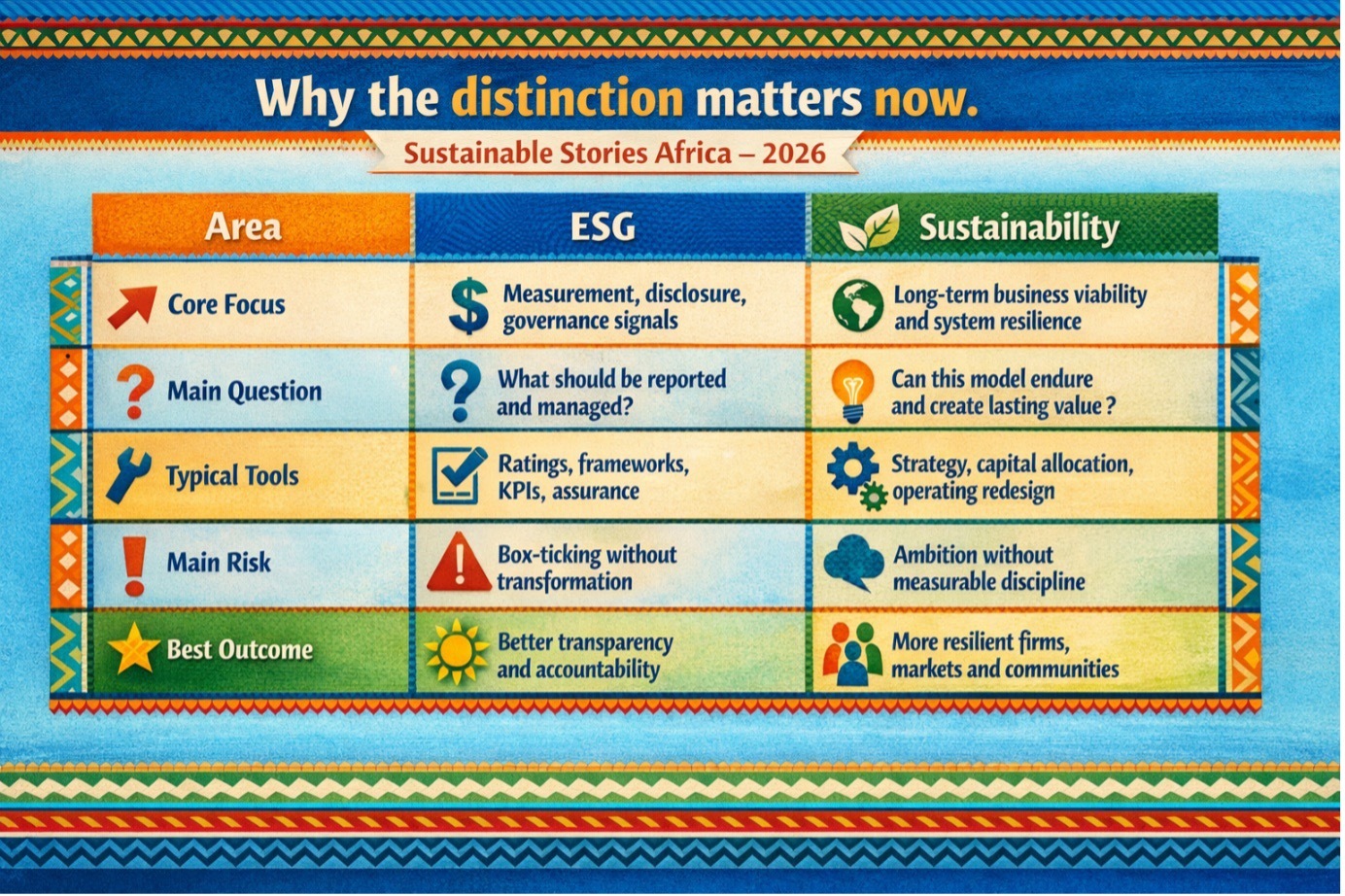
Why the distinction matters now
The tension is becoming harder to ignore. Global investors increasingly want comparable ESG data, but African firms operate in markets where material risks do not always fit neatly into imported templates.
A manufacturer facing diesel dependence, a bank financing climate-exposed sectors, or an agribusiness managing water and land pressures is not dealing with disclosure alone. Each is dealing with survival, licence to operate and long-term resilience.
That is why the phrase “sustainability is not ESG” is gaining force.
- ESG is best understood as a lens for measuring and disclosing risks, opportunities and conduct.
- Sustainability is the operating model underneath. One helps markets assess performance; the other determines whether performance can last.
For African and Global South markets, the distinction is especially important because local companies are often asked to meet global standards while solving unfinished development problems.
- A mining company may publish climate metrics, but sustainability also depends on community trust, water stewardship and post-extraction value.
- A consumer goods business may disclose emissions, but its future may hinge just as much on affordable energy, waste systems and sourcing resilience.
The market is starting to understand that reporting quality alone is not the same as strategic durability.
What stronger sustainability could unlock
Handled well, this reframing could be one of the most useful shifts in corporate Africa. It allows boards and executives to stop treating ESG as a communications function and start treating sustainability as a core business discipline.
That means asking harder questions about product design, capital expenditure, energy systems, labour standards, supplier resilience and governance credibility.
The upside is substantial. Companies that make this shift early are better placed to win investor confidence, reduce operational volatility and build stronger relationships with regulators and communities.
They are also more likely to spot new growth areas in clean energy, circular production, climate adaptation, financial inclusion and nature-linked business models.
The alternative is costly. Firms that confuse sustainability with reporting may satisfy short-term disclosure demands while remaining exposed to deeper shocks.
In African markets, where margins for error are often thinner, that disconnect can quickly become a financing problem, a reputation problem or a social legitimacy problem.
Boards must move beyond box-ticking
The practical implication is clear: African businesses need to stop asking whether ESG matters and start asking what sustainability requires.
- Boards should define which environmental, social and governance issues are truly material to enterprise value and public trust in their own markets, not just in foreign reporting templates.
- Investors should reward credible transition plans, not presentation quality alone. Regulators should push for disclosure, but also create room for context-sensitive implementation that reflects local realities.
- Advisers, auditors and sustainability teams also have a role to play. They must help shift the conversation from “What do we need to report?” to “What must change in the business?”
That is where corporate integrity becomes real: when governance, incentives and capital decisions align with long-term resilience rather than annual messaging cycles.
Path Forward – Turning disclosure into a durable strategy
African markets are likely to keep adopting stronger ESG rules, but the bigger opportunity lies in using them as a gateway to real sustainability.
That means linking disclosures to strategy, investment discipline and local development outcomes.
The firms that lead will be those that treat ESG as a tool, not the destination. In that model, sustainability becomes the broader test of whether growth can remain credible, competitive and socially legitimate over time.
Culled From: Sustainability Is Not ESG