A Climate & Capital Media essay argues that sustainable investing is not only about climate, but also about poverty, discrimination and inequality.
The case matters now as ESG faces political pushback and investors demand proof that sustainability can protect returns.
For African markets, the message is practical: gender-smart finance can strengthen climate resilience, food systems, governance and inclusive growth.
Sustainability Is Also A Gender Question
Sustainable investing is being reframed as both a gender and climate issue after a Climate & Capital Media essay argued that women’s interest in sustainable finance reflects not only environmental concern but also the lived experience of pay gaps, discrimination and unequal economic systems.
Written by sustainable investment expert Julie Gorte, a former senior executive at Impax Asset Management and Calvert, the 17 April 2026 article argues that climate change, biodiversity loss, poverty and gender inequality are interlinked.
Sustainable investing must therefore move beyond emissions to address who bears the highest costs of climate disruption.
This comes as ESG and diversity policies face political pushback, even as Morgan Stanley research shows sustainable funds matching or outperforming traditional funds, challenging claims of a returns penalty.
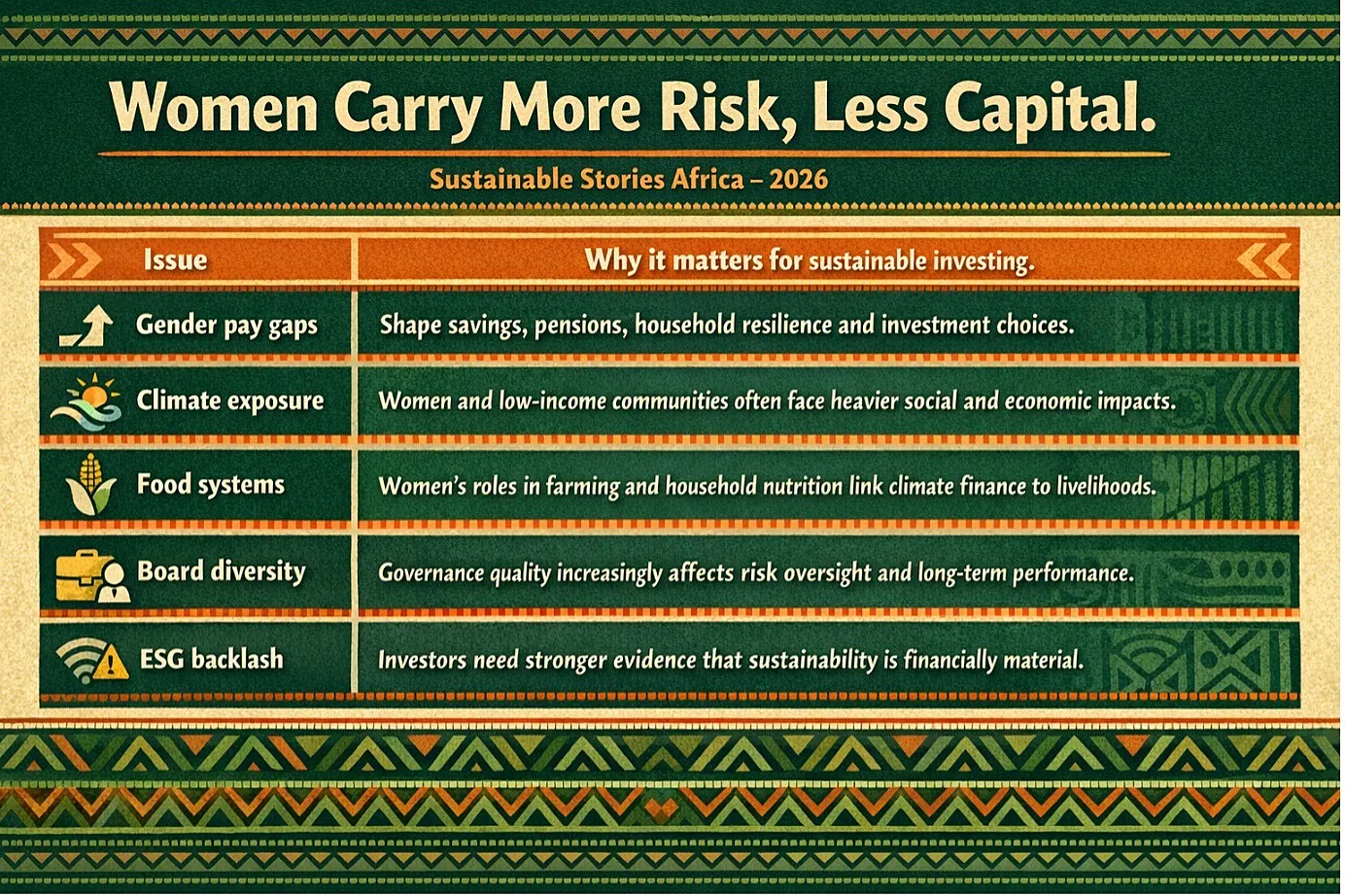
Women Carry More Risk, Less Capital
The Climate & Capital essay opens with a sharp line: “Women: Like Men, Only Cheaper,” using the phrase to highlight the global pay gap that shapes women’s financial lives and investment choices.
It argues that when women earn less, carry more household risk and face higher exposure to climate shocks, sustainability becomes personal economics rather than abstract ethics.
That logic is especially visible in African and wider Global South markets, where women anchor food systems, informal trade, care work and frontline climate adaptation.
Climate & Capital argues that women have long been among the founders and leaders of sustainable finance, even while mainstream finance remains heavily male-dominated.
The essay names Joan Bavaria, Amy Domini and Mindy Lubber as examples of women who helped shape the early sustainable investing field when many market actors still viewed it as financially inferior.
The governance evidence also matters. The article cites MSCI research showing that companies with at least 30% female directors achieved cumulative returns 18.9% higher than companies without such representation between July 31, 2019, and September 30, 2024.
Gender-Smart Finance Can Strengthen Resilience
Gender-smart sustainable investing promises that it connects capital to real economy outcomes.
It can support women-led enterprises, climate-smart agriculture, clean energy access, circular economy ventures, water resilience and community-based adaptation.
For African investors, banks and policymakers, the opportunity is not to treat gender as a soft social add-on. It is to treat it as a risk lens.
- Who controls land?
- Who receives credit?
- Who has access to clean energy?
- Who manages household water and food stress?
- Who is represented in corporate decisions?
These questions affect project performance, creditworthiness, supply-chain stability and social licence.
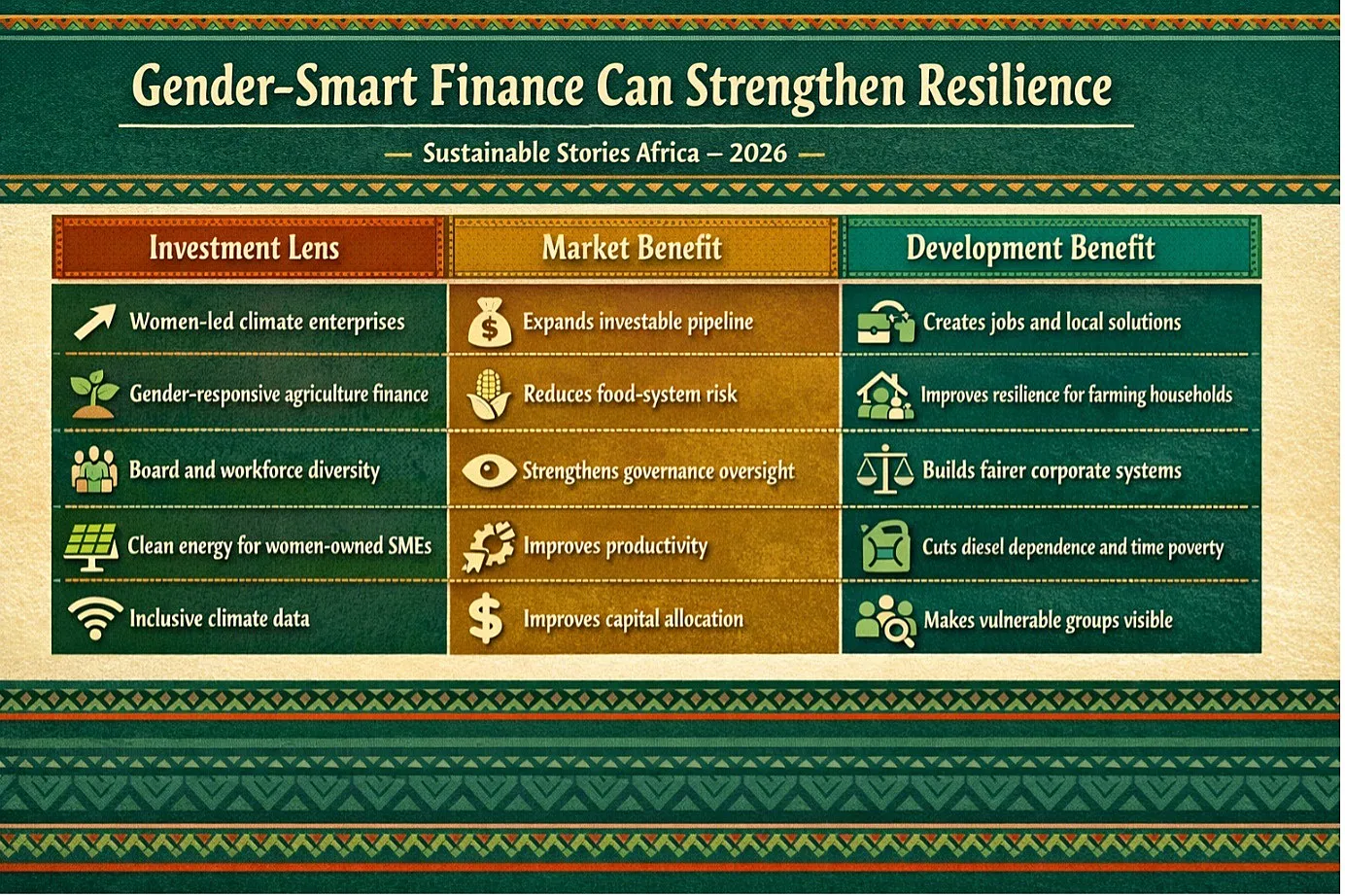
The Climate & Capital argument is strongest where it rejects a false choice between returns and justice. Sustainable investing, Gorte writes, has two missions: solving social and environmental problems while providing competitive returns.
Investors Must Price Inequality Properly
The next step is to make gender visible in climate finance.
- Asset managers should ask how portfolio companies manage pay equity, board representation, supply-chain inclusion and climate risks affecting women.
- Banks should design credit products for women-led green businesses.
- Development finance institutions should make gender and climate metrics part of project preparation, not post-investment storytelling.
- Companies also need to move from disclosure to practice.
A sustainability report that mentions inclusion but fails to track women’s access to leadership, procurement, finance and workplace safety will increasingly look incomplete.
For African markets preparing for deeper ESG scrutiny, gender data should sit beside emissions, water and governance indicators.
The wider lesson is clear: if finance ignores inequality, it will misprice climate risk. If it integrates gender, it can unlock better decisions, stronger governance and more resilient communities.
Path Forward: Price Gender, Finance Climate Resilience
Sustainable investing must now prove that gender equality is financially material, not decorative. Investors should link climate finance to pay equity, board diversity, women-led enterprises and community resilience.
For African markets, the priority is practical: build gender-smart ESG data, expand credit to women-led green businesses, and ensure climate capital reaches households, farms and companies where resilience is built daily.
Culled From: Sustainable investing for the “cheaper” gender - Climate and Capital Media