Britain will scrap its Carbon Price Support levy on electricity generation from April 2028.
The decision follows coal’s removal from the UK grid and rising pressure to lower electricity costs for households and industry.
For African markets, the lesson is clear: carbon pricing must evolve with power systems, not outlive the problem it was designed to solve.
A Coal-Era Levy Meets Its Sunset
Britain is set to phase out a key carbon pricing tool that helped drive coal out of its power sector, signalling a shift as governments confront the political and economic challenge of keeping clean energy affordable.
In an April 16, 2026, statement to Parliament, the Treasury confirmed that the Carbon Price Support (CPS) will be removed from April 2028.
Introduced in 2013, the levy taxed fossil fuels used in electricity generation to reinforce carbon pricing beyond the UK Emissions Trading Scheme.
The government argues the policy has achieved its objective: coal has largely exited the grid, the UK ETS has matured, and progress towards the Clean Power 2030 target is reducing reliance on fossil fuels.
For African policymakers and utilities, the lesson extends beyond the UK context. Carbon pricing is most effective when aligned with broader power sector reforms, including grid stability, investment signals, affordability, and long-term energy transition planning.
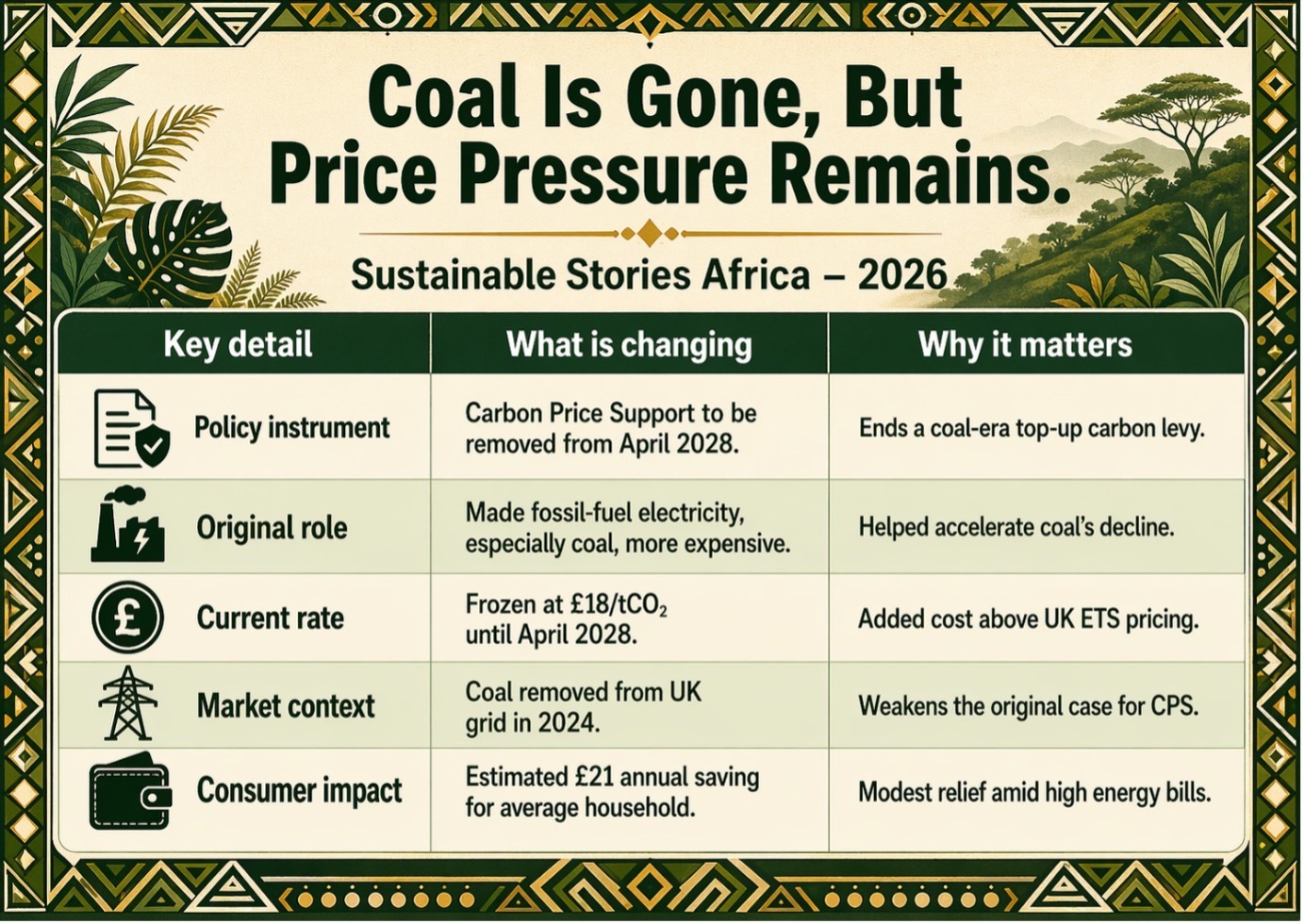
Interest: Coal Is Gone, But Price Pressure Remains
The Carbon Price Support (CPS) has been a central pillar of Britain’s coal phase-out strategy, raising the cost of high-emission electricity generation and accelerating the shift towards gas, renewables, and lower-carbon power sources.
Introduced in 2013, the tax made coal-fired generation increasingly uncompetitive, alongside carbon costs under the UK Emissions Trading Scheme, where prices have hovered around £49 per tonne.
With coal generation ending in 2024, the policy’s role has diminished. The CPS, frozen at £18 per tonne until 2028, is now set for removal, with analysts estimating potential household savings of about £21 annually and a reduction of roughly £7 per megawatt hour in wholesale electricity prices.
The move aligns with broader reforms to stabilise energy costs, including plans to weaken the link between electricity and volatile gas prices in managing the long-term contracts for low-carbon generators, to cover up to one-third of supply.
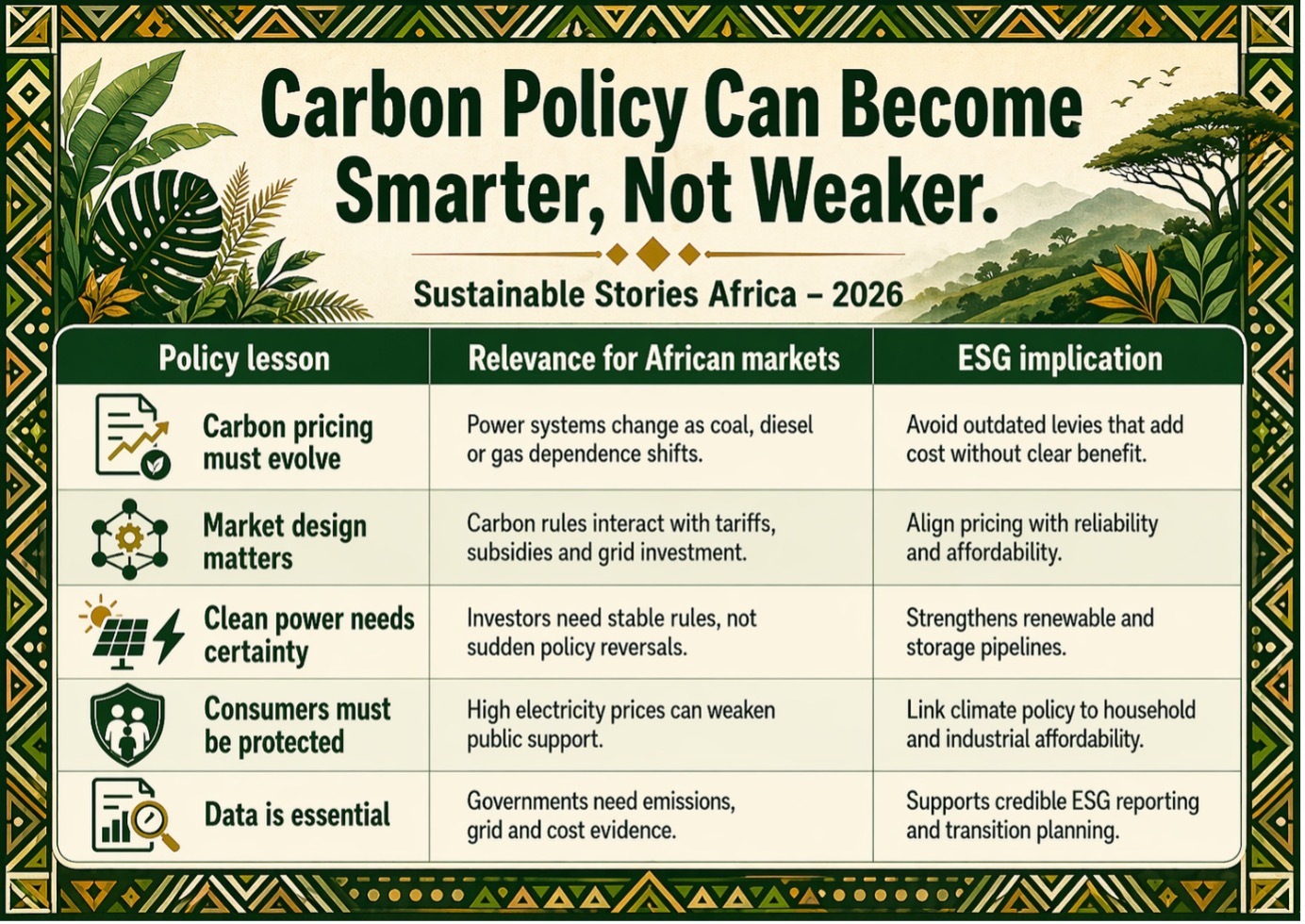
Carbon Policy Can Become Smarter, Not Weaker
The debate over removing the Carbon Price Support (CPS) reflects a broader question: how carbon pricing should evolve as power systems decarbonise.
The Institute for Fiscal Studies describes the move as a modest but positive step, noting that CPS had begun to distort incentives, given that electricity generation is already regulated under the UK Emissions Trading Scheme (ETS).
The ETS caps total emissions; removing CPS is unlikely to increase overall emissions but may reshape the distribution of costs across sectors.
For African markets, the implication is clear: carbon pricing is most effective when aligned with system realities and policy timing.
Layered or poorly coordinated instruments risk raising costs without delivering proportional emissions reductions.
The Energy and Climate Intelligence Unit, however, cautions that CPS played a critical role in eliminating coal and warns that its removal, ahead of UK-EU ETS alignment, could expose British electricity exports to future carbon border costs.
Build Carbon Rules Around System Reality
The action point for African power markets is not to copy Britain’s tax removal. It is to study the sequencing.
Countries still reliant on diesel generation, inefficient grids, or coal-linked imports may need carbon-pricing tools to discourage high-emission power.
However, those tools must be paired with alternatives: renewable procurement, transmission investment, storage, mini-grids, industrial support and consumer protection.
Nigeria, South Africa, Kenya, Ghana and other African markets face a similar balancing act.
They must attract clean-energy finance while avoiding electricity policies that punish households and manufacturers before reliable alternatives are available.
Carbon pricing can guide investment, but it cannot replace grid expansion, regulatory coordination or bankable project pipelines.
For businesses, the UK decision also reinforces a reporting lesson: transition risk changes.
A levy, subsidy or emissions market can reshape power costs, supply-chain emissions and investment assumptions within a few years.
ESG teams should therefore track policy shifts as financial risks, not just sustainability footnotes.
Path Forward – Price Carbon, But Protect Power Transition
The path forward is disciplined sequencing: price emissions, retire high-carbon assets, protect consumers and keep investment signals credible.
African markets can use the UK shift as a practical lesson. Carbon pricing should accelerate cleaner power, not become a blunt cost burden.
The priority is to design rules that reward lower emissions, strengthen grids, mobilise financing, and keep electricity affordable for households, firms and public trust.
Culled From: UK to Scrap Carbon Tax on Power in 2028 as Coal Exit Reshapes Electricity Market and Carbon Pricing