
Private markets are moving toward a common ESG reporting language through the ESG Data Convergence Initiative.
The framework responds to a long-running problem: fragmented sustainability data across private equity portfolios, funds and companies.
For African and Global South businesses seeking investment, better ESG data could shape access to capital, risk pricing and long-term resilience.
Private Markets Face a Data Reckoning
Private markets do not only have an ESG problem. They have a compatibility problem.
That is the gap the ESG Data Convergence Initiative, or EDCI, is trying to close.
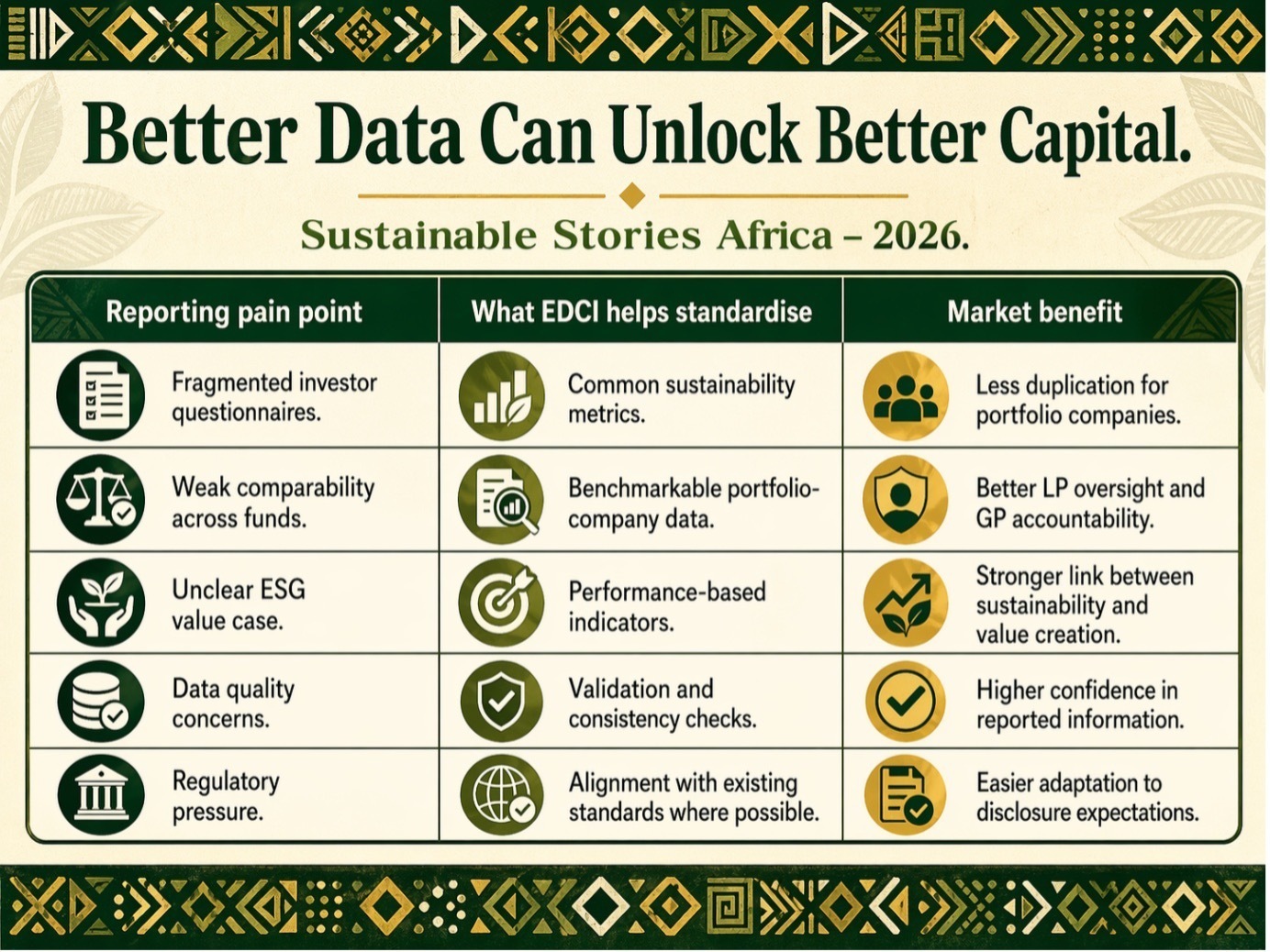
The initiative is an industry-wide effort to streamline how private investment firms collect and report sustainability data, replacing fragmented questionnaires and inconsistent metrics with a more comparable, performance-based approach.
The issue matters now because private equity, infrastructure and private credit increasingly finance the companies that build energy systems, logistics networks, hospitals, factories, digital infrastructure and food supply chains.
However, many of those businesses remain outside the reporting discipline expected of listed companies.
For a portfolio company in Lagos, Nairobi or Accra, the challenge is practical. One investor may ask for emissions data, another for diversity metrics, another for safety indicators, and another for climate targets.
Without convergence, ESG reporting becomes a compliance maze rather than a value-creation tool.
One Framework, Many Investor Questions
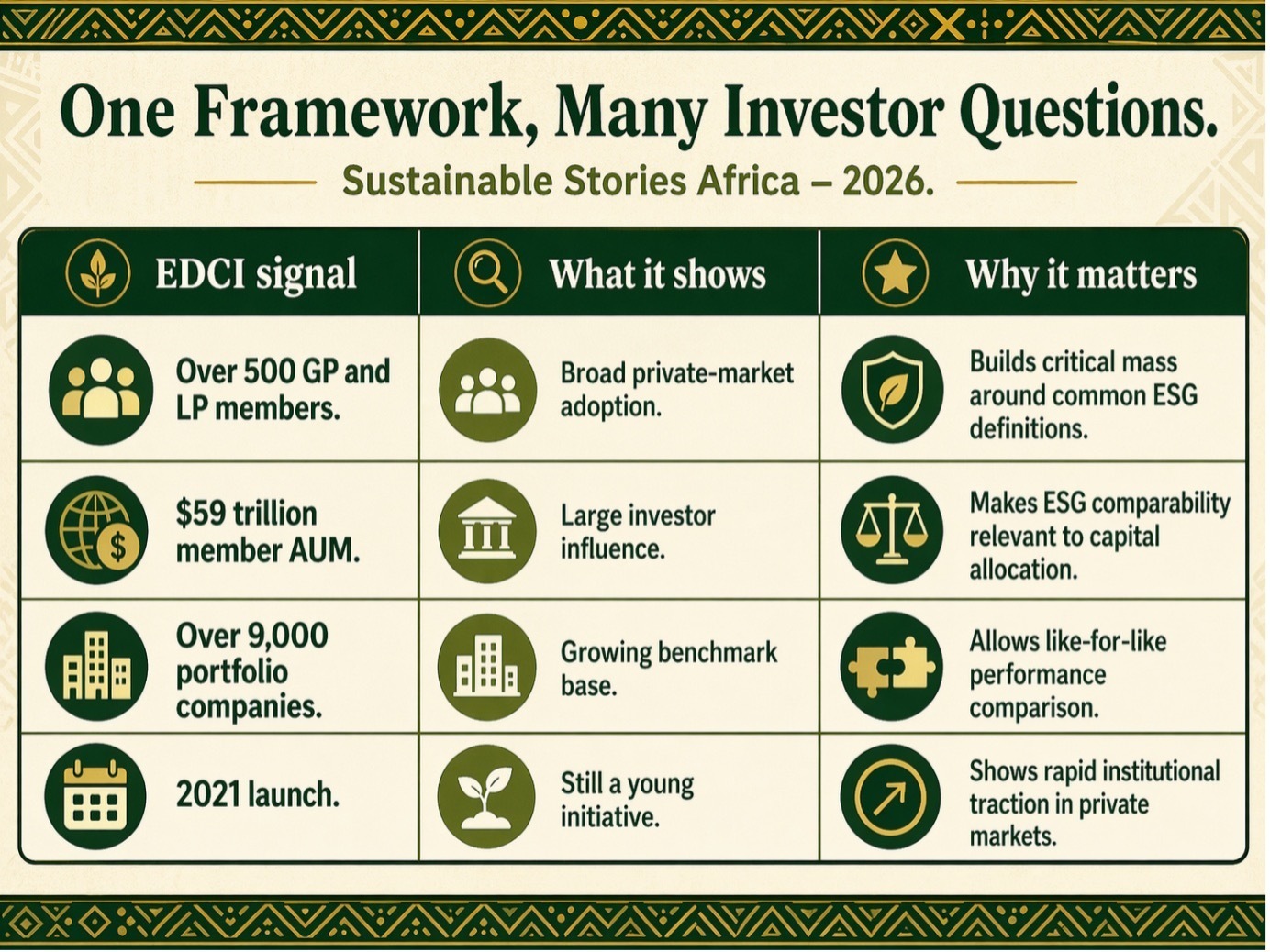
Launched in 2021 by private-market stakeholders, the ESG Data Convergence Initiative (EDCI) was designed to solve a persistent gap: the limited availability of comparable sustainability data from private companies.
Its platform now counts 500-plus general partner and limited partner members, representing approximately $59 trillion in assets under management and more than 9,000 portfolio companies.
Rather than imposing every disclosure framework simultaneously, EDCI focuses on a core set of standardised metrics, drawing on existing industry standards to improve data quality and benchmarking confidence.
The strategic significance is clear. In private equity and venture capital, ESG is shifting from broad intention to disciplined measurement.
Collaborative tools like EDCI are enabling investors to standardise metrics across portfolios, moving sustainability from a values statement into a performance management discipline.
Better Data Can Unlock Better Capital
The promise of EDCI is not paperwork. It is better capital discipline.
- When private-market ESG data is comparable, investors can ask sharper questions: Which companies are reducing emissions?
- Which firms are improving workplace safety?
- Which portfolio companies are improving diversity?
- Which assets are exposed to transition risk?
- Which managers are turning ESG policy into operational performance?
For African private companies, this matters because international capital increasingly comes with ESG expectations attached.
A manufacturing firm seeking growth equity, a renewable-energy developer raising project finance, or a logistics company preparing for expansion may all face investor requests for emissions, safety, governance and workforce data.
When done properly, EDCI-style reporting can reduce friction.
- It can help companies avoid answering ten versions of the same ESG question.
- It can also help local fund managers demonstrate that African assets are not merely high-growth opportunities, but measurable, governable and resilient investments.
The risk of inaction is clear. Without comparable ESG data, good companies may be undervalued, weak performers may hide behind vague sustainability claims, and investors may price uncertainty into African and Global South markets.
Turn ESG Reporting Into Market Infrastructure
The next step is to treat ESG data as market infrastructure, rather than a side report.
Private equity firms should embed EDCI-aligned indicators into portfolio monitoring from the point of investment, not as an afterthought during fundraising.
- Limited partners should reward managers who produce consistent, decision-useful sustainability data.
- Portfolio companies should build basic systems for collecting emissions, energy, safety, workforce and governance information before investor pressure becomes urgent.
- Regulators and development finance institutions also have a role.
In African markets, they can support local ESG data capacity, train fund managers, encourage interoperable disclosure tools and help small and mid-sized companies avoid being locked out of global capital because they lack reporting systems.
The strongest opportunity is convergence without overload: enough standardisation to build trust, but enough flexibility to reflect local realities.
Path Forward – Make ESG Data Investment-Ready
Private markets need ESG data that investors can compare, companies can collect, and communities can trust.
EDCI’s value lies in turning fragmented reporting into a shared language for performance, risk and accountability.
For African markets, the priority is capacity. Fund managers, portfolio companies and regulators should build practical data systems now, so sustainability reporting becomes a gateway to capital, not a barrier to growth.
Culled From: How the ESG Data Convergence Initiative Standardises ESG Reporting in Private Markets | OneStop ESG