The Iran war has pushed energy security and inflation back to the centre.
That matters because oil-linked shocks are again feeding into prices, budgets and policy.
For African markets, renewables now look like macroeconomic protection as much as climate action.
A War Shock Reopens an Old Economic Lesson
The latest war-linked disruption around Iran is reinforcing a growing consensus among policymakers and investors: renewable energy is no longer just climate policy, but a tool for managing inflation and macroeconomic risk.
A recent Green Central Banking analysis argues that the energy transition should be viewed as central to monetary and financial stability. This is due to shocks in fossil fuel prices, growth expectations and household costs.
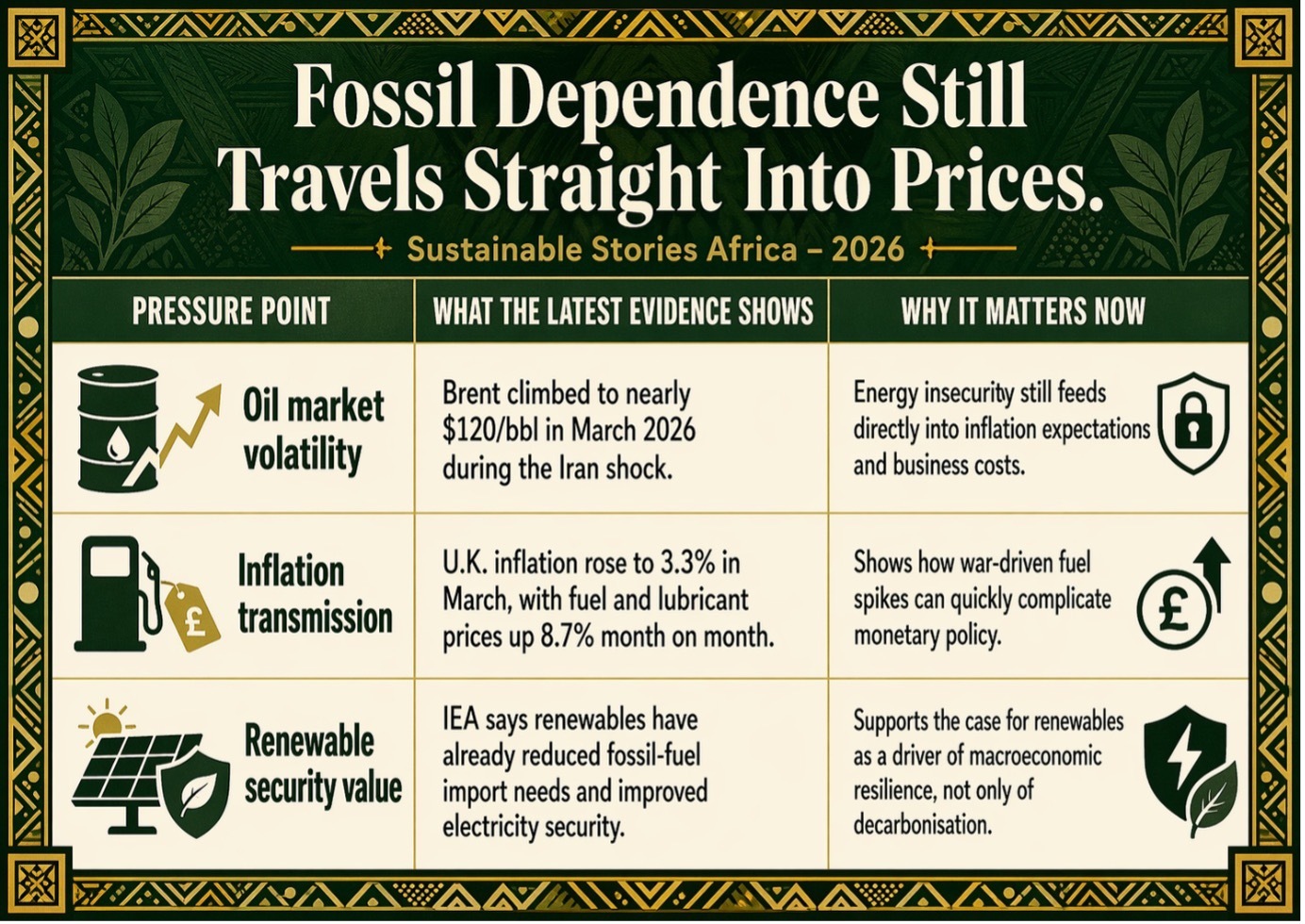
The timing is significant. The International Energy Agency reported that Brent crude rose to nearly $120 per barrel in March amid the conflict in Iran before easing, while supply disruptions heightened concerns about renewed inflationary pressure.
S&P Global cut its 2026 oil demand forecast by 700,000 barrels per day, reflecting weak demand and disrupted supply.
For African economies, the implications are immediate, as imported fuel costs feed into transport, food and electricity prices, raising a critical question about accelerating domestic clean energy investment.
Fossil Dependence Still Travels Straight Into Prices
The inflationary impact of geopolitical shocks is becoming harder for policymakers to ignore. In March, Oxford Economics warned that the Iran conflict was increasing inflation risks, challenging the long-held assumption that central banks could “look through” oil-driven price spikes.
The Wall Street Journal reported that U.K. inflation rose to 3.3% in March 2026, with fuel and lubricant prices climbing 8.7% month on month, partly driven by tensions in the Middle East.
This context reinforces a key argument from Green Central Banking: when renewables do not eliminate price shocks, they reduce exposure to the most volatile segment of the energy system, imported fossil fuels.
The International Energy Agency supports this view, noting that the expansion of renewables has strengthened electricity security and reduced import dependence.
According to Carbon Brief, 107 countries have already cut reliance on imported fossil fuels for power generation.
For African economies, this highlights how cleaner domestic energy can ease the transmission of inflation.
What Countries Gain by Moving Faster
The upside outweighs the lower emissions. When countries build more solar, wind, storage, and stronger grids, they are not only reducing carbon exposure; they are also lowering vulnerability to imported energy inflation.
That matters especially for economies that face recurring exchange-rate pressure, large fuel import bills or weak fiscal room to cushion shocks.
The Green Central Banking argument lands because it reframes clean energy as a tool for price stability, planning certainty and household protection.
For African markets, this could be transformative. A more resilient domestic electricity system can reduce diesel dependence, support productive sectors, and soften the pass-through from global oil turmoil into local inflation.
In practical terms, that means more predictable operating costs for manufacturers, less subsidy stress for governments and fewer sudden price jumps for households already stretched by food and transport costs.
Treat Energy Transition as Economic Defence
The policy implication is clear. Governments should stop defending renewables only in environmental language and begin presenting them more honestly as inflation defence, industrial strategy and energy-security infrastructure.
Central banks and finance ministries should integrate energy transition risk into inflation and stability analysis, while development financiers should back projects that reduce fossil-fuel import exposure over time.
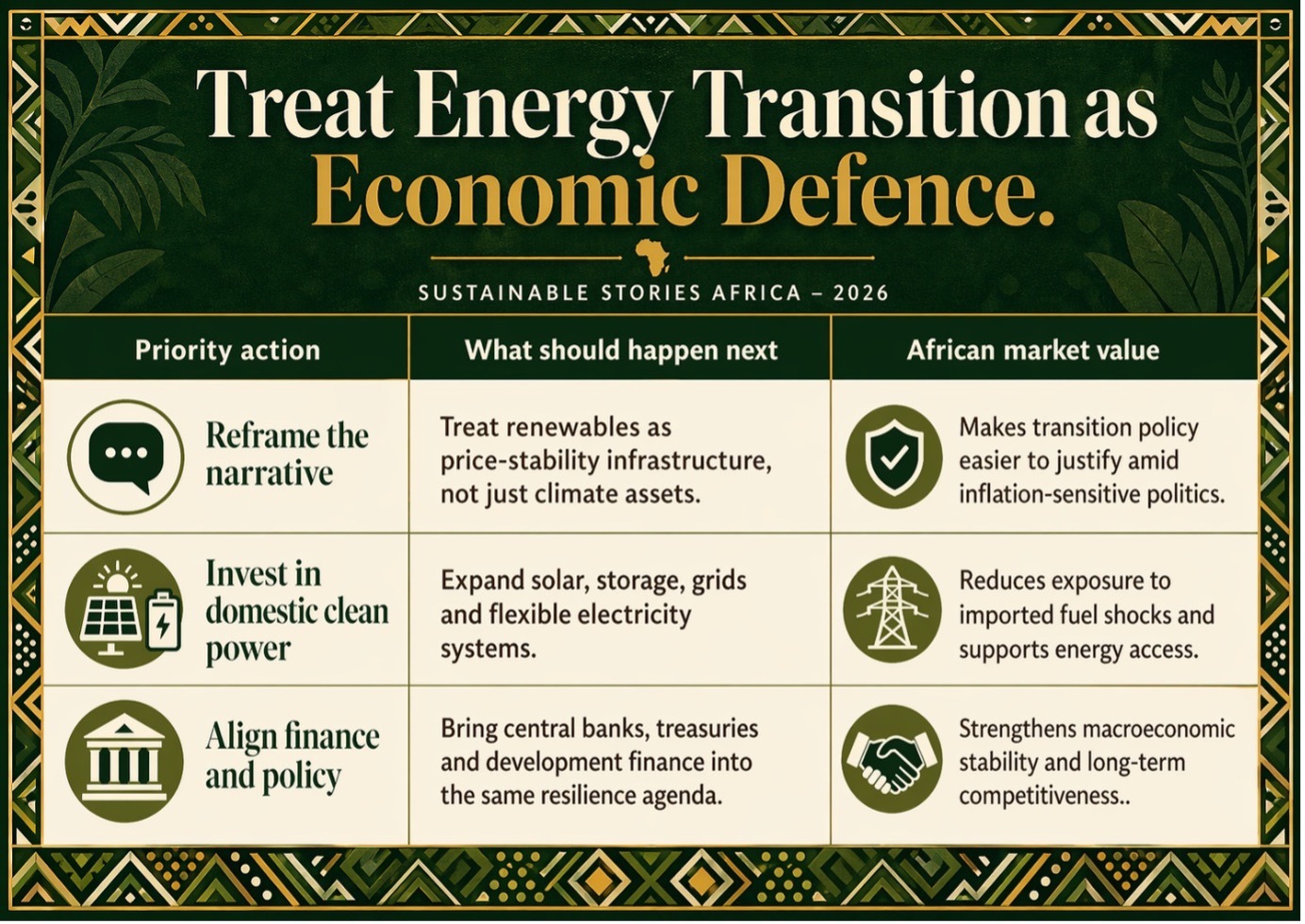
The deeper point is that every fossil-fuel shock is also a policy test. Countries that keep treating the energy transition as optional climate branding may find themselves importing inflation again and again.
Path Forward – Price Stability Needs Cleaner Power
African markets have an opening to recast energy transition as economic self-protection.
The stronger case now is not only lower emissions, but lower vulnerability to imported inflation and geopolitical disruption.
That makes the next step straightforward: accelerate domestic renewable capacity, grid resilience and smarter energy finance.
In today’s risk environment, ESG progress and inflation management are both risk management strategies that are employed more efficiently.
Culled From: Iran war shows renewable energy is inflation management too - Green Central Banking