
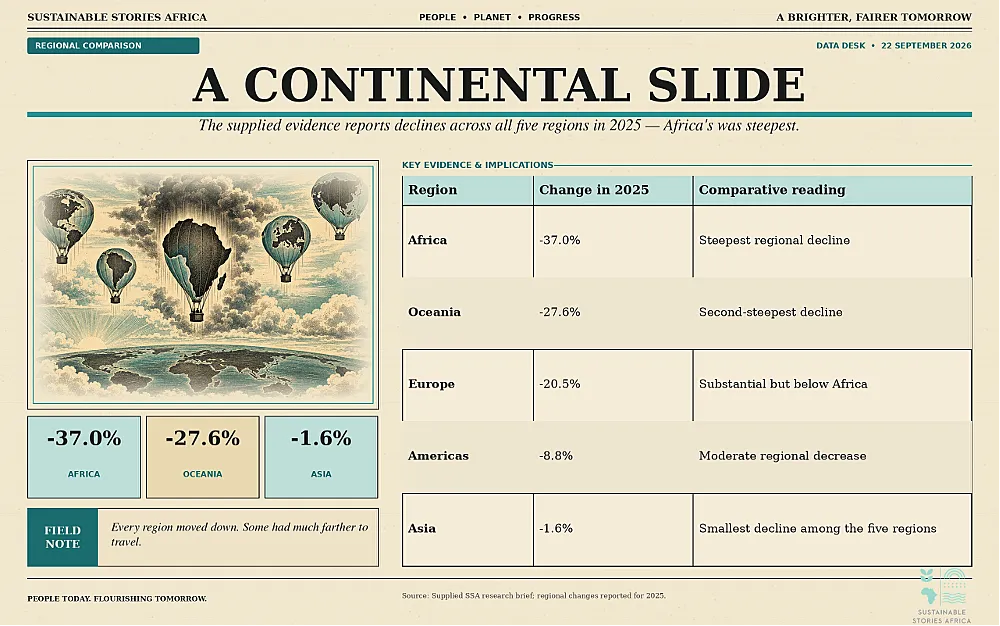
United States visa issuances to Africa fell 37% in 2025, the steepest decline among world regions.
Egypt and Nigeria accounted for more than half of Africa’s reduction, while B1/B2 visitor visas drove most of the continental fall.
The figures raise questions about mobility, business links and access; however, they do not alone reveal whether fewer applications or lower approval rates caused the decline.
Africa Leads A Worldwide Visa Decline
Africa recorded the sharpest regional drop in United States visa issuances in 2025, according to Intelpoint’s analysis of US Department of State data.
- Issuances fell from about 401,800 in 2024 to 253,200 in 2025, a decline of 148,600 or 37%.
Every region recorded a reduction; however, Africa’s contraction was far deeper than Asia’s 1.6%, the Americas’ 8.8%, Europe’s 20.5% and Oceania’s 27.6%.
- Africa accounted for 26.6% of the 550,800 fewer visas issued across the five regions, despite representing a smaller share of the total flow than some other regions.
Visitor Visas Explain Most Lost Issuances
B1/B2 visas for temporary business and tourism accounted for 84% of Africa’s overall decline.
- Together, Egypt and Nigeria contributed more than half of the continent’s reduction, concentrating the effect in two of its most populous and internationally connected economies.
The result can affect more than holidays.
- Visitor visas support business meetings, conferences, family visits and professional networks.
- A sharp fall can therefore raise costs for firms and families, narrow access to international markets and reduce opportunities for in-person exchange.
The burden is greater where travellers already face long journeys to interview locations and high application-related expenses.
Numbers Need Transparent Explanations And Context
Issuance totals are not the same as approval rates.
- They can change because application volumes rise or fall, processing capacity shifts, eligibility decisions change, interview access narrows, or administrative policy is adjusted.
- Without matching data on applications, refusals, appointment availability and visa categories by country, the figures cannot show a single cause.
That distinction matters for public debate.
- A reduced number of visas issued may reflect fewer applicants, tougher screening, delayed processing or several forces acting together.
- Governments, universities, companies and travel organisations need category-level evidence before designing a response or drawing conclusions about how African applicants were treated.
Country concentration also deserves attention.
- When Egypt and Nigeria account for more than half of Africa’s decline, a continental average can hide very different experiences elsewhere.
- Disaggregated reporting would show whether the fall was broad-based or driven by a small number of high-volume routes, and whether business, tourism, student or other travel channels faced the greatest practical disruption.
Mobility Systems Must Become More Accountable
US authorities should publish timely, comparable country-level data covering applications, issuances, refusals, waiting times and appointment capacity.
- Clear explanations of major year-on-year changes would help applicants plan and allow policymakers to distinguish operational bottlenecks from policy effects.
African governments can support travellers through accurate public guidance, stronger document systems and consular engagement where processing constraints are evident.
Businesses should also use hybrid participation in international events when physical access is uncertain.
- The immediate priority is transparency: a 37% decline is significant, but meaningful accountability requires knowing where and why the pathway narrowed.
Applicants also need predictable procedures.
- Clear appointment calendars, timely notices and accessible review information reduce the financial harm created by uncertainty.
These operational improvements would not guarantee visas, but they would make the system easier to navigate and allow legitimate travel decisions based on evidence rather than speculation.
Path Forward – Explain The Decline And Restore Access
Authorities should pair issuance totals with applications, refusals, waiting times and category-level explanations.
That evidence would show whether demand, processing capacity or policy drove the fall.
African institutions can improve applicant guidance and preserve international exchange through consular engagement and credible hybrid options while access constraints are addressed.
Culled from: Every region saw B1/B2 visa issuances drop in 2025 — Africa's decline was the steepest of all - Intelpoint