Kenya Power posted a $193 million profit after tax for the year to June 2026, extending its profitable run to three years.
Higher electricity sales and better network efficiency supported the result, while utilities in Ethiopia and South Africa also reported stronger profits.
The gains create room for investment, but tariff increases keep affordability and service quality at the centre of the debate.
Kenya Power Extends Its Recovery
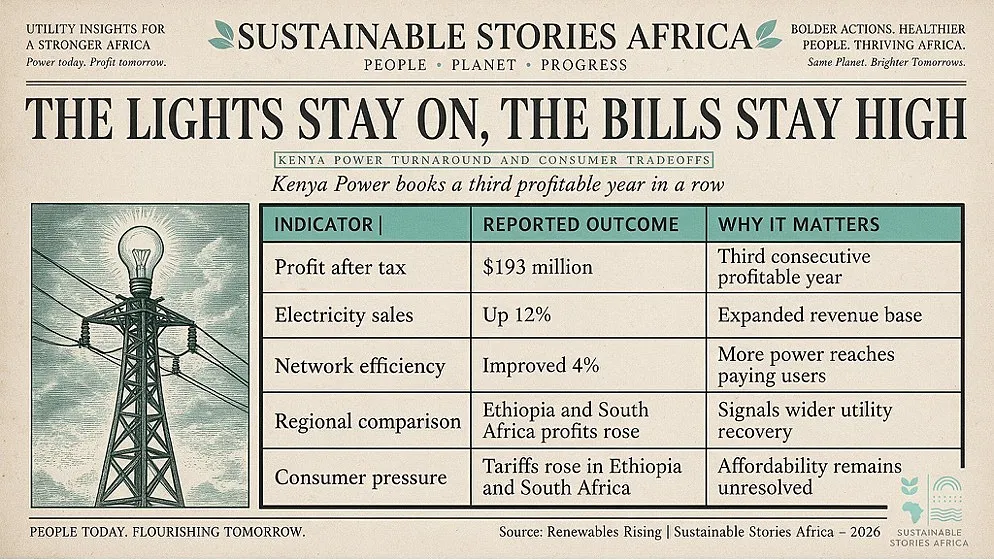
Kenya Power reported profit after tax of $193 million for the year ended June 2026, its third consecutive profitable year, according to Renewables Rising.
- Electricity sales increased by 12%, while distribution and transmission efficiency improved by 4%.
The utility joins major operators in Ethiopia and South Africa in reporting stronger profits.
The result is notable in a sector where weak collections, network losses, ageing assets, currency exposure and politically sensitive tariffs have often produced financial distress.
- Stronger earnings can improve a utility's ability to maintain infrastructure, connect customers and attract finance, but only if profits are converted into reliable and affordable service.
Sales And Efficiency Drive Earnings
A 12% rise in sales expands revenue, while a 4% efficiency improvement means more generated electricity reaches paying users.
- Together, those changes strengthen cash flow without relying solely on price increases.
Reducing technical losses, theft, billing errors and collection gaps remains one of the fastest ways African utilities can improve performance.
Kenya Power's position is also changing as the market prepares for greater competition and possible unbundling.
- The company may need to develop generation projects, reinforce networks and define its future role in grid control and management.
- Profits provide capacity to invest, but competition will increase pressure to demonstrate service quality and disciplined capital allocation.
Consumers Carry Part Of The Adjustment
Improvement in utility finances can come with higher tariffs.
- Ethiopia and South Africa raised electricity prices during 2026, while Kenya abandoned a proposed tariff review after consumer complaints.
The contrast shows the political and social limits of cost recovery in markets where households and small businesses already face high living and operating costs.
Tariffs that remain below efficient cost can weaken utilities and delay investment.
- Sharp increases without visible reliability gains can also reduce trust, encourage non-payment and intensify energy poverty.
Regulators therefore need transparent tariff models, targeted support for vulnerable users and clear performance obligations for the utilities that receive additional revenue.
Profits Should Fund Better Service
Utilities should publish how they will use earnings improvements, including network reinforcement, metering, renewable integration, maintenance and customer service.
- Regulators can tie tariff decisions to measurable reductions in outages and losses, faster connections and accurate billing.
Governments should avoid using utility balance sheets to conceal subsidies or unfunded public obligations.
- Where support is necessary, it should be budgeted transparently and targeted.
Financially stronger utilities can anchor economic growth, but consumers will judge the turnaround by the electricity available at homes and businesses, not by profit figures alone.
Governance Determines Whether Recovery Lasts
Utility turnarounds can fade if political interference, weak procurement or delayed government payments return.
- Boards and regulators need credible audits, transparent power-purchase obligations and clear separation between commercial decisions and social policy.
- Public institutions should pay their bills on time, while any mandated subsidy should have an identified budget source.
Stronger balance sheets can enable Climate resilience.
- Utilities can invest in network hardening, distributed renewable energy and storage to reduce exposure to drought, storms and fuel-price shocks.
- The investment case should include service reliability and avoided losses, not only new generation capacity.
Path Forward –Convert Utility Profits Into Reliable Power
African utilities should direct stronger earnings toward networks, metering, maintenance and new capacity while reporting results against public service targets.
Regulators must balance cost recovery with affordability through transparent tariffs and targeted support.
Sustained profitability matters most when it produces fewer outages, lower losses and wider access.
Culled from: Major utilities post rare profit increases