South Africa’s power conversation is moving from emergency supply toward the design of a competitive electricity market.
Aurora Energy Research and Mulilo identify transmission, batteries, flexibility and patient capital as decisive constraints and opportunities.
The transition will succeed only if new capacity produces reliable, affordable power and transparent market signals.
The Crisis Eases, The Market Challenge Begins
South Africa’s electricity debate is entering a new phase. A few years ago, the overriding objective was to end load shedding.
Now, as private investment accelerates and the proposed South African Wholesale Electricity Market takes shape, the question is how to build a system that remains reliable and affordable while its generation fleet changes.
That shift framed an Energy Unplugged discussion released on September 1, 2026, between Caroline Still, Aurora Energy Research’s Market Lead for South Africa, and Jan Fourie, chief executive of renewable-energy developer Mulilo.
Their conversation placed transmission at the centre of the next bottleneck and identified batteries, flexibility, procurement reform and patient capital as foundations of the emerging market.
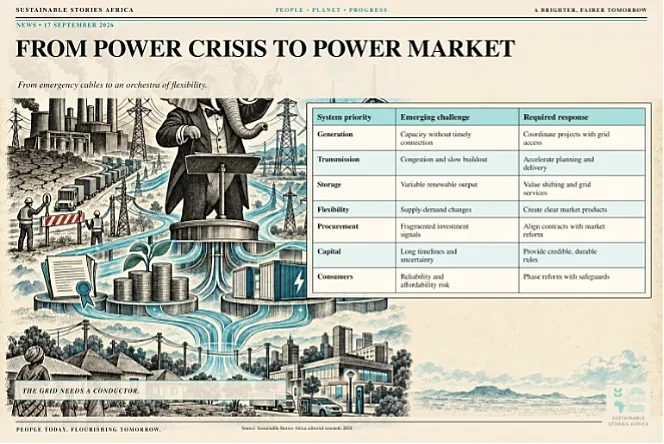
Transmission Now Limits The Next Buildout
Adding generation is no longer enough if projects cannot secure grid access or deliver power when the system needs it.
- Renewable resources are often concentrated far from demand centres, while transmission planning and construction take years.
- Congestion and curtailment can therefore weaken project economics even when wind and solar plants are technically ready to produce.
Batteries change that equation by shifting electricity across time, smoothing renewable output and providing services that support system stability.
- In a more competitive market, those capabilities can become valuable products rather than invisible engineering functions.
- Flexibility may come from storage, dispatchable generation, responsive demand or contracts that reward participants for changing output and consumption when conditions tighten.
The proposed wholesale market could also reshape procurement and pricing.
- Instead of relying mainly on centrally negotiated capacity, transparent market signals could reveal when and where electricity is most valuable.
However, transition design matters:
- Weak rules, concentrated market power or unclear grid access can transfer risk to consumers and deter the long-horizon investment needed for infrastructure.
Market Signals Can Reward Useful Power
A well-designed market could attract a wider pool of developers and financiers while distinguishing between cheap energy and dependable system value.
- Solar generated at midday, battery capacity available during an evening peak and transmission that unlocks a constrained region should not be treated as identical products.
- Clear prices can guide investment toward the combination the system requires.
For households and businesses, the desired outcome is practical:
- Fewer outages, lower system costs and more predictable tariffs.
For workers and communities:
- A managed transition can create new technical roles and investment while giving affected coal regions time and support to diversify.
For investors:
- Credible rules and stable institutions reduce uncertainty that cannot be solved by only technology.
Sequencing is crucial.
- If market trading begins before metering, settlement, grid codes and enforcement are dependable, participants may price uncertainty into contracts and consumers may carry the cost.
- A staged launch, supported by published simulations and stress tests, would let institutions build competence while exposing design weaknesses before they affect the entire system.
Reform Must Coordinate Wires, Rules And Capital
South Africa should align transmission expansion, connection queues, procurement and wholesale-market rules rather than treating them as separate programmes.
- Grid access information should be transparent, projects should face realistic delivery milestones, and market design should value flexibility without creating windfall costs or excluding smaller participants.
Regulators and policymakers also need consumer safeguards, independent oversight and a phased implementation plan that can be tested and corrected.
Developers and financiers should build for system needs, not merely for installed megawatts.
The country has a rare opportunity to reform its market while replacing and expanding generation; coordination will determine whether that opportunity becomes affordable power or another layer of complexity.
Path Forward – Coordinate Grid Expansion With Market Reform
South Africa should publish credible transmission timelines, transparent connection rules and phased wholesale-market safeguards that protect competition and consumers.
Procurement and finance should reward batteries, flexible demand and generation that delivers power where and when the system needs it.