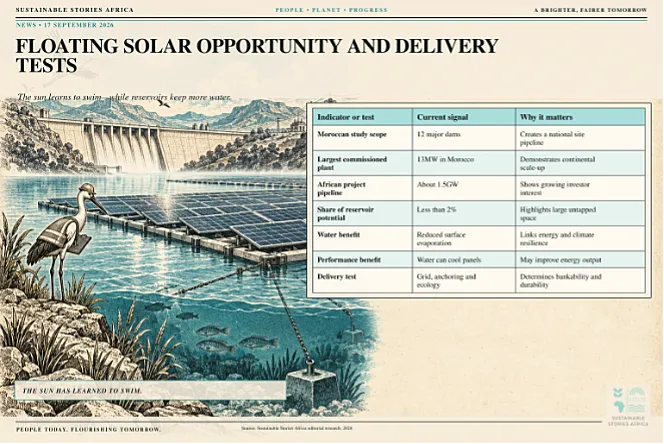
Morocco plans feasibility studies for floating solar projects across 12 major dams after commissioning a 13MW plant.
Across Africa, about 1.5GW is under development, yet that pipeline represents less than two per cent of estimated freshwater-reservoir potential.
The technology could add clean power while limiting evaporation, but careful reservoir planning will determine its value.
Solar Panels Move Onto Africa’s Reservoirs
Morocco is preparing to study floating solar installations at 12 major dams, signalling that reservoirs could become an important part of Africa’s clean-energy build-out.
Renewables Rising reported on September 15, 2026, that the plan follows Morocco’s commissioning of a 13MW floating solar plant, described as the continent’s largest.
The wider opportunity is substantial but largely untouched.
- About 1.5GW of floating solar projects are under development across Africa, yet this represents less than two per cent of the estimated technical potential of freshwater reservoirs alone.
For countries balancing electricity shortages with intensifying heat and water stress, using an existing water surface for power generation offers an unusually connected response.
Dams Offer Power, Cooling And Conservation
Floating photovoltaic systems place solar modules on buoyant structures anchored to a reservoir bed or shoreline.
- They can avoid some of the land acquisition and competing-use pressures faced by ground-mounted projects, particularly near dense cities, farms or protected areas.
- Existing dam roads, substations and transmission corridors may also reduce development friction where they have spare capacity.
The water itself can improve performance.
- Cooler surroundings can help panels operate more efficiently, while partial shading of the surface can reduce evaporation in hot, dry climates.
These benefits explain the growing interest in pairing floating solar with hydropower reservoirs:
- Daytime solar can complement controllable hydro generation, and shared infrastructure can potentially make better use of grid connections.
However, a reservoir is not an empty project site.
- Developers must assess water levels, wind, waves, sediment, water quality, fisheries, recreation and dam operations.
- Anchoring systems must withstand seasonal variation, and electrical equipment must be designed for a wet, corrosive environment.
- Feasibility studies therefore need to evaluate energy yield and water-system impacts together.
Integrated Planning Could Unlock Wider Benefits
If Morocco’s studies identify viable sites, the programme could create a repeatable model for other African countries with large reservoirs and constrained grids.
- A well-designed project can supply low-carbon electricity without requiring a new land footprint, conserve some water and support local work in engineering, installation, monitoring and maintenance.
The strongest case will be made where several benefits overlap.
- A project beside existing transmission, close to demand and on a reservoir with high evaporation exposure may deliver more system value than one chosen only for its theoretical panel capacity.
- Transparent environmental and social assessment will also be essential, particularly for communities whose livelihoods depend on fishing, irrigation or access to the water.
Portfolio planning can further reduce risk.
- Rather than advancing every site at once, authorities can select a small group with different climatic and operational conditions, compare performance and feed the evidence into later procurement.
- Shared technical standards and open results would allow lenders, regulators and neighbouring countries to learn from early installations instead of repeatedly paying for the same uncertainties.
Feasibility Must Measure More Than Megawatts
Governments and utilities should use the next round of studies to build a public evidence base:
- Seasonal generation profiles, avoided evaporation, grid-connection costs, ecological effects, local procurement potential and lifecycle responsibilities.
- Procurement should allocate risks clearly and require developers to monitor water quality and equipment performance over time.
Regulators can help by clarifying water-use rights, permitting, safety standards and how floating solar will be dispatched alongside hydropower.
Financiers, meanwhile, should assess projects on total system value rather than headline capacity.
Africa’s 1.5GW pipeline is a start; converting potential into dependable power will depend on disciplined site selection and long-term stewardship.
Path Forward – Choose Sites Through Water-Energy Evidence First
Morocco should rank the 12 dams using energy yield, evaporation exposure, grid access, ecology and community use, not capacity alone.
Clear permits, bankable contracts, local skills and public monitoring can turn early projects into a responsible regional model.
Culled from: Floating solar eyes dams to boost generation