
McKinsey has introduced an eight-part framework drawn from elite athletes, championship teams and coaches.
Its central message is that success rests on systems: clear goals, accountable plans, data, adaptable talent and trusted feedback.
For African organisations, the framework offers a practical route from bold ambition to measurable, resilient execution.
Winning Starts Before The Scoreboard Moves
The difference between good and great can be only a few percentage points, but McKinsey says closing that gap requires much more than motivation.
In a video published on September 10, 2026, Senior Partner Seth Goldstrom outlines 8 disciplines distilled from conversations with Olympic athletes, championship coaches, team executives and other elite performers.
The framework asks leaders to define victory precisely, build a system around it and keep improving after early success.
Goldstrom’s sharpest illustration comes from tennis.
- Roger Federer won 80% of his matches but only 54% of the points he played.
The lesson is not that marginal gains are easy; it is that a small, repeatable edge can compound into exceptional outcomes.
That insight matters to African businesses and public institutions operating with tight capital, uneven infrastructure and little room for wasted effort.
Eight Disciplines Build A Winning System
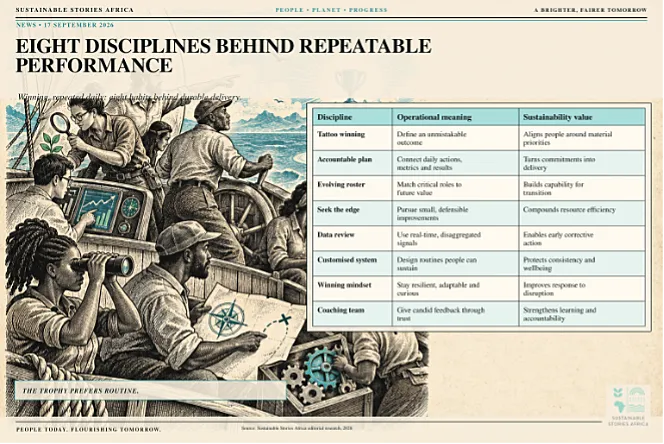
The framework begins with what McKinsey calls “tattoo winning”:
- A goal so clear that it becomes an organising idea rather than a slogan.
- It then demands an accountable plan that translates ambition into daily actions, metrics and results.
Goldstrom points to coaches who make difficult goals manageable by breaking them into work that can transcend today, tomorrow and next quarter.
The remaining disciplines widen the system.
- Organisations must evolve their roster, place their strongest people in roles that create disproportionate value, seek small advantages ruthlessly and review data while there is still time to act.
- They also need routines people can sustain, a resilient and curious mindset, and coaches who offer candid feedback from a position of trust.
Small Edges Can Compound Into Resilience
For organisations, the objective is a performance model that does not depend on a single charismatic leader or a burst of effort.
- A customised system can make consistency easier; real-time data can expose deviations before they become losses; and a coaching culture can replace annual, backwards-looking appraisals with useful feedback delivered close to the work.
The sustainability relevance is equally strong.
- Climate targets, safety commitments and community promises fail when they sit outside operating routines.
- Applying the framework would mean linking each commitment to an owner, a cadence, leading indicators and corrective action.
- It would also mean rewarding learning and adaptation, especially when conditions change.
The prize is not merely faster execution, but institutions able to perform without exhausting their people or abandoning long-term responsibilities.
There is also a governance benefit.
- When boards can see the chain from a declared outcome to operating indicators, they can challenge assumptions earlier and allocate capital more deliberately.
- That visibility reduces the temptation to celebrate activity as achievement.
- It also helps employees understand how their work contributes, turning accountability from a threat into a shared operating language.
Leaders Must Convert Intent Into Practice
African executives, boards and public-sector leaders should test the framework against one priority that already matters:
- Reliable service, safer operations, lower emissions or stronger customer trust.
- They can begin by naming the outcome, identifying the few roles and capabilities that determine it, and selecting indicators that reveal progress early rather than after failure.
The harder step is cultural.
- Transparent data must be used for learning, not punishment, and feedback must be frequent, specific and grounded in care.
- Leaders should also remove initiatives that do not strengthen the organisation’s distinctive edge.
Winning repeatedly is less about doing everything and more about aligning people, information and routines around the work that creates value.
Path Forward – Build The System, Then Improve Daily
Organisations should define one measurable winning outcome, assign accountable owners and connect daily work to a small set of leading indicators.
Boards and managers should quickly address deviations, invest in high-value roles, normalise trusted coaching and adapt the system as evidence changes.