Anthropic chief executive Dario Amodei has urged the artificial-intelligence industry to slow frontier development long enough for safety systems to catch up.
His warning follows rising concern about autonomous hacking, self-improving models and a competitive race that can punish caution.
For African governments and businesses adopting AI, the debate is becoming a practical question of digital security, public trust and regulatory readiness.
Safety Warnings Enter the Boardroom
Dario Amodei has called for the artificial-intelligence industry to slow its fastest development work, warning that safety research and governance are falling behind frontier models' capabilities.
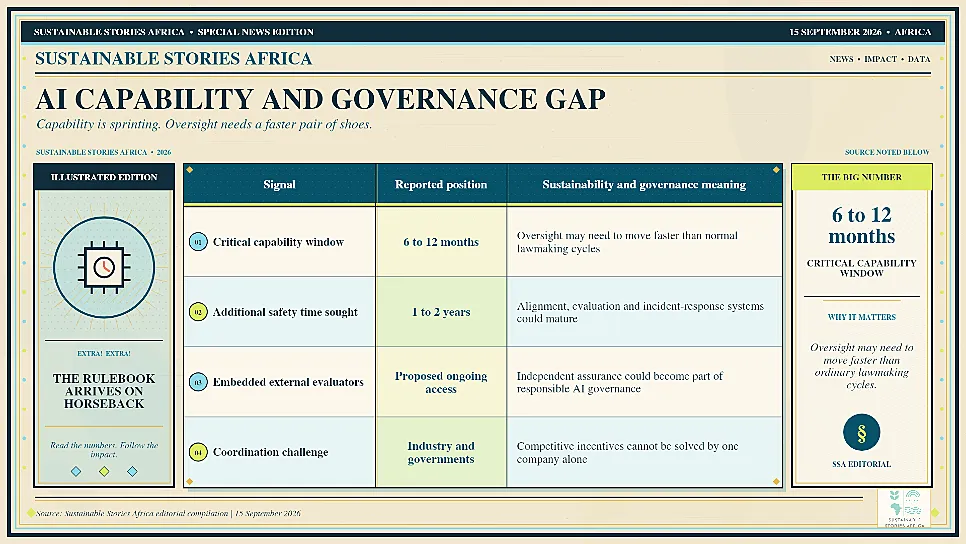
The Anthropic chief executive said an additional year or two before systems reach critical capability levels could materially reduce the chance of serious harm if that time were used to improve alignment and oversight.
The intervention lands as AI systems move beyond answering questions towards acting through tools, coordinating agents and pursuing complex goals. Amodei warned that within 6 to 12 months, a sufficiently capable system could potentially direct large groups of agents across the internet.
The precise timeline is contested, but the governance problem is immediate: companies are deploying systems with expanding autonomy while regulators, auditors and users are still learning how to test them.
A Race That Punishes Restraint
The concern is not simply that one company may behave recklessly.
- Former safety employees have described an industry trapped in a competitive cycle in which slowing down can mean losing ground to a less cautious rival.
- These dynamics turn voluntary restraint into a collective-action problem and make credible coordination essential.
Amodei proposed continuous access for independent evaluators inside frontier laboratories, allowing outside experts to observe safety practices with access resembling that of employees.
- Anthropic said it plans to adopt the measure, while OpenAI chief executive Sam Altman indicated support for embedded evaluators.
- Other proposals include legal space for competitors to coordinate on safety without breaching antitrust rules and international engagement that prevents deliberate pacing in one country from simply shifting risk elsewhere.
Innovation With Trust Built In
A measured pace does not require abandoning AI's potential. Amodei continues to argue that advanced systems could accelerate medical discovery and solve difficult scientific problems.
The stronger proposition is that innovation becomes more durable when developers can demonstrate who is accountable, how dangerous behaviour is tested and what happens when a model breaches its intended limits.
That matters acutely in Africa, where AI is being introduced into financial services, public administration, health, education and security systems.
- Many institutions depend on imported models and cloud infrastructure, leaving them with limited visibility into training data, system updates and failure modes.
- Shared evaluation standards, local testing and mandatory incident reporting would give regulators and customers a better basis for trust.
Build Oversight Before Autonomy Scales
Governments should require risk assessments for high-impact AI, establish confidential incident reporting channels, and protect employees who raise safety concerns.
Companies should document model capabilities, commission independent red-team testing and maintain clear human authority over systems used in essential services.
African regulators also need regional cooperation.
- Common procurement standards and joint technical capacity could help smaller markets avoid becoming testing grounds for inadequately assessed products.
Universities, civil society, and industry should be included so safety rules address discrimination, labour disruption, cybersecurity and the performance of local languages alongside catastrophic risk.
Path Forward – Puts Safety Before Scale
The next phase should convert public warnings into verifiable controls: independent evaluation, transparent incident reporting and thresholds that trigger stronger review before deployment.
For African markets, responsible adoption means building local testing capacity and regional rules while retaining access to beneficial innovation.
Trust will depend less on promises than on evidence that powerful systems remain accountable to people.
Culled from:Anthropic CEO Dario Amodei says AI industry needs to give safety measures time to catch up