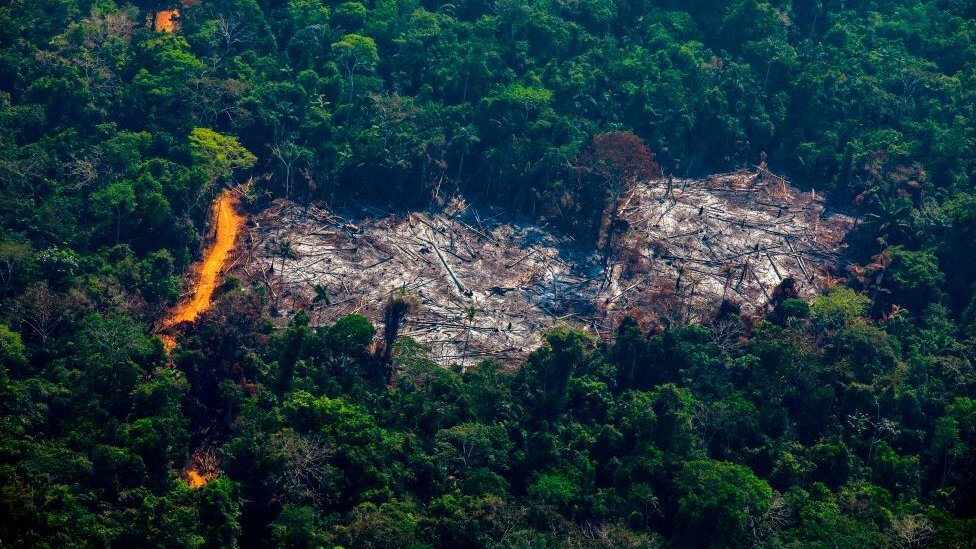
Companies are adopting the voluntary TNFD framework to identify how ecosystems support operations and where nature loss creates financial exposure.
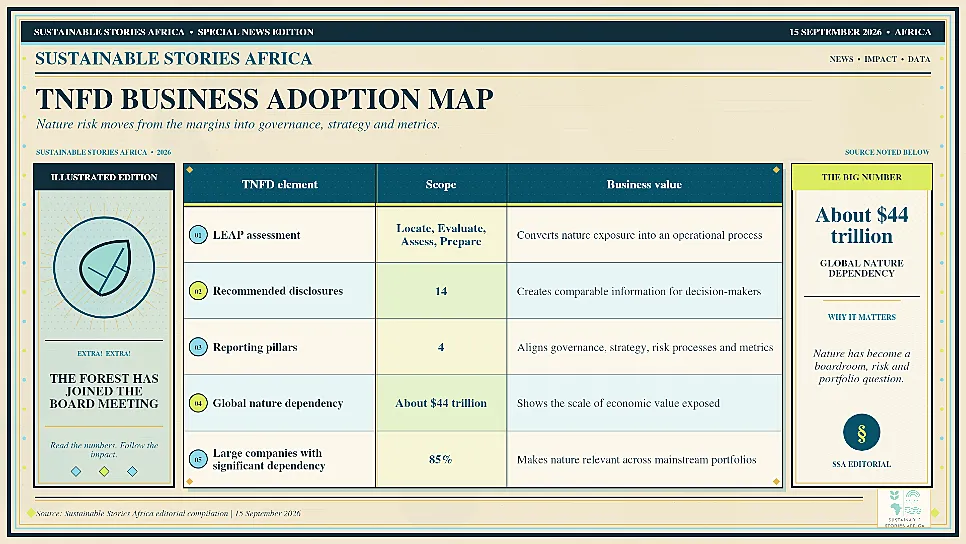
The framework uses 14 recommended disclosures across governance, strategy, risk and impact management, and metrics and targets.
For African businesses dependent on land, water and natural resources, early adoption can improve decisions before disclosure expectations harden.
Nature Risk Reaches Financial Decisions
Businesses are beginning to adopt the Taskforce on Nature-related Financial Disclosures framework before regulation requires them to do so, recognising that water scarcity, soil degradation, biodiversity loss and ecosystem disruption can affect costs, assets and supply continuity.
- The shift places nature alongside climate, currency and credit as a risk category requiring board attention.
The economic dependency is substantial.
- The World Economic Forum has estimated that about $44 trillion of economic value, more than half of global gross domestic product, is moderately or highly nature dependent.
- S&P Global has found that 85% of the world's largest companies have significant nature dependencies, while nearly half have at least one facility in a Key Biodiversity Area.
TNFD Turns Exposure Into Method
TNFD gives companies a structured way to move from general concern to evidence.
- Its LEAP approach asks organisations to locate their interface with nature, evaluate dependencies and impacts.
- Assess material risks and opportunities
- Prepare to respond and report.
The framework then organises disclosure through 14 recommendations across four pillars: governance, strategy, risk and impact management, and metrics and targets.
Adoption can begin internally.
- A company may map water-intensive sites, farms, mines, factories or suppliers before making a public statement.
That work can expose vulnerabilities that ordinary financial reporting misses until a drought stops production, a flood closes a route or deteriorating soil raises input prices.
Better Information Strengthens Resilience
Early adoption can help management prioritise capital, diversify suppliers and protect critical sites before disruption becomes expensive.
- It can also improve conversations with banks and investors by showing where exposure exists, who owns it and how progress is tracked.
- Disclosure becomes the result of stronger management rather than a substitute for it.
The framework is designed to connect with systems companies already use.
- It follows the four-pillar architecture familiar from climate reporting and has interoperability guidance with European Sustainability Reporting Standards and the Global Reporting Initiative.
- CDP has aligned its questionnaire with TNFD recommendations, reducing the risk that nature reporting becomes a disconnected compliance exercise.
For African businesses, this integration is valuable.
- Agriculture, mining, tourism, infrastructure and consumer supply chains depend directly on water, land and ecosystems, yet data can be fragmented.
- A phased approach allows firms to start with material locations and improve coverage as local capacity develops.
Start With Dependencies, Not Reports
Boards should first ask where the business depends on nature and where it affects nature in return.
Management can then map priority locations and value-chain nodes, assess financial materiality and assign clear ownership.
Companies should document uncertainty rather than waiting for perfect datasets.
Regulators and stock exchanges can support adoption through guidance, shared taxonomies and capacity building, while avoiding a box-ticking approach.
Financial institutions should ask borrowers about location-specific nature exposure and help clients finance mitigation.
Public disclosure should follow credible internal work, with metrics tied to decisions and outcomes.
Path Forward – Makes Nature Risk Manageable
TNFD adoption should begin with material dependencies, exposed locations and accountable governance, then expand towards comparable disclosure as data improves.
African companies that start early can strengthen resilience, investor confidence and strategic planning.
The goal is not another report, but the capacity to recognise, price and manage nature-related risk before ecosystems fail.
Culled from: Why Adopt TNFD? Why businesses are adopting the Nature-related Financial Disclosures framework