Nigeria's federal allocations rose sharply in nominal naira terms between 2021 and 2026, but inflation, currency depreciation and debt obligations reduced their purchasing power.
The argument shifts attention from how much government distributes to what public institutions can actually buy and deliver.
Transparent real-value reporting is needed to connect higher revenues with services, investment and household welfare.
Nominal Gains Meet A Real Value Test
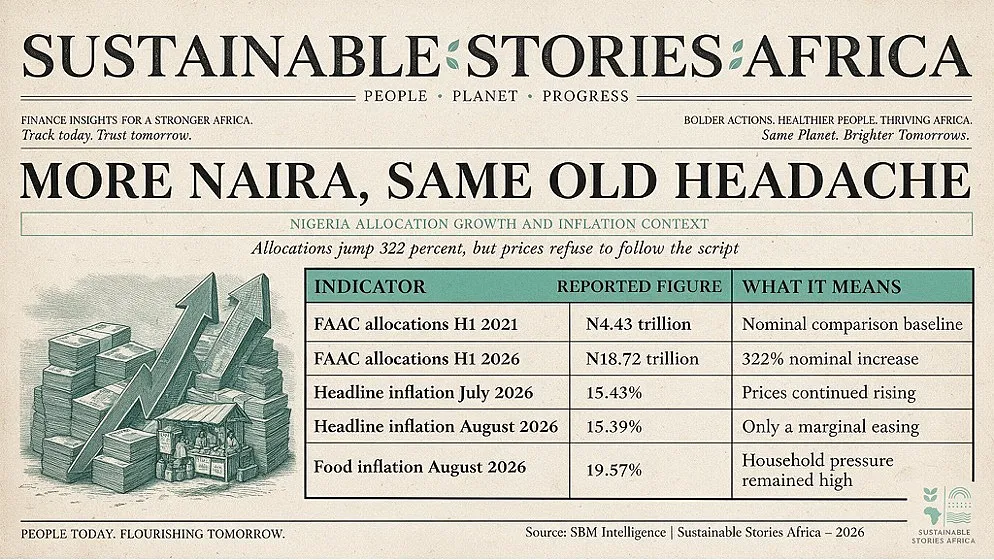
Nigeria's Federation Account Allocation Committee disbursements rose to N18.72 trillion in the first half of 2026 from N4.43 trillion in the same period of 2021, an increase of 322%, according to Agora Policy data cited by SBM Intelligence.
Former Vice-President Atiku Abubakar used the figures to argue that the headline rise does not show an equivalent increase in government spending power.
His criticism focuses on the gap between nominal revenue and lived economic outcomes.
- The naira has lost value, domestic prices have risen, and debt obligations absorb part of public income.
A state may receive more naira and still struggle to buy imported equipment, complete infrastructure, fund health services, or maintain payroll without arrears.
Inflation Relief Remains Too Small
Nigeria's headline inflation eased to 15.39% in August 2026 from 15.43% in July, while food inflation stood at 19.57%, SBM Intelligence reported.
- The monthly improvement is welcome, but it does not reverse the price increases already built into household and government budgets.
- Slower inflation means prices are rising less quickly; it does not mean they have returned to earlier levels.
For families, food, transport and energy costs determine whether economic statistics feel credible.
For public institutions, construction materials, medicines, vehicles, technology and contractor rates shape the real reach of allocations.
Comparing current transfers only with older nominal figures can therefore overstate the additional service capacity created.
Public Finance Needs Purchasing Power Measures
A clearer fiscal debate would publish allocations in nominal terms, inflation-adjusted naira and a relevant foreign-currency benchmark, alongside debt deductions and capital execution.
- This would let citizens and lawmakers see how much value reaches each tier of government and how much is converted into completed projects.
The issue also affects accountability.
- Larger receipts raise expectations, but weak procurement, delayed budgets and recurrent spending can prevent new revenue from improving public services.
- States that receive more must show whether there are improvements in school attendance, primary healthcare, water supply, road maintenance and business conditions.
- Revenue growth should be assessed against outcomes rather than cash transfers alone.
Governments Must Convert Revenue Into Services
Federal and state authorities should disclose the real value of allocations and the share committed to debt, salaries and capital investment. Independent fiscal institutions, civil society and legislatures can use those figures to test whether spending choices protect essential services from inflation and exchange-rate shocks.
Governments can also reduce exposure by improving local procurement where quality and scale allow, prioritising projects with clear completion paths and limiting new commitments that create recurrent costs without reliable funding. The objective is not to dismiss higher revenue, but to ensure it produces measurable public value.
State Comparisons Need Consistent Evidence
A common reporting format would also allow comparisons among states.
- Receipts per resident, capital spending per resident, project completion rates and service indicators could reveal which governments convert similar resources into better outcomes.
- Such comparisons should reflect different needs and starting conditions, but they would move debate beyond political claims about total allocations.
Citizens need accessible information, not only technical fiscal documents.
- Quarterly dashboards can show transfers received, deductions, major contracts, delivery dates and verified results.
When revenue rises, the public should be able to see which clinics, classrooms, roads or water systems were funded and whether they are functioning.
Path Forward – Measure Revenue By Services Delivered Publicly
Nigeria should report federal transfers alongside purchasing-power adjustments, debt deductions and project execution.
That would make year-to-year comparisons across years more accurate and public debate more useful.
The decisive test is whether higher allocations improve services and household welfare.
Transparent outcome reporting can show where revenue gains work and where inflation, debt or weak execution continues to absorb them.
Culled from: Atiku does the maths nobody wanted done