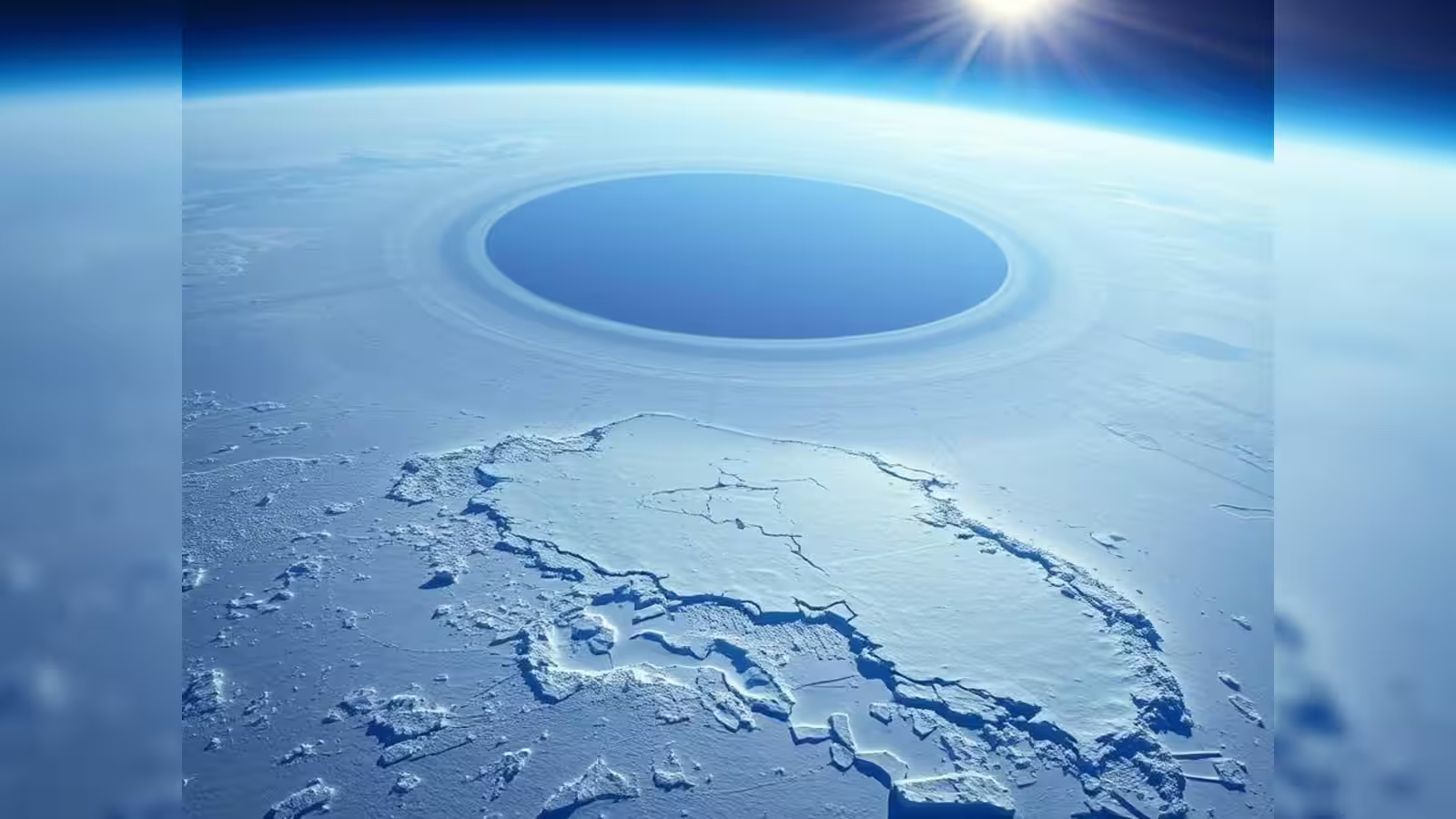
The 2025 Antarctic ozone hole was among the weakest in more than two decades, with its maximum ozone mass deficit more than 25% below the 1990 - 2010 average.
The result supports long-term recovery under the Montreal Protocol, though annual weather patterns still create substantial variation.
Scientists say sustained monitoring, calibration and public ultraviolet protection remain essential, especially in under-observed regions.
Ozone Hole Records A Milder Year
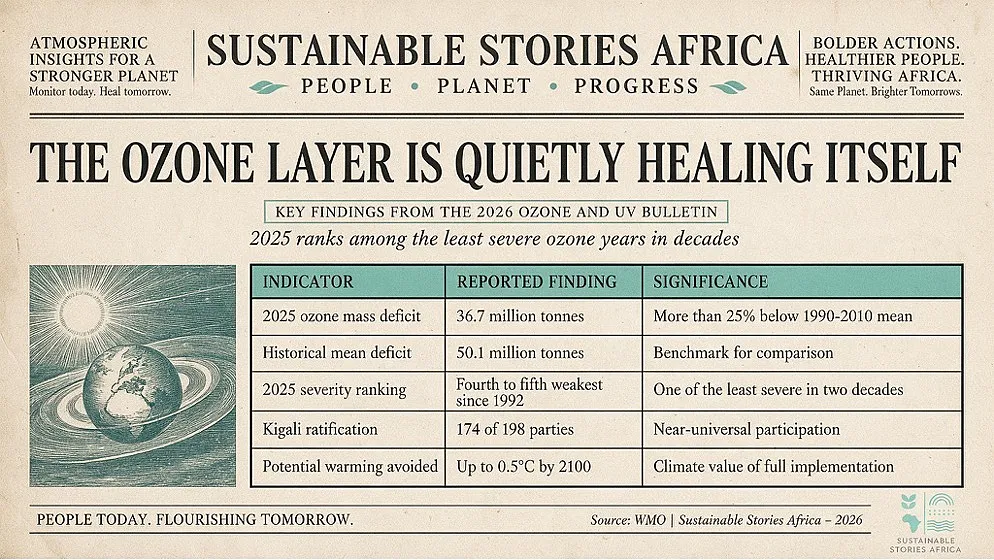
The 2025 Antarctic ozone hole was the fourth- to fifth-weakest since severe depletion patterns began in 1992, according to the World Meteorological Organisation's September 2026 Ozone and UV Bulletin.
- Its maximum ozone mass deficit reached 36.7 million tonnes on 29 September, more than 25% below the 1990 - 2010 average of 50.1 million tonnes.
The smaller hole followed an early period of depletion and then rapid warming in the Antarctic lower stratosphere during September, which slowed further ozone loss.
- The polar vortex broke up relatively early, and low ozone columns largely disappeared by late October.
The result continues the break from unusually deep and persistent holes recorded between 2020 and 2023.
Recovery Continues With Annual Variation
About 90% of atmospheric ozone sits in the stratosphere.
- If compressed to the Earth's surface, it would form a layer only about three millimetres thick, yet it blocks nearly all dangerous short-wave ultraviolet radiation.
Long-term observations show that the decline driven by ozone-depleting substances stopped and recovery began about 2000.
Weather and atmospheric circulation can still produce large yearly differences.
- In 2025, total ozone was above average across much of the Southern Hemisphere but below average from Greenland and Europe across Central Asia to northern Japan.
Scientists caution that full recovery will take several more decades, so one mild Antarctic season should not be treated as completion.
Monitoring Protects Science And Public Health
The bulletin highlights a century of continuous ozone measurements at Arosa and Davos in Switzerland and the need to sustain global observing networks.
- A recent combined calibration event brought together more than 50 specialists from 16 countries and instruments from Egypt, Kenya, Uganda and South Africa.
- About half the participating instruments recorded ozone deviations below 1% from the reference Brewer instrument.
Gaps remain in regional coverage and calibration capacity, particularly in the Global South.
- Reliable measurements help verify whether reported reductions in controlled chemicals match atmospheric trends.
- They also detect unexpected emissions, such as the CFC-11 increase identified in 2018, and improve public ultraviolet forecasts.
Cooling Policy Adds Climate Benefits
The Kigali Amendment, adopted in 2016, requires countries to phase down hydrofluorocarbons used in cooling.
- It has been ratified by 174 of the Montreal Protocol's 198 parties and aims to cut global HFC use by more than 80% by the late 2040s.
- Full implementation could avoid up to 0.5 degrees Celsius of warming by 2100.
Countries can increase the benefit by replacing refrigerants while improving appliance efficiency.
- That can lower electricity demand, reduce bills and ease pressure on grids as cooling needs grow
- Public-health work must continue as well: ultraviolet monitoring and clear protection guidance remain important because ozone recovery is gradual and surface UV is also shaped by clouds, aerosols and local conditions.
Ultraviolet Risk Still Requires Daily Action
Ozone recovery does not remove the need for everyday UV protection.
- The bulletin notes that surface exposure also depends on cloud cover, aerosols and local conditions.
- Modern forecasts can combine satellite observations and ground instruments to provide more local guidance, helping people decide when shade, protective clothing, hats, sunglasses and sunscreen are needed.
Monitoring infrastructure must remain accurate through regular calibration and maintenance. Affordable instruments and regional training can expand coverage in the tropics and southern mid-latitudes, where data remain limited.
- Open access to trusted UV information would support health agencies, schools, outdoor workers and the public.
Path Forward – Protect Recovery Through Monitoring And Compliance
Governments should maintain Montreal Protocol controls, implement Kigali schedules and fund regional atmospheric and ultraviolet monitoring, calibration and technical training.
African countries can pair efficient cooling with stronger measurement networks and accessible UV information.
Continued science, compliance and public protection will determine whether current progress becomes lasting recovery.