A 33-market survey finds that climate change is felt most intensely in Latin America, while reported personal impact is lower in North America and northern Europe.
The gap matters because public support for climate policy begins from different daily pressures, from heat and crop losses to insurance, food and energy costs.
Governments and businesses need locally credible climate messages backed by adaptation that people can see and use.
Unequal Exposure Shapes Climate Urgency
People across the world increasingly recognise climate change, but they do not experience it with the same intensity.
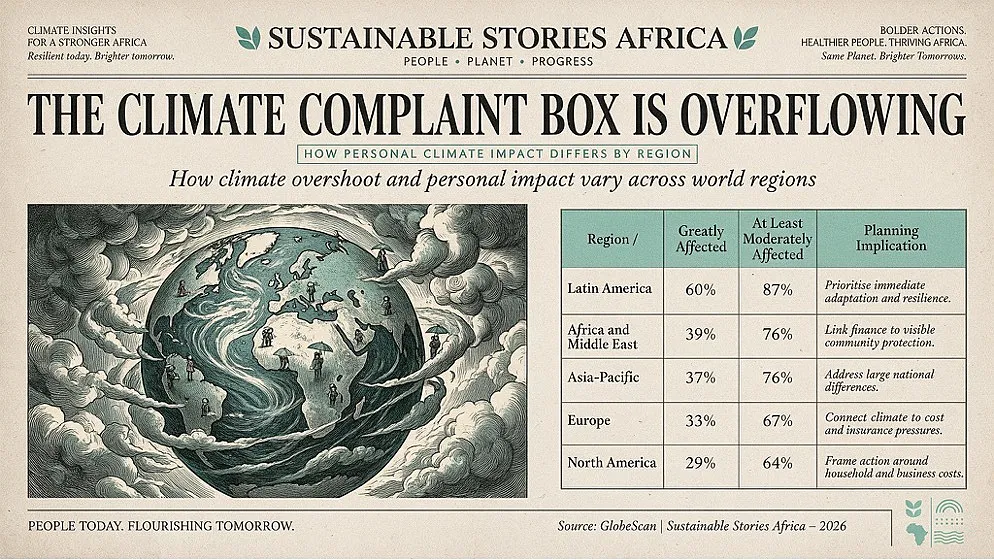
- A GlobeScan survey of 32,102 respondents in 33 markets during July and August 2026 found that 60% of people in Latin America said climate change greatly affected them personally.
- That compares with 39% in Africa and the Middle East, 37% in Asia-Pacific, 33% in Europe and 29% in North America.
The difference changes the starting point for climate action.
- In places facing recurring heat, storms, drought or disrupted livelihoods, adaptation is a present household and business need.
- Elsewhere, climate concern competes with pressures that feel more immediate. GlobeScan found that 56% of North Americans and 49% of Europeans said the rising cost of living greatly affected them, well above the shares reporting great personal climate impact.
National Differences Complicate Regional Averages
Regional averages conceal large national gaps.
- France and Italy reported great personal impact of 54% and 53%, close to the levels recorded in highly exposed markets.
- Sweden and the Netherlands were both at 17%. In Asia-Pacific, Vietnam stood at 52%; India, Indonesia and Thailand each recorded 49%, compared with Australia at 23% and Japan at 25%.
Africa and the Middle East also contain different realities.
- Kenya recorded 44% saying they were greatly affected, compared with 29% across the Gulf markets surveyed.
When people reporting moderate impact are included, the reach is broader:
- 76% in Africa and the Middle East and Asia-Pacific, 67% in Europe and 64% in North America said they were at least moderately affected.
Local Evidence Can Strengthen Public Trust
A universal climate message is unlikely to work across these conditions.
- In high-impact markets, people need practical evidence that public spending, corporate investment and development finance can protect water, food systems, housing and supply chains.
- In lower-impact markets, engagement may be stronger when it explains links between climate disruption and costs already appearing in energy bills, insurance premiums and food prices.
For African decision-makers, the findings reinforce the case for adaptation finance that reaches communities.
Public concern can weaken when warnings are repeated without visible protection.
- Heat action plans, climate-smart agriculture, early-warning systems and resilient urban services turn an abstract global risk into measures that improve safety and economic continuity.
Institutions Must Design For Place
Governments, financiers and companies should test climate plans against local exposure and public priorities before launching campaigns or projects.
- Surveys can identify what people feel, but budgets and implementation determine whether trust grows.
- Climate communication should therefore accompany clear delivery indicators, such as homes protected from floods, farmers reached with forecasts, or businesses supported to withstand supply interruptions.
The data also warns against interpreting lower reported impact as safety.
- Two-thirds of Europeans and nearly two-thirds of North Americans still reported at least moderate effects.
Different levels of urgency call for different entry points, not delayed action.
Finance Must Follow Unequal Exposure
The survey also has implications for climate finance.
- Regions reporting stronger personal impact often have less fiscal space to protect communities, even though drought, floods and heat already damage incomes and infrastructure.
International finance should therefore distinguish between the capacity to pay and the urgency of adaptation.
- Grants, concessional lending and insurance tools can help governments act without worsening debt stress.
Businesses operating across markets should use the same local lens.
- Supply-chain assessments, worker protections and community investment should reflect actual heat, water and disaster exposure.
Publishing local targets and progress can show whether corporate climate commitments address the places where operations and livelihoods are most at risk.
Path Forward – Local Climate Action Must Reflect Reality
Climate plans should combine regional targets with local evidence on exposure, livelihoods and household costs.
Governments and businesses can then explain action in terms people recognise and track.
For African markets, the priority is to connect public concern with funded adaptation, reliable services and transparent results.
That approach can strengthen resilience while building durable support for emissions reduction.
Culled from: One Climate Crisis, Different Realities