
Most executives say they understand their sustainability strategy, but only a minority can quantify its effect on profit, cash flow or valuation.
Evidence from more than 2,000 verified projects suggests the measurement gap often begins when projects are approved without baselines, targets or verification methods.
Companies can improve investment decisions by designing financial evidence into sustainability initiatives from the start.
Measurement Gap Weakens Investment Cases
Companies increasingly claim that sustainability creates commercial value, yet many cannot show how it affects their finances.
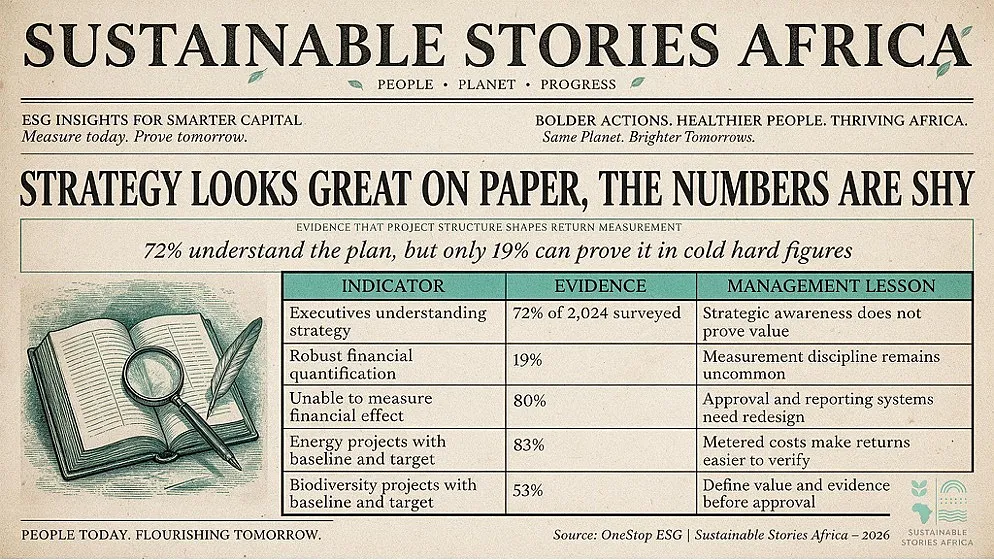
A KPMG survey of 2,024 senior executives in 19 countries, conducted between November 2025 and May 2026, found that 72% said they understood their sustainability strategy and performance in detail.
Only 19% used robust methods to quantify financial impact, while 80% could not measure effects on profit, cash flow or valuation.
Research highlighted by OneStop ESG suggests that this is often a project-design failure rather than a shortage of sophisticated valuation models.
Mike Kelly, founder of Nemetan, examined a library of more than 2,000 verified sustainability projects with measured outcomes.
Projects were more likely to report returns when established costs, baselines, dated targets and verification methods early.
Early Structure Determines Financial Evidence
The contrast between energy and biodiversity projects illustrates the problem.
- Energy initiatives began with a financial baseline and target 83% of the time, compared with 53% for biodiversity projects.
- Energy use arrives with meters and bills; as such, savings can be traced.
- Habitat benefits may have no established accounting line, making value harder to record even when the project works.
The evidence base includes practical returns.
- Shahi Exports provided reading glasses to sewing-machine operators over 35, lifting productivity by 6% and recovering about three times the cost within three months.
- A New York school district spent $7,800 replacing oversized water meters and saved $35,000 annually.
- Two small metal finishers reported yearly savings of about $57,000 and $46,000 after removing chemicals or equipment.
Removing Waste Often Produces Fast Returns
The largest group of business models in the evidence library focused on source reduction, with 706 projects.
- Another 428 used avoid, reduce, substitute or offset approaches, while 217 applied a nine-part circular economy framework.
The strongest returns often came from eliminating an input, chemical, machine or period of idle operation before waste was created.
This matters for African businesses operating under high energy costs, foreign-exchange pressure and constrained capital.
- A project that reduces diesel use, water loss, rejected materials or machine downtime can produce a cash benefit that finance teams recognise.
- The same discipline can be applied to social and nature projects, but only if decision-makers define the intended outcome and measurement method before spending begins.
Boards Need Evidence Before Approval
Approval forms should require the investment amount, operating baseline, target return, measurement period and named verification method.
- Discovery-driven planning can then work backwards from the return a business needs, record the assumptions required to achieve it and release funding in stages as evidence improves.
Precedents also matter.
- Teams should compare a proposed project with similar initiatives and document the conditions behind their returns.
- That prevents supplier forecasts or internal optimism from becoming the only basis for approval.
It also makes later reporting credible enough to guide the next investment decision.
Disclosure Should Connect Outcomes And Accounts
The same discipline should be carried into corporate reporting.
- Sustainability disclosures often list activities and physical outcomes without showing how they affect operating costs, revenue, risk or asset value.
- Finance and sustainability teams should agree on definitions, data owners and assurance before implementation; as such, a result can be traced from the site or community to the financial statement or management account.
Not every benefit should be forced into a single monetary figure.
- Biodiversity, worker safety and community trust may require physical and social indicators alongside financial measures.
The key is to state the decision value clearly, avoid false precision and record enough evidence for boards to compare options responsibly.
Path Forward – Build Financial Proof Before Spending Begins
Companies should redesign sustainability approvals so every material project starts with a baseline, target, timeframe, assumptions and verification plan.
Projects can then be reviewed against measured results instead of general claims.
For African firms, starting with resource efficiency can create near-term savings while building the measurement culture needed for larger climate, nature and social investments.
Culled from: Turning sustainability into financial value: lessons from the evidence