
MTN Nigeria is apparently in talks to acquire spectrum held by Mafab Communications, including a 100 MHz block suited to high-capacity 5G services.
The proposed transaction could put underused spectrum to work, but it also raises questions for regulators about competition, pricing and rollout.
Approval should depend on measurable consumer and market benefits, not transfer of the licence alone.
Spectrum Talks Raise A Regulatory Test
MTN Nigeria is in discussions to acquire Mafab Communications' spectrum assets, according to TheCable and other reports.
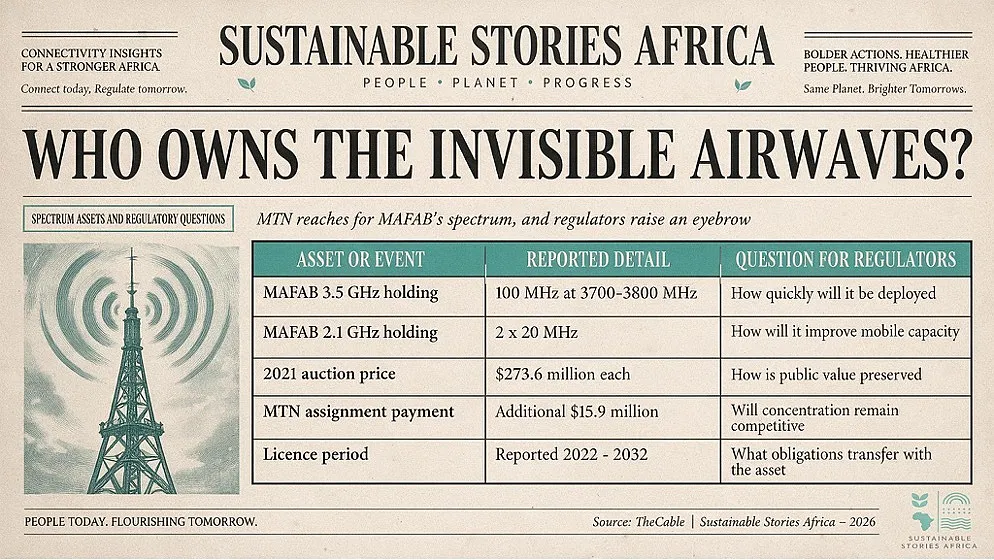
- The proposed transaction covers Mafab's 2 x 20 MHz holding in the 2.1 GHz band and a 100 MHz block in the 3.5 GHz band.
- The price is yet to be disclosed, and any transfer would require regulatory scrutiny.
The talks matter because radio spectrum is a scarce public resource.
- Additional holdings could help MTN expand capacity and improve high-speed services, while Mafab's 3.5 GHz block has remained largely unused since licensing.
However, moving valuable frequencies to the largest operator also requires a careful competition assessment and enforceable rollout obligations.
Auction History Shapes The Debate
MTN and Mafab emerged as winners after 11 bidding rounds in the Nigerian Communications Commission's December 2021 auction.
- Each secured a 100 MHz block in the 3.5 GHz band at a winning price of $273.6 million.
- MTN paid a further $15.9 million during assignment to obtain the 3500-3600 MHz block, while Mafab received 3700-3800 MHz.
Mafab's licence, issued in 2022 with a reported 10-year term ending in 2032, was intended to support a new 5G network.
- 4 years of limited deployment have strengthened the efficiency argument for a transfer.
- Spectrum that remains idle cannot improve broadband quality, support enterprise services or deliver the public value expected from licensing.
Consumers Need More Than A Transfer
Combining adjacent or complementary spectrum can improve network capacity and lower unit costs.
- For users, that could mean faster data, better performance in congested areas and stronger fixed-wireless broadband.
- Businesses may gain from cloud services, private networks and lower-latency applications where coverage and affordable devices are available.
Those benefits are not automatic.
- A transaction that increases concentration without binding investment commitments could weaken competitive pressure.
Regulators must examine spectrum caps, wholesale access, coverage obligations, service quality and the effect on smaller operators.
The public also needs clarity on whether Mafab met its original obligations and how the proposed transfer changes them.
Approval Should Carry Clear Conditions
The NCC should publish the basis for any approval, subject to commercial confidentiality, and state how the deal advances efficient spectrum use, competition and consumer welfare.
- Conditions could include time-bound deployment, coverage outside premium urban areas, quality-of-service targets and reporting on actual use of the acquired frequencies.
Nigeria should also preserve credible routes for market entry and infrastructure sharing.
- Efficient spectrum use can coexist with competition when rules are transparent and consistently enforced.
The test is whether the transaction expands affordable, reliable connectivity rather than simply enlarging one operator's asset base.
Digital Inclusion Remains The Practical Test
Additional spectrum has public value only when it is paired with towers, fibre backhaul, power and affordable devices.
- Urban capacity gains may improve premium services without closing rural or low-income access gaps.
- Coverage commitments should therefore identify underserved locations and distinguish population coverage from reliable, usable service.
The regulator should monitor prices and quality after any deal, including speeds, outages, latency and complaint resolution.
- Publishing comparable operator data would help consumers, investors and policymakers determine whether greater spectrum concentration produces efficiency or weakens competitive discipline.
Path Forward – Tie Spectrum Approval To Public Benefits
Regulators should assess the transaction against competition, coverage, service quality and efficient-use standards, then publish clear reasons for their decision.
Any approval should include measurable rollout commitments and consumer safeguards.
That would convert an asset transfer into verifiable progress on Nigeria's broadband and digital-economy goals.
Culled from: MTN moves to acquire Mafab’s 5G spectrum