The African Development Bank plans $20 million in reimbursable grants for four green hydrogen and derivatives projects in Egypt, Morocco, Namibia and South Africa.
The selected projects represent an estimated $23 billion in investment and target cleaner fuels, green ammonia and low-carbon iron.
The grants aim to move promising proposals toward investment readiness, where finance, infrastructure and local benefits will determine success.
Grants Target Investment Readiness
The African Development Bank Group will provide $20 million in reimbursable grants to support four green hydrogen and derivatives projects in Egypt, Morocco, Namibia and South Africa, subject to approval by its Board of Directors.
- The Sustainable Energy Fund for Africa is expected to provide the funding under the Africa Green Hydrogen Programme.
The call for proposals ran from 10 April to 11 May 2026 and attracted 81 submissions from 18 countries.
- The 4 selected projects span sustainable marine and aviation fuels, green ammonia and low-carbon iron.
Their central task is now to convert large technical ambitions into bankable projects with credible buyers, infrastructure, safeguards and financing structures.
Four Projects Share Twenty Million Dollars
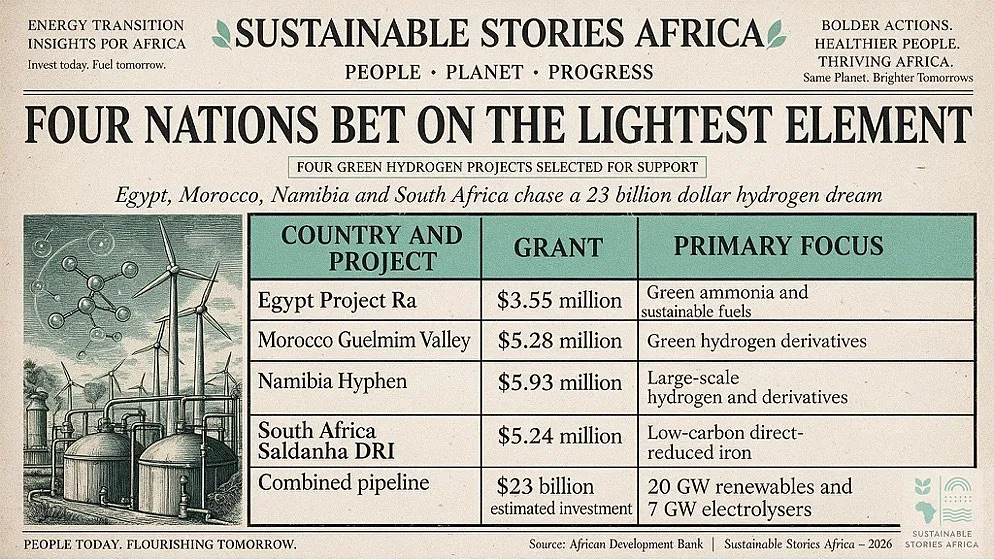
- Project Ra in Egypt, sponsored by DAI Infrastruktur, will receive $3.55 million.
- Morocco's Guelmim Green Hydrogen Valley, sponsored by Nareva Holding, secured $5.28 million.
- Namibia's Hyphen project is allocated $5.93 million
- The Saldanha Hydrogen DRI project in South Africa secured $5.24 million.
Together, the projects represent an estimated investment of $23 billion, about 20 GW equivalent of solar and wind generation, 7 GW of electrolyser capacity and 2,950 MWh of battery storage.
The grant total is small compared with the capital required, but preparation funding can enable the studies, structuring and risk reduction needed before committing commercial finance.
Industrial Benefits Depend On Local Design
The project mix links renewable electricity with industrial demand.
- Egypt, Morocco and Namibia are targeting sustainable fuels for marine and aviation markets.
- South Africa's Saldanha project would use hydrogen in direct-reduced iron production.
These uses could support export revenue and industrial decarbonisation where long-term buyers accept the cost and certification requirements.
Local development benefits must be designed rather than assumed.
- The Bank says the programme could expand access to desalinated potable water and electricity by using surplus generation, while supporting skills, jobs and technology transfer.
Governments and sponsors will need transparent agreements on land, water, community benefits, domestic value addition and the share of output intended for local industry.
Bankability Must Include Social Credibility
Project preparation should test renewable-resource quality, grid connections, port and pipeline requirements, water use, environmental impacts and demand contracts.
- It should also disclose who carries construction, price and offtake risks.
- Large export projects can struggle if local communities see land and water pressures without corresponding services or employment.
The reimbursable structure should be explained clearly, including when repayment is triggered and how grants support public objectives.
- Strong preparation can crowd in private capital, but the projects will earn legitimacy only if investment readiness includes environmental protection, fair consultation and measurable domestic benefits.
Large Scale Ambition Needs Market Discipline
The selection rate was highly competitive: four projects emerged from 81 proposals across 18 countries.
- That signals strong developer interest, but it also shows the limited pool of preparation finance.
Future calls should publish selection lessons so other African projects can improve technical design, offtake strategy, environmental safeguards and domestic value propositions.
Sponsors must also test projects against changing global hydrogen prices and policy incentives.
- Phased development, credible buyers and transparent cost assumptions can reduce the risk of stranded infrastructure.
- Public support should unlock learning and investment without shielding private developers from risks they are best placed to manage.
Path Forward – Turn Preparation Funding Into Bankable Projects
The four sponsors should use the grants to complete rigorous technical, financial, environmental and market studies, with transparent milestones before making larger commitments.
African governments and financiers should also secure local skills, access to infrastructure and community benefits.
These conditions can help green hydrogen support industrial development instead of becoming an export enclave.