Asia’s artificial intelligence boom is adding data centres faster than clean power systems can support them.
Local grids, water supplies and climate resilience are coming under pressure as fossil fuels meet much of the new demand.
Banks, technology companies and governments now face a test: finance digital growth without locking communities into higher emissions and infrastructure risk.
Data Centres Raise Local Climate Stakes
Asia’s race to build artificial intelligence infrastructure is colliding with a slower clean-energy transition.
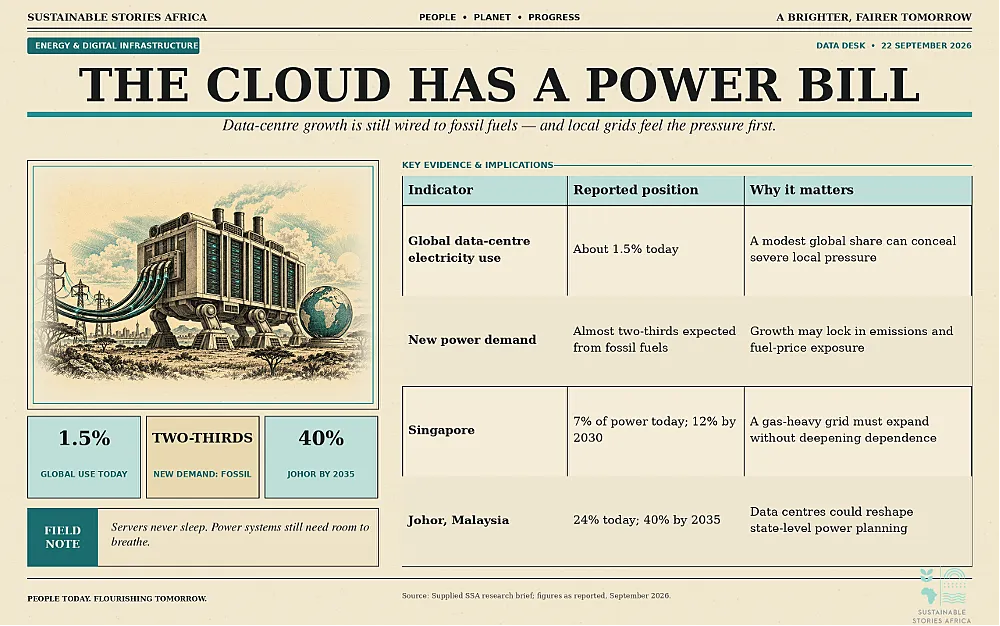
Green Central Banking reported on September 22 that almost two-thirds of the additional electricity data centres worldwide require in the next decade is expected to come from fossil fuels, even as lenders and technology companies present AI as a tool for sustainability.
The tension is most visible in concentrated markets.
- Data centres use roughly 1.5% of global electricity, but their local footprint can be much larger.
- In Singapore, where natural gas dominates generation, the sector consumes about 7% of power and could reach 12% by 2030.
In Johor, Malaysia, Wood Mackenzie estimates that data centres could absorb 40% of state electricity demand by 2035, up from 24% today.
Efficiency Gains Cannot Replace Clean Supply
Developers argue that more efficient chips, cooling systems and workload management can reduce energy and water use per unit of computing.
However, efficiency can also lower costs and stimulate additional demand, a pattern known as the rebound effect.
- Professor Jonatan Pinkse of King’s Business School warned that any resulting pressure may be felt less by financiers than by the societies hosting the infrastructure.
The risk is broader than carbon.
- Data centres need reliable power, cooling water, transmission capacity and protection from heat, flooding and storms.
- When new facilities cluster in already constrained areas, households and smaller businesses can face higher competition for electricity and water.
- Climate hazards can also disrupt the digital services that governments, banks and businesses increasingly depend upon.
Public planning must therefore consider cumulative demand, not approve each project in isolation.
- A facility may appear manageable on its own while several developments together require new generation, substations and water infrastructure.
- Publishing these combined requirements would allow host communities to understand the trade-offs before contracts, permits and public incentives are finalised.
Clean Infrastructure Can Share Digital Benefits
Better outcomes are possible if clean generation, storage and grid upgrades arrive before or alongside new computing capacity.
- Long-term renewable contracts can support additional projects, while transparent water plans and heat-resilient design can reduce community conflict.
- Locating flexible workloads where and when low-carbon electricity is available would also make digital demand more responsive to power-system conditions.
For African markets pursuing data-centre investment, Asia offers an early warning.
- Digital infrastructure can strengthen cloud services, financial inclusion and local enterprise, but weak grids and water scarcity can turn growth into a public burden.
Investment incentives should therefore be tied to additional clean power, measurable efficiency, local consultation and clear emergency plans.
Finance Must Test Claims Against Outcomes
Banks should assess the full energy and water consequences of facilities they finance, not only whether a loan carries a green label.
- Borrowers should disclose projected electricity demand, generation sources, water consumption, climate scenarios and community impacts.
Regulators can require lenders to show how financed infrastructure aligns with national transition plans and avoids shifting costs to the public.
Governments also need planning rules that connect approvals to grid capacity and resource limits.
- Pauses on construction in constrained locations show that social consent cannot be assumed.
The central question is no longer whether AI will expand, but whether the infrastructure behind it will reinforce fossil dependence or accelerate a fair clean-power build-out.
Path Forward – Clean Power Must Lead Digital Growth
Asia’s next data-centre approvals should require additional clean generation, credible water plans and transparent reporting on local impacts.
Lenders can reinforce those conditions through financing covenants and climate-risk review.
African governments can apply the lesson early: link digital investment incentives to grid upgrades, renewable supply, community consultation and resilience standards before concentrated demand creates avoidable pressure.
Culled from: Clean power is not keeping pace with Asia’s AI boom