
Ecological concepts take an average of seven years to enter major United Nations environmental policy, a new study finds.
Some ideas were adopted immediately while others took as long as 28 years, and policy outcomes improved at smaller governance scales.
The evidence points to a double challenge: move knowledge into decisions faster, then turn those decisions into accountable local action.
Evidence Often Waits Years For Policy
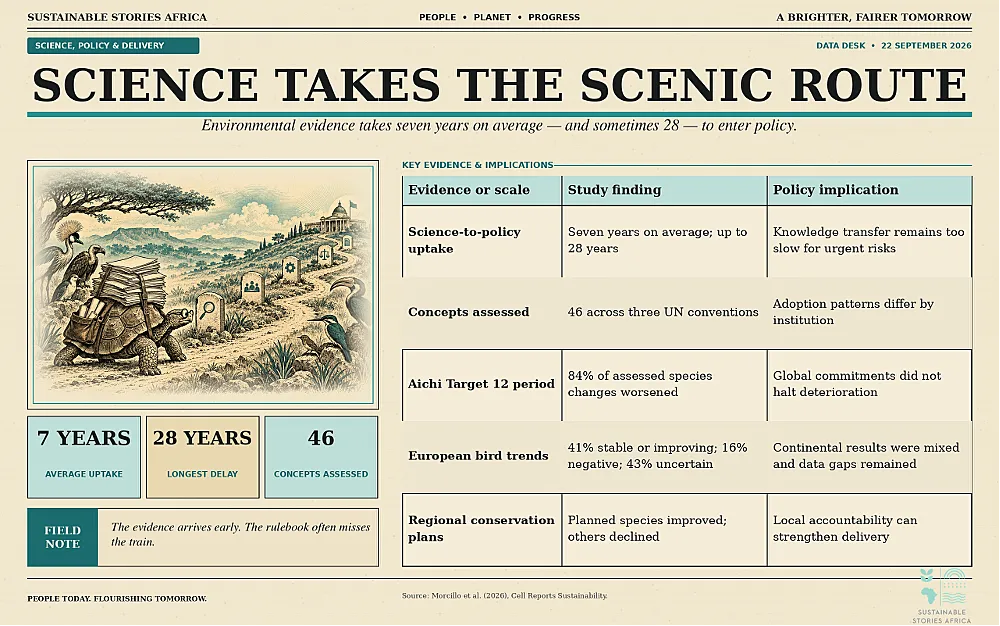
Scientific knowledge is taking an average of seven years to enter the policy documents of the world’s three major United Nations environmental conventions, according to research in Cell Reports Sustainability.
Some ecological concepts were incorporated immediately, while others waited up to 28 years.
The researchers examined 46 ecological concepts across conventions on climate change, biodiversity and desertification.
- They measured the time between a concept’s appearance in scientific literature and its inclusion in Conference of the Parties documents.
- Older concepts generally moved faster, but positive language or apparently simpler concept types did not guarantee quicker adoption.
Different Conventions Absorb Knowledge Differently
The uptake pattern was convention-specific.
- Climate policy incorporated atmospheric, abiotic and structural concepts more quickly, reflecting its historical focus on mitigation.
- Biodiversity and desertification documents showed more individual patterns, suggesting that alignment between scientific and political agendas can matter more than a concept’s general category.
Some important ideas faced delays longer than 20 years.
- The climate convention took more than 25 years to incorporate ecosystem services, while concepts such as extreme events and soil biodiversity were slow to enter desertification policy.
- Communication barriers, political trade-offs and uncertainty all matter, but the uneven pattern suggests there is no single explanation.
Local Delivery Shows Stronger Conservation Results
The study also examined whether policy produced results at global, continental and regional scales.
- During the Aichi Biodiversity Target period, 84% of assessed species that changed conservation status moved in the wrong direction
- At least 160 species were declared extinct.
- In Europe, the Natura 2000 case showed 41% of covered bird species with stable or expanding breeding territories, 16% declining and 43% uncertain.
A regional case in Spain’s Valencian Community produced a more hopeful result.
- Vulnerable bird species with approved conservation plans showed positive population trends, while species without plans declined.
The comparison is illustrative rather than universal, but it highlights the value of clear responsibility, closer oversight and stronger stakeholder participation.
Bridge Knowledge And Implementation Together
Governments and international bodies need permanent channels that connect scientists, policymakers and affected communities before targets are finalised.
- Knowledge brokers can translate evidence without erasing uncertainty, while co-production can ensure researchers address questions decision-makers can use.
- Policy language must also become more specific and enforceable.
African environmental institutions can strengthen delivery by pairing global commitments with funded national and local plans, public indicators and named responsibility.
- Scientific inclusion is not enough if budgets, enforcement and community participation do not follow.
The real measure of the science-policy interface is not how often evidence is cited, but whether ecosystems and people experience better outcomes.
The authors also caution that their implementation comparison uses selected biodiversity case studies and should not be treated as a universal ranking of governance scales.
- International agreements remain essential because they create shared direction and enable local action.
The lesson is to connect scales deliberately: global ambition, national finance and law, and local institutions able to monitor results and adjust practice.
Regular public reviews can keep that chain visible.
- They should record which scientific findings were considered, why recommendations were accepted or deferred, who is responsible for implementation and whether ecological indicators are changing.
This turns evidence use from an occasional consultation into a trackable part of environmental governance.
Path Forward – Move Evidence Faster Then Deliver Locally
Environmental institutions should use knowledge brokers, shared research agendas and timely evidence reviews to shorten policy delays without hiding scientific uncertainty.
Global commitments must connect to funded local plans, measurable indicators, named responsibility and community participation so policy adoption becomes visible ecological improvement.