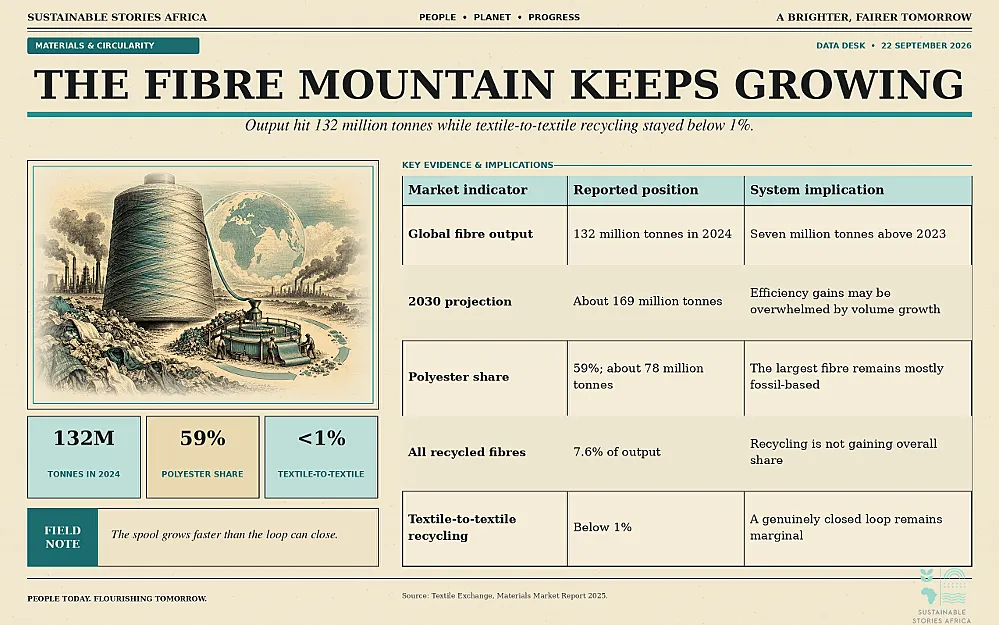
Global fibre production reached a record 132 million tonnes in 2024, mainly polyester, with continued reliance on virgin inputs.
Recycled materials grew in volume but were accountable for only 7.6% of output, while textile-to-textile recycling remained below 1%.
New materials can reduce fashion’s footprint only if they replace virgin fibre and attract the finance, demand and rules needed to scale commercially.
Fibre Output Reaches Another Global Record
The story of fashion’s sustainable materials is being overtaken by growth.
- Textile Exchange data cited by OneStop ESG puts global fibre production at 132 million tonnes in 2024, up from 125 million a year earlier and more than double the level recorded in 2000.
On the current path, annual output could reach 169 million tonnes by 2030.
- Polyester accounted for 59% of total production, or about 78 million tonnes, and 88% of it remained fossil-based.
- Recycled fibres across all materials accounted for a 7.6% share.
- Less than 1% of global fibre came from old textiles turned into new textiles, the circular process consumers often imagine when they see a recycled label.
Recycling Growth Does Not Yet Displace
Recycled polyester output increased from about 8.9 million to 9.3 million tonnes in 2024; however, its share of the polyester market slipped from 12.5% to 12% because virgin production grew faster.
- Around 98% of recycled polyester still comes from plastic bottles rather than discarded clothing.
Innovators are also learning how difficult it is to cross from demonstration to mass production.
- Mycelium materials have faced closures or paused expansion, while textile recyclers have failed, restarted or adopted slower phased plans.
- Technical complexity, mixed fabrics, uncertain feedstock, high capital costs and weak long-term purchasing commitments continue to limit scale.
Material choices also carry trade-offs that simple labels can miss.
- Recycled polyester usually has a lower production footprint than virgin polyester, but bottle-derived fibre does not create a closed clothing loop and synthetic garments can shed microfibres during use.
Credible claims should reflect composition, durability, shedding, recyclability and end-of-life pathways rather than rely on one favourable attribute.
Commercial Scale Needs Coordinated Demand
Europe’s transition illustrates the financing challenge.
- A 2026 BCG and ReHubs analysis estimated that raising textile-to-textile recycling from below 1% to around 15% by 2035 could require €8 billion to €11 billion in capital investment and €5 billion to €6.5 billion in recurring annual operating costs.
- Plants need guaranteed demand, while brands hesitate when recycled inputs cost more than virgin fibre.
Regulation is beginning to change those incentives.
- European rules are tightening environmental claims, developing digital product information and moving towards producer responsibility for textile waste.
For African textile and fashion economies, circular systems could support repair, sorting, fibre recovery and manufacturing jobs; however, they must be designed around local value chains rather than dependence on imported waste.
Brands Must Prove Actual Material Substitution
Companies should report absolute virgin-fibre use, not only the share of preferred materials in selected collections.
- Long-term purchase agreements can help recycling plants secure finance, while garment design should reduce hard-to-separate blends and make repair and recovery easier.
Policymakers can support collection and sorting while requiring producers to pay for end-of-life costs.
Consumers cannot carry the transition alone, particularly when product claims obscure material composition or durability.
- The test for sustainable textiles is measurable displacement: fewer tonnes of virgin fossil fibre, longer product life and more old garments returned to useful material.
Innovation matters, but growth lying on expanding virgin production will not deliver circularity.
Path Forward – Make New Fibres Replace Virgin Production
Brands should disclose absolute virgin-fibre reductions, sign long-term recycled-material contracts and design garments for durability, repair and recovery.
Policymakers must align claims, collection and producer responsibility rules.
African markets can build circular jobs through local sorting, repair and recycling systems, provided investment strengthens domestic value chains and safeguards workers and communities.
Culled from: The Rise of Sustainable Textiles: Can New Materials Break Fashion's Dependence on Virgin Fibres?