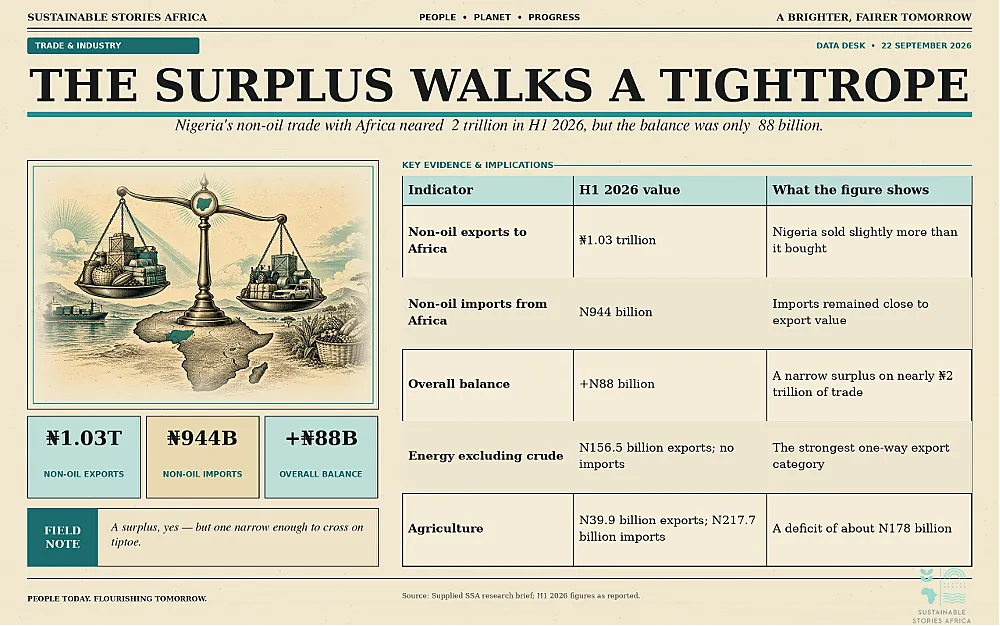
Nigeria recorded an N88 billion surplus in nearly N2 trillion of non-oil trade with Africa during the first half of 2026.
Energy exports supported the balance, while agricultural imports exceeded exports by about N178 billion, as the quarterly gap increased.
The mixed picture shows why headline trade balances must be read alongside individual sectors’ productive capacity.
Narrow Surplus Masks Sector Gaps
Nigeria sold N1.03 trillion in non-oil goods to African markets and imported N944 billion in the first half of 2026, leaving a surplus of about ₦88 billion on trade worth almost ₦2 trillion.
- Intelpoint’s analysis of National Bureau of Statistics data describes a relationship close to balance overall but sharply divided by product category.
Energy trade excluding crude oil was entirely export-led:
- Nigeria sold N156.5 billion to African countries and recorded no imports in the category.
- Solid minerals also favoured exports, which represented 66.1% of category trade.
- Raw materials and manufactured goods were more evenly split between sales and purchases.
Agriculture Moves Strongly Against The Balance
Agriculture produced the clearest deficit.
- Nigeria imported N217.7 billion of agricultural products from Africa but exported only N39.9 billion.
- Imports therefore represented 84.5% of the category’s trade, creating a deficit of roughly N178 billion.
The direction also worsened during the period.
- The agricultural gap grew from N59 billion in the first quarter to N119 billion in the second.
- That increase matters for a country seeking food security, rural employment and foreign-exchange resilience.
Imports can stabilise supply, but persistent dependence may also expose consumers to currency and transport shocks.
Regional Demand Can Support Productive Growth
The near balance suggests that African markets already matter to Nigerian producers.
- The African Continental Free Trade Area (AfCFTA) can deepen that opportunity if firms gain reliable logistics, standards certification, trade finance and market information.
- More manufactured and processed exports would create value beyond the sale of primary commodities.
Agriculture offers the largest development opening.
- Raising yields, storage capacity, cold chains and processing could replace some imports without closing the market to beneficial regional trade.
The goal should not be self-sufficiency at any cost, but a more competitive food system that can supply consumers, reward farmers and export higher-value products.
Policy Must Target The Weak Categories
Trade policy should move beyond celebrating an aggregate surplus.
Government and industry need product-level plans for categories where constraints are persistent.
- In agriculture, that means dependable power, transport, extension services, quality inputs, irrigation where appropriate and finance suited to production cycles.
Officials should also publish more accessible quarterly trade data and track whether AfCFTA implementation reduces non-tariff barriers.
- Export promotion must be matched by quality assurance and timely border processes.
Nigeria’s trade with Africa is near balanced, but the composition shows the unfinished work:
- Diversify the export base while fixing the agricultural systems behind the widening deficit.
Private-sector coordination is equally important.
- Farmer organisations, processors, transporters, standards agencies and banks need shared production forecasts and clear purchase commitments.
- When demand is predictable, producers can invest with greater confidence, and lenders can assess cash flows more realistically.
Such coordination can reduce post-harvest loss, improve traceability and help Nigerian suppliers compete on quality rather than rely on periodic import restrictions.
The same discipline should apply to energy exports.
- Strong performance in one category should support broader industrial capability through transparent revenue, dependable domestic supply and investment in processing.
Otherwise, the headline surplus may remain concentrated in a narrow segment while employment-rich sectors continue to struggle with infrastructure and productivity constraints.
Path Forward – Build Capacity Behind The Trade Numbers
Nigeria should target agricultural productivity, storage, processing and logistics while helping manufacturers meet regional standards and secure trade finance.
Aggregate balance alone is not enough.
Quarterly product-level monitoring can show whether AfCFTA reforms are widening competitive exports, reducing avoidable bottlenecks and creating durable value across Nigerian communities.
Culled from: Nigeria sold almost as much non-oil to Africa as it bought, except in energy and agriculture - Intelpoint