Researchers detected microplastics at all nine sacred freshwater sites sampled in South Africa’s Eastern Cape and KwaZulu-Natal region.
Concentrations ranged from five to 48 particles per litre, with the highest level at the intensively used Isinuka spring.
The baseline study links freshwater protection to public health, cultural practice and community-led environmental management.
Sacred Waters Are Not Pollution-Proof
Microplastics were found at every sacred freshwater site examined in a new South African baseline study, challenging the belief that culturally protected springs and geochemically unusual waters are necessarily pristine.
The research was published online on August 4 in the African Journal of Aquatic Science.
Scientists collected one-litre surface-water samples from nine locations in March 2025:
- Four associated with Isinuka springs
- Five carbon-dioxide-seeping systems along the Bongwana Fault and near Mbizana.
These waters support drinking, domestic use, ritual bathing, spiritual cleansing and traditional healing, making contamination an ecological and cultural concern.
Fibres Dominate Particles Found At Sites
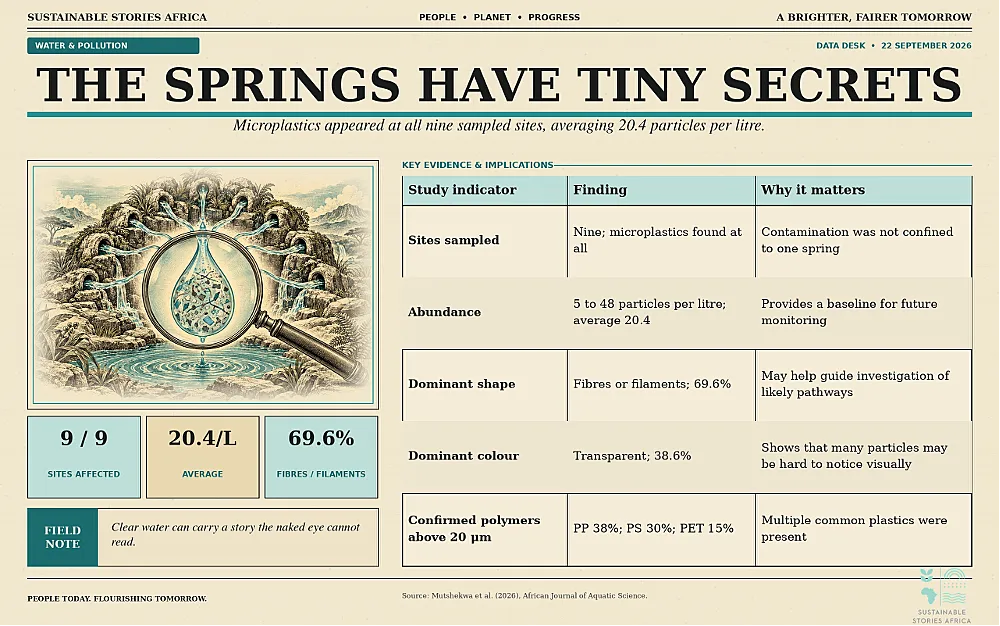
The team counted 184 microplastic particles, with site concentrations ranging from 5 to 48 particles per litre and averaging about 20.4.
- Site 1 at Isinuka spring, described as the most intensively used sacred location, recorded the highest abundance.
- A carbon-dioxide-seeping site recorded the lowest.
Fibres and filaments made up 69.6% of observed shapes, followed by fragments at 21.7%.
- Transparent particles were most common at 38.6%, followed by white at 19% and blue at 15.8%.
- Particles larger than 20 micrometres formed the largest size group, at 51.1%.
Baseline Evidence Creates A Protection Opportunity
Polymer testing on a random subsample of particles above 20 micrometres identified six types.
- Polypropylene was most common at 38%, followed by polystyrene at 30%, polyethylene terephthalate at 15%, polyethylene at 12%, polydimethylsiloxane at 4% and polyvinyl chloride at 1%.
The study does not establish the health effects of drinking water from these sites or identify every pollution source.
- It also lacked replicate samples at each location because of community restrictions, and polymer confirmation did not cover particles below 20 micrometres.
Those limits make the findings a starting point, not a complete risk assessment.
The controls and procedural blanks showed no microplastic contamination, and the researchers used a conservative reporting threshold of five particles per litre.
- Even so, one sample per site cannot capture daily or seasonal variation.
- Rainfall, visitor numbers, water flow and nearby activity may change concentrations, so repeated sampling is necessary before authorities compare sites or judge whether conditions are improving.
Protection Must Combine Science And Culture
Authorities and researchers should expand monitoring to water, sediments and aquatic organisms, repeat sampling across seasons and investigate pathways such as clothing fibres, litter, runoff and visitor activity.
- Public health communication must be accurate and avoid presenting unresolved exposure questions as proven harm.
Community participation is essential.
- Sacred waters are governed through cultural meaning as well as environmental rules, and protective measures will be stronger when traditional leaders, users, scientists and local authorities design them together.
- Waste controls, respectful visitor guidance and locally understandable monitoring results can protect trust while reducing pollution at its source.
This approach must respect community authority over access and research.
- Agreements should explain what will be sampled, how results will be shared and how local knowledge will influence protection measures.
- Providing communities with practical monitoring skills can also turn a one-off academic study into sustained stewardship and quicker detection of new pollution pressures.
Prevention remains more practical than trying to remove microscopic particles after contamination.
- Better solid-waste collection, limits on litter near water, washing and sanitation facilities away from springs, and education for visitors can reduce likely inputs, while research clarifies which sources contribute most at each site.
Path Forward – Protect Sacred Waters Through Shared Stewardship
South Africa should expand seasonal monitoring across water, sediments and biota while investigating pollution pathways and communicating health uncertainty responsibly.
Traditional leaders, communities, scientists and local authorities should jointly design waste controls, visitor guidance and long-term protection for culturally significant freshwater systems.