
Investors are asking African companies to show how climate and sustainability risks affect earnings, assets, financing and business continuity.
The shift moves ESG reporting beyond corporate storytelling and into the systems used for strategy, risk and capital allocation.
Companies that connect reliable sustainability data to financial decisions could strengthen resilience and access to capital; those that cannot may face higher scrutiny and costs.
Investors want numbers that explain value
African companies face rising pressure to explain how climate change, resource constraints and social risks could affect financial performance and long-term competitiveness.
- Investors are no longer satisfied with stand-alone sustainability reports filled mainly with activities and commitments.
- They increasingly want evidence that management understands what the data means for revenue, costs, assets, financing and continuity.
The emerging test is straightforward but demanding: can a company connect a climate or sustainability issue to a decision?
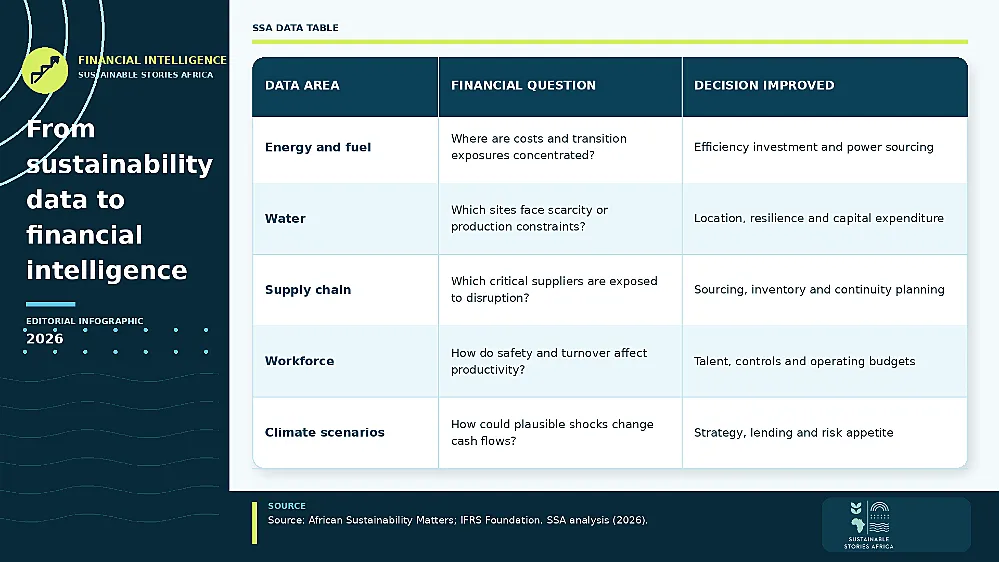
- That may mean showing how drought changes production forecasts, how unreliable power affects margins, how a flood could interrupt logistics, or how workforce turnover increases operating costs.
The quality of those connections could influence access to capital and its price.
Disclosure is becoming operational business intelligence
International Sustainability Standards Board requirements are accelerating the shift.
- IFRS S1 creates a general baseline for sustainability-related financial information.
- IFRS S2 focuses on climate-related risks and opportunities that could affect cash flows, access to finance or cost of capital.
African regulators and exchanges are examining how such standards fit local markets.
For companies, the practical work begins below the published report.
- Electricity, fuel, water, waste, employee and supplier data may sit in different departments, use inconsistent definitions or lack documented controls.
- Finance teams may see the figures only at year-end, after operational decisions have already been made.
Turning those records into intelligence requires common definitions, named data owners, controls, escalation thresholds and board oversight.
It also requires scenario analysis: not a prediction of one future, but an assessment of how the business could perform under plausible physical and transition shocks.
Better information can unlock resilient capital
Reliable data can do more than satisfy investors.
- A manufacturer that tracks energy by facility can identify inefficient equipment and test the payback from renewable power.
- A food processor that maps water dependence can protect production.
- A bank that understands climate risks within its loan book can improve credit decisions before losses emerge.
Comparable disclosures can also help capital markets distinguish between companies adapting their operations and those relying on broad claims.
- That credibility may support investor confidence, more informed lending and better allocation of scarce capital towards resilient infrastructure and businesses.
- The opportunity is especially important in mining, agriculture, banking and manufacturing, where climate and resource risks already shape performance.
Build controls before reporting demands accelerate
- Boards should treat sustainability information as part of enterprise governance.
- Management must identify material risks, link them to strategy and financial planning, and document why an issue is or is not financially significant.
- Internal audit and assurance providers should test the processes behind key metrics, not merely the appearance of the final report.
The transition also changes accountability inside the organisation.
- Chief financial officers cannot outsource financially relevant climate judgements to a sustainability team, while sustainability leaders need access to budgets, asset registers and risk models.
- Data owners should certify inputs, finance should challenge estimates, and boards should compare reported targets with actual capital expenditure.
- Where a company claims that an issue is immaterial, it should retain evidence explaining the time horizons, thresholds and scenarios considered.
This connected process reduces the risk that glossy commitments sit beside financial plans pointing in the opposite direction.
Regulators and investors must also keep proportionality in view.
- Smaller companies may lack sophisticated systems and could face excessive compliance costs if requirements multiply without technical support.
- Alignment around common definitions, phased implementation and capacity building can reduce fragmentation while preserving decision-useful information.
- Disclosure succeeds only when it changes choices; publication alone does not reduce risk.
Path Forward – Financial Intelligence Must Drive African Resilience
African companies should integrate sustainability data into budgeting, risk management, capital expenditure and board reporting.
The immediate priority is a controlled dataset that links material environmental and social factors to financial consequences.
Regulators, investors and professional bodies should support phased adoption, assurance capacity and proportionate tools for smaller firms.
The goal is credible information that improves decisions before disruption becomes loss.