Artificial intelligence is making information and analysis more abundant across the economy.
Sustainability strategist Kristina Wyatt argues that this shift may increase the value of resilience.
Reliable systems, healthy ecosystems and trusted human judgement could move from defensive safeguards to productive assets that attract investment and support long-term prosperity.
Abundant intelligence changes what markets value
Every technological era changes productivity and what markets reward.
- Factories and machines elevated physical capital during industrialisation.
- Software, knowledge and data became defining assets of the information age.
As artificial intelligence makes analysis and expertise more widely available, sustainability strategist Kristina Wyatt argues that resilience may become a more valuable source of economic advantage.
Her thesis, published in The Next Theory of Value, reframes resilience from a defensive cost into a productive asset.
- A system that keeps functioning through shocks can attract investment, protect livelihoods and create opportunities that a brittle, efficiency-only system cannot.
The question is especially relevant as climate disruption, geopolitical tension, cyber risk and supply-chain instability collide with rapid technological change.
Reliability can become productive infrastructure
The idea is visible in ordinary economic decisions.
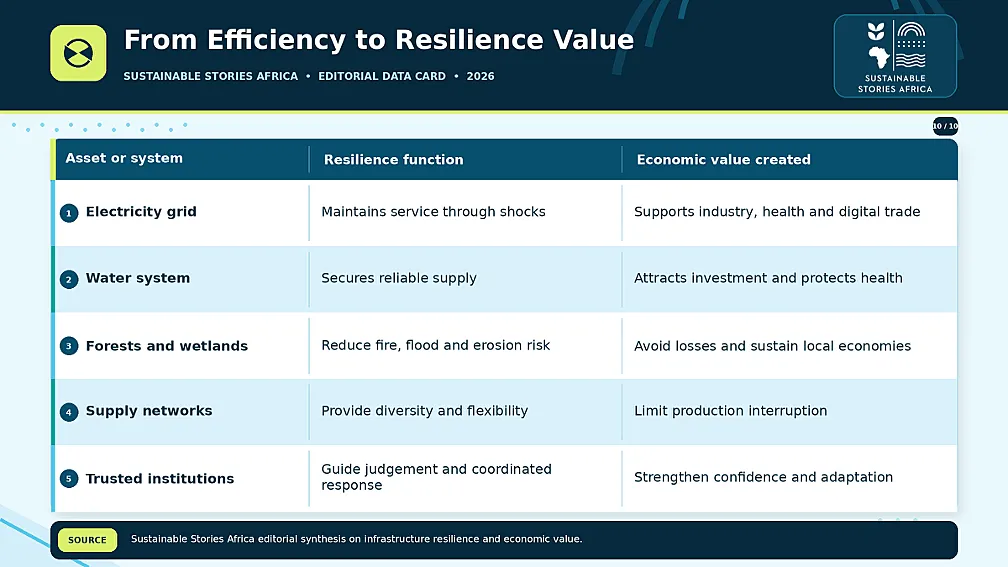
- A reliable electricity grid supports manufacturing and digital services. Secure water attracts households and industry.
- Diverse suppliers reduce the chance that one disruption stops production.
- Skilled workers and trusted institutions help organisations interpret AI outputs, make difficult decisions and adapt when models meet unfamiliar conditions.
Wyatt extends the argument to nature.
- Forests can reduce wildfire and erosion risks, wetlands can absorb floods, and healthy watersheds can protect water quality.
These are not merely environmental amenities.
- They support farms, infrastructure, recreation, insurance affordability and public health.
When resilience is treated as value creation, conserving natural systems can become part of competitiveness and capital allocation rather than a separate corporate-responsibility programme.
Africa can convert resilience into advantage
African markets face acute exposure to climate shocks and infrastructure gaps, but they also have an opportunity to build more adaptive systems before inefficient models are locked in
- Distributed renewable energy can keep clinics and small businesses operating when central grids fail.
- Climate-smart agriculture, digital payments and regional supply networks can help communities absorb shocks while opening new markets.
The risk is that resilience becomes another vague label.
- Investors need evidence linking expenditure to service continuity, reduced losses, faster recovery or improved ecosystem function.
- Communities need a role in defining what resilience means, because a project that protects an asset while shifting costs onto informal settlements is not resilient at system level.
The strongest strategies combine redundancy, flexibility, inclusion and learning.
Put resilience onto financial statements
Governments should evaluate infrastructure using whole-life value, avoided losses and service continuity, not only the lowest upfront cost.
Companies can map dependencies on power, water, logistics, ecosystems, talent and digital systems, then disclose the investments that reduce material vulnerabilities.
Banks and insurers can reward credible risk reduction through better terms, while guarding against overstated benefits.
- AI can support this work by analysing scenarios and detecting weak signals, but human judgement, trust and accountability remain essential.
Decision makers should also recognise that resilience cannot be owned by one organisation.
- Shared grids, watersheds, transport networks and public-health systems require coordinated investment.
- If intelligence becomes abundant, the durable advantage may belong to societies capable of using it without allowing their physical, ecological and social foundations to fail.
Measurement will determine whether the concept changes decisions.
- Useful indicators may include hours of service maintained during disruption, recovery time, supplier concentration, water availability, ecosystem condition and the distribution of benefits across income groups.
These measures should complement, rather than replace, financial performance.
- When boards can compare the cost of prevention with expected losses and wider social value, resilience becomes easier to fund.
- It also becomes harder to treat maintenance, workforce capability and nature protection as expendable costs when budgets tighten.
Public procurement can accelerate the shift by rewarding durability, adaptability and lifecycle performance.
Standards and finance should favour systems that can be repaired, upgraded and locally maintained, creating skills and jobs while reducing dependence on fragile external supply chains today.
Path Forward – Invest in systems that keep working
Decision-makers should measure resilience as productive capacity: continuity, adaptability, avoided losses and inclusive recovery.
- Nature and public systems belong inside investment analysis.
AI can improve forecasting, but it cannot replace trusted institutions or shared infrastructure.
The next theory of value will be credible only when resilient systems deliver better outcomes for people, businesses and ecosystems.