Nairobi’s rapid outward growth is transforming smallholder land in Kiambu County into increasingly valuable real estate.
However, the gains from rising prices are accompanied by inheritance disputes, shrinking farms and fragile prospects for young people.
Kenya’s challenge is to make urbanisation create broad opportunity rather than deepen land insecurity.
A City’s Expanding Edge
Nairobi’s growth is reaching far beyond its formal boundaries, reshaping the rural and peri-urban communities that surround Kenya’s capital.
- In Kiambu County, rising land values are turning once-modest smallholdings into sought-after assets.
- However, the process is also creating family tensions, displacement risks and growing uncertainty for young people whose futures have long been tied to land.
Peter Lockwood’s book, Peasants to Paupers: Land, Class and Kinship in Central Kenya, draws on field research conducted between 2017 and 2022 and examines how Nairobi’s expanding urban footprint interacts with long-standing land inequality and economic insecurity.
The story complicates the usual narrative of urban progress.
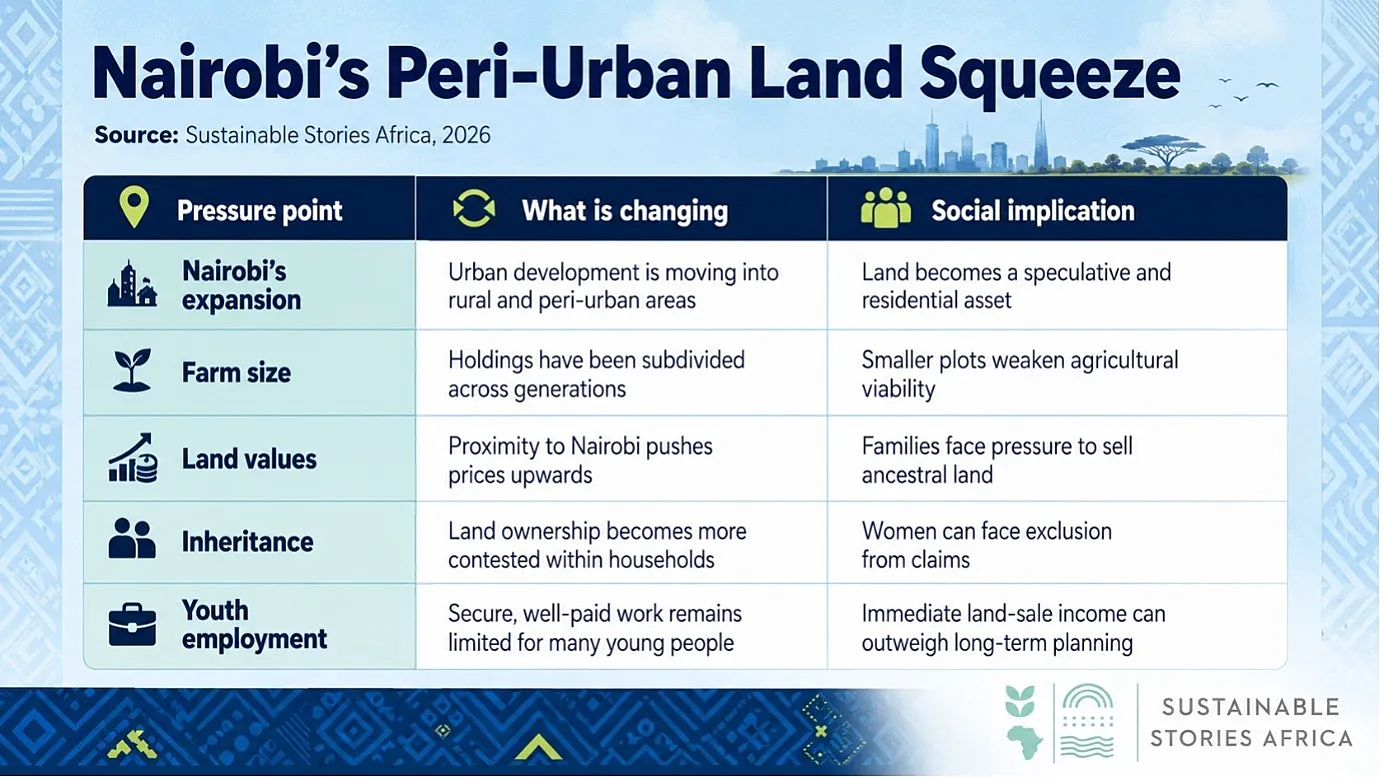
- New roads, housing developments, malls and commuter settlements may signify investment; however, they can also raise the price of survival for households whose landholdings are becoming smaller, more contested and more valuable at the same time.
Land Under Pressure
Kiambu illustrates the collision between urban property markets and a history of unequal land ownership.
- Lockwood notes that holdings allocated to farmers in the 1950s, averaging up to two hectares, have in many cases been divided through inheritance across generations into plots of around one hectare or less.
As Nairobi expands northwards, these small plots have gained significant market value.
- That creates a difficult calculation: sell and secure an immediate cash windfall, or retain land that offers identity, family security and a diminishing agricultural livelihood.
The consequences are not evenly distributed.
- The research highlights gendered struggles around inheritance, including attempts by male heirs to exclude sisters from land claims after their parents die.
- It also follows the experiences of young men facing underemployment and limited prospects for stable, decently paid work.
This context can make land sales appear like one of the few available routes to immediate economic relief.
Urbanisation With Security
Nairobi does not need to stop growing.
- Kenya needs cities that grow in ways that protect rights, spread economic opportunity and acknowledge the social costs borne by communities at the urban edge.
That means treating peri-urban residents as stakeholders, not simply as land sellers awaiting development.
- Better land records, transparent valuation, accessible legal support and stronger inheritance protections could help households make informed choices rather than distress-driven decisions.
A more inclusive approach would also connect land policy to employment policy.
- Young people need credible routes into productive work, enterprise and skills development if land is to remain an asset they can build from, rather than the last resource they must liquidate.
Plan Beyond Property Values
County and national authorities should integrate social-impact assessments into major development and zoning decisions on Nairobi’s fringe.
Development plans should ask who benefits from rising values, who is displaced and whether infrastructure investment matches housing, jobs and public services.
Land-rights awareness is equally urgent.
- Women and younger family members need access to documentation, mediation and legal pathways that protect them from unfair exclusion when land is subdivided or sold.
Private developers, financiers and infrastructure investors also have responsibilities.
- Projects should avoid treating land acquisition as a purely transactional exercise. Fair consultation, transparent compensation and locally shared benefits are essential to maintaining social legitimacy.
Path Forward – Making Growth Work for Communities
Kenya’s urban future depends on planning that values people as much as property. Secure tenure, gender-responsive inheritance systems and transparent local land governance can reduce the risk that city expansion produces new forms of rural poverty.
Investment in decent work, affordable housing and public transport must accompany peri-urban growth. Without these measures, rising land values may enrich a few households temporarily while leaving many others with fewer assets and weaker prospects.